What Weapons Did Samurai Use? Complete Guide to Japanese Arms & Armor

What Weapons Did Samurai Use? Complete Guide to Japanese Arms & Armor

What Types of Weapons Did Samurai Actually Use in Feudal Japan?


During Japan's feudal era, samurai were the most influential military class. They not only represented power and honor but also shaped the warfare of centuries. When people search for Japanese weapons or samurai weaponry, they are often interested in more than just swords—they want to understand a complete system of weapons, tactical evolution, and the spirit of bushido. This article provides a detailed analysis of the main types of weapons used by samurai throughout history, offering a comprehensive view of ancient Japanese warfare.


What is the Most Popular Japanese Weapon?

The Most Iconic Samurai Weapons: Katana and Tachi

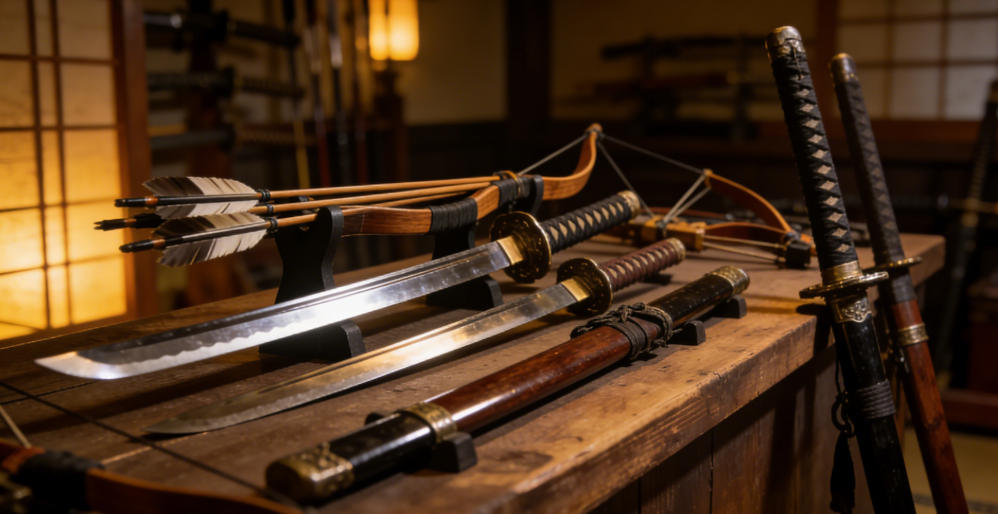
When discussing samurai equipment, the most widely recognized weapon is the samurai sword. These swords were not only central on the battlefield but also a symbol of the warrior’s status and identity. The Katana, known for its curved single-edged blade and two-handed grip, emphasizes fast-draw slashing and fluid consecutive attacks, making it highly effective in close-quarters combat.

Traditional Katana were crafted using multiple layers of folded steel and differential hardening techniques, resulting in unique blade patterns that combine sharpness with resilience. This meticulous craftsmanship ensured reliability in battle and made high-quality samurai swords highly sought after in the collector’s market. Enthusiasts and historians often choose hand-forged swords with robust construction to ensure both performance and aesthetic value.

In the Heian and Kamakura periods, the main battlefield weapon was the Tachi. Compared to the Katana, the Tachi had a longer, more curved blade, better suited for cavalry combat. It was usually suspended with the edge facing downward, allowing effective strikes from horseback. As combat tactics shifted from cavalry charges to infantry engagements, the Katana gradually replaced the Tachi, offering greater versatility and efficiency in close-range battles.

Samurai often carried two swords as part of the Daisho system—a long Katana paired with a short Wakizashi. This combination was especially practical in confined spaces or indoors, where the shorter sword provided flexibility for close-quarters fighting and emergency defense. This pairing reflected both social status and practical combat functionality.

Today, the influence of the samurai sword extends far beyond combat, serving as a cultural symbol. Collectors and enthusiasts worldwide continue to seek high-quality swords, whether for display, historical study, or replicas for film and anime. The Katana remains one of the most iconic pieces of Japanese weaponry, commanding attention and appreciation globally.

What Weapons Did Samurai Use? Complete Guide to Japanese Arms & Armor


Core Long-Range Weapon: Yumi, the Japanese Longbow

Before the introduction of firearms, the bow was one of the core battlefield weapons for samurai. The Yumi, the Japanese longbow, often exceeded two meters in length and featured a unique asymmetrical design—shorter on top and longer on the bottom. This shape allowed for stable and powerful shots both on foot and horseback, making it one of the most distinctive developments in the history of archery.

During the Kamakura period, samurai specialized in mounted archery. Bowmen played a critical role in weakening enemy formations before charges, demonstrating highly trained accuracy and timing. This emphasis on technique made the longbow an essential part of the samurai weapon system.

Archery later evolved into the martial art of Kyudo, focusing not only on hitting the target but also on breathing, concentration, and body coordination. Even after firearms became widespread, archery remained a cultural and spiritual practice, preserving the tradition of samurai skill.

With the introduction of matchlock guns in the 16th century, battlefield tactics shifted toward volley fire and coordinated firepower. Although bows gradually lost their prominence in combat, they continued to hold ceremonial, competitive, and cultural significance, reflecting the transformation of samurai weapons from practical tools to symbols of heritage.

Polearm Weapons: Yari and Naginata

In large-scale battles, swords alone could not maintain a stable line of defense. Long-handled weapons became a key component of late-period Japanese warfare, extending attack range and strengthening formation control. These weapons were widely used by both infantry and samurai during the Sengoku period.

The Yari, a straight-bladed spear, emphasized thrusting efficiency and was ideal for densely packed formations. Large numbers of ashigaru (foot soldiers) carried spears to form cohesive lines, providing both offensive and defensive capabilities against cavalry and infantry assaults. Samurai also adapted the spear according to battlefield conditions, demonstrating tactical flexibility.

The Naginata, combining a long shaft with a curved blade, could perform sweeping and chopping motions. It was especially effective against cavalry or for breaking enemy formations. The weapon required skillful coordination and continuous movement, and it was used not only by male samurai but also by some female warriors, further enriching the diversity of the Japanese weapon system.

From bows to spears to naginata, the samurai military system was far more than a sword-based culture. It consisted of layered weaponry, integrating long-range, mid-range, and close-combat arms. Each weapon had a distinct role at different historical stages, collectively shaping a highly structured and strategically organized feudal Japanese warfare system.

What Weapons Did Samurai Use? Complete Guide to Japanese Arms & Armor

Short Weapons and Specialized Arms: The Systematic Samurai Arsenal

Within the complete framework of Japanese weapons, samurai did not rely solely on long swords or polearms. Beyond primary battlefield equipment, they carried a variety of auxiliary weapons samurai tailored to different combat scenarios and tactical needs. This created a layered and flexible arsenal, with short weapons and specialized arms playing key roles in indoor combat, close-quarters encounters, bodyguard duties, surprise attacks, and urban policing. These arms are an essential part of studying the samurai weapons system.

Wakizashi, the side sword, was an essential companion to the Katana, forming the Daisho dual-sword system. This long-and-short combination not only reflected a samurai’s social status but also enhanced combat versatility. In tight corridors or close-quarters confrontations, the shorter blade allowed for quick draws and consecutive strikes, making it a practical weapon beyond ceremonial use. Even today, collectors favor well-constructed, finely crafted traditional short swords as classic components of the samurai arsenal.

Tanto, the short dagger, emphasized personal defense. Its compact size allowed for concealment and rapid deployment in sudden encounters. With a rich history and diverse designs, the tanto holds a significant place in the study of Japanese swordcraft and traditional forging techniques, attracting attention from historians and weapon enthusiasts alike.

Kusarigama, the chain-and-sickle, was a highly skill-dependent specialized weapon. Combining a sickle with a weighted chain, it allowed the wielder to entangle an opponent’s weapon or limbs and then deliver a decisive strike. It could also be used for mid-range control and harassment. Mastery required precise rhythm and spatial awareness, and the weapon had dedicated training within classical martial arts schools, making it an important subject in the study of traditional weapon tactics.

Jitte, the iron truncheon, appeared more often in urban policing and protective roles. Its design focused on blocking, controlling, and trapping opponents’ blades rather than inflicting damage. It served as a defensive and restraining weapon and was widely used in Edo-period city security systems, demonstrating that samurai responsibilities extended beyond the battlefield to societal governance.

Beyond melee weapons, the introduction of the Tanegashima matchlock in the 16th century revolutionized Japanese warfare. After its arrival, the firearm was quickly adapted and mass-produced locally, and it saw large-scale deployment during the Sengoku period. The advent of firearms shifted tactics from traditional sword and spear duels to coordinated volley fire and strategic maneuvering. For an extended period, cold weapons and firearms coexisted, reshaping Japan’s military organization.

Overall, the samurai arsenal was far more complex than a simple sword culture. It included long swords, short swords, polearms, specialized weapons, and firearms, forming a multi-layered system in which different arms complemented each other to create a complete combat structure. This complexity makes the development of Japanese weapons a critical window for studying ancient Japanese warfare and military culture, attracting historians, collectors, and cultural scholars worldwide.


Samurai Armor and Weapon Integration

Discussing Japanese weapons cannot ignore the armor systems. Samurai armor, including Yoroi and the later Do Maru, emphasized a balance between mobility and protection. Tactical choices were closely tied to equipment.

For example, during the era of mounted archery, bows were paired with lighter armor, whereas in the Sengoku period, polearms were integrated with formation tactics. High-interest search terms include samurai armor and weapons, traditional Japanese armor set, and battle-ready samurai armor.


Historical Evolution and Cultural Influence of Samurai Weapons

From the Heian to Edo periods, samurai weapons continuously evolved alongside changing tactics. Swords transitioned from cavalry auxiliaries to symbols of identity and spirit, polearms reached their peak during the Sengoku period, and firearms sparked a military revolution.

Today, Japanese weapons remain a popular field for collectors and cultural studies. Terms such as samurai sword collection, Japanese weapon history, and traditional samurai battle gear continue to attract high search interest.


Hand Forged Japanese Iaito Practice Sword 1060 Carbon Steel Unsharp Full Tang

COOLKATANA Hand Forged Full Tang Dull Katana -SL-1317-U-U


Conclusion

When people search for weapons samurai or Japanese weapons, they are exploring an entire military civilization. Samurai weapons were not just tools of war; they embodied status, honor, and the spirit of bushido. Understanding the types, uses, and historical evolution of these arms offers deeper insights into ancient Japanese martial culture and provides a clear framework for collecting, studying, and preserving this heritage.


Hinterlassen Sie einen Kommentar

Bitte beachten Sie, dass Kommentare vor der Veröffentlichung freigegeben werden müssen

Suchen Sie auf unserer Seite