


Traditional Chinese Weapons: Swords, Spears & Martial Arts History
What Are the Most Famous Traditional Chinese Weapons and Their Uses?
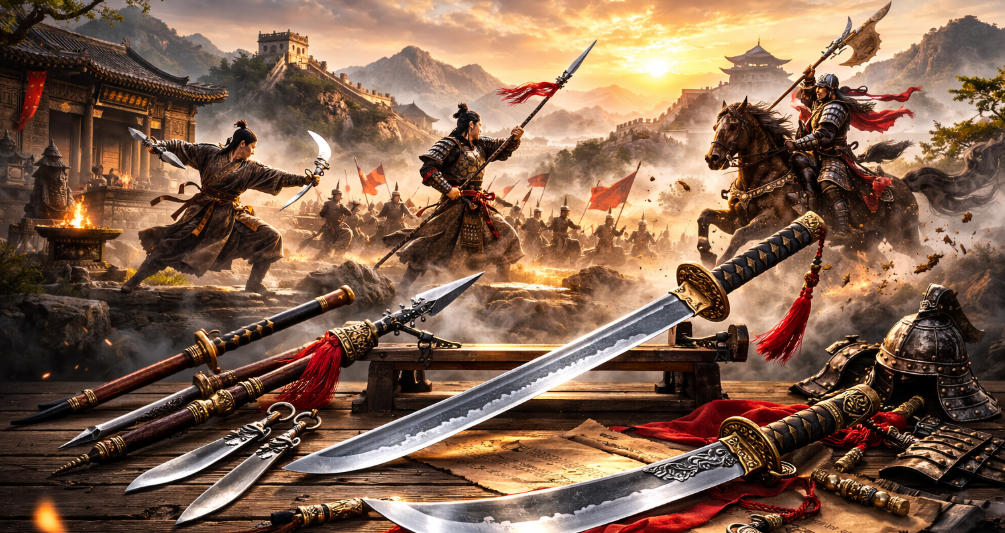
Traditional Chinese weapons are not only representative of ancient melee arms but also key symbols of Chinese martial arts culture and historical civilization. From swords, sabers, spears, and halberds to a variety of unique arms, China’s ancient weaponry is diverse and systematized, making it one of the richest melee weapon cultures in the world.
This article provides a systematic analysis of the complete range of traditional Chinese weapons, types of ancient Chinese melee arms, martial arts weapon classifications, and historical background. It helps readers gain a deeper understanding of Chinese weapon culture while incorporating high-search-volume keywords and long-tail phrases suitable for SEO optimization in the history and culture niche.
1. The Four Major Traditional Chinese Weapons: Sword, Saber, Spear, Halberd
In Chinese martial arts and ancient warfare systems, the sword, saber, spear, and halberd are known as the 'Four Major Weapons,' forming the foundation for studying Chinese martial weapons.

1. Sword (Jian) — 'Lord of Weapons,' Double-Edged Long Sword
The sword is one of the most prestigious and culturally significant traditional Chinese weapons, often called the “Lord of All Weapons.” Beyond combat use, it represents status, ritual, and spiritual cultivation.
Typically double-edged and straight, Chinese swords focus on thrusting techniques, supplemented by slicing, parrying, and stabbing. Compared to heavier weapons, swords emphasize skill and agility. From the Spring and Autumn period to the Warring States, bronze swords were highly developed, and with the advancement of steel production during the Han and Tang dynasties, swords became more practical in combat.
In martial arts, sword techniques stress 'lightness, fluidity, and unity of body and blade,' as seen in Taiji Jian, Wudang Jian, and southern sword styles, where swordplay also cultivates mind and body.
Features:
-
Double-edged for attack and defense
-
Emphasis on footwork and body coordination
-
Focus on thrusting techniques
-
Emphasizes balance and rhythm
-
Suitable for individual combat
Common Types:
-
Bronze Sword (Spring & Autumn, Warring States)
-
Han Sword (heavier, practical)
-
Tang Sword (strong and powerful)
-
Soft/Performance Swords (for martial arts demonstration)
Historically, the sword symbolized status and virtue, and in Chinese culture, it often represents justice, moral integrity, and personal cultivation.
2. Saber (Dao) — The Most Practical Single-Edged Weapon
The saber was one of the most widely used weapons on Chinese battlefields and the primary weapon in armies. Compared to the sword’s finesse, the saber emphasizes power and efficiency, making it dominant in historical combat.
A typical Chinese saber has a single edge with a thick spine, ideal for chopping and slashing. Its forward-heavy design delivers strong impact, suitable for close-range combat. By the Han dynasty, sabers largely replaced swords in military use.
In martial arts, saber techniques focus on powerful, fast strikes, emphasizing movement from the waist. Representative styles include Miao Dao, Pu Dao, and Spring and Autumn Da Dao routines.
Features:
-
Single-edged, thick spine, sturdy structure
-
Strong chopping/slashing power
-
Forward-centered balance for impact
-
Straightforward operation, suitable for combat
Common Types:
-
Miao Dao (long saber combining sword and saber traits)
-
Pu Dao (long-handled military saber)
-
Niuwai Dao (curved saber, Qing dynasty)
-
Ring-Head Saber (Han dynasty)
-
Zhanma Dao (heavy two-handed saber)
The saber symbolizes military power and spirit, often featured in literature, opera, and wuxia media. Its practical use surpasses the sword in historical prevalence.
3. Spear (Qiang) — 'King of All Weapons,' Core Polearm
The spear is revered as the 'King of Weapons,' occupying a pivotal role in Chinese armies from the Warring States to the Ming and Qing dynasties. Cost-effective and tactically versatile, spears were central for infantry and cavalry.
Typically composed of a spearhead, shaft, and red tassel, the latter adds both decoration and practical functions, like distracting opponents and preventing blood from sliding down. Spear techniques center on thrusting but include flicks, sweeps, and parries. In battle formations, spear units formed defensive screens against cavalry, as seen in the Ming 'Mandarin Duck' formation.
Features:
-
Long reach
-
Thrust-focused technique
-
Versatile techniques including wrapping and leveraging
-
Ideal for formations and teamwork
-
Simple to manufacture, suited for mass troops
Common Types:
-
Standard Long Spear
-
Flower Spear (martial arts routines)
-
Hook-Sickle Spear (enhanced control)
-
Double-Headed Spear
In martial arts, the spear is essential for foundational training, emphasizing waist power, footwork, and explosive strength.
4. Halberd (Ji) — Hybrid Polearm for Piercing and Slashing
The halberd combines spear thrusting with a transverse blade, allowing stabbing, cutting, hooking, and sweeping. Popular from the pre-Qin to Han dynasty, it was often used by nobility and high-ranking generals.
Its structure usually includes a long shaft with multi-functional blades. The transverse blade allows both linear thrusts and sweeping actions for battlefield control.
Halberds were suitable for cavalry or senior officers, enabling mounted thrusts and broad attacks. Complex to manufacture, they were less common than spears but highly effective in tactical use.
Features:
-
Combines stabbing and slashing
-
Capable of hooking and controlling enemy weapons
-
Suitable for cavalry and officers
-
Complex structure, high craftsmanship requirement
Common Types:
-
Bronze Halberd (pre-Qin)
-
Fangtian Halberd (with crescent-shaped side blade)
-
Long Halberd (extended reach)
Halberds symbolize both martial power and authority in historical literature and opera, making them culturally iconic.
2. Complete Guide to Traditional Chinese Cold Weapons (In-Depth Analysis of Specialty Arms)
Beyond the four major weapons—sword, saber, spear, and halberd—China’s traditional cold weapon system includes numerous specialty arms. These weapons played important roles in ancient warfare, martial arts, escort services, folklore, and media. Understanding the full range of Chinese cold weapons not only helps systematically study weapon evolution but also provides insight into the classification of martial arts weapons.
Butterfly Swords — Iconic Short Weapons of Southern Styles
Butterfly swords are classic short weapons in traditional Chinese martial arts, commonly used in southern styles and an essential part of dual-blade techniques. Each sword is single-edged and paired, emphasizing rapid close-range strikes and continuous pressure.
In Chinese short weapon combat, butterfly swords are ideal for street fighting and close-quarters combat. Their short length allows for concealment and fast deployment in tight spaces. Traditional techniques include hooking, pressing, locking, chopping, and thrusting, requiring hand coordination and rhythm. They are a key component of dual-blade training.
Historically, butterfly swords were widely used in Qing dynasty folk martial arts, closely associated with escort services and civilian self-defense. In modern martial arts demonstrations and media, butterfly swords remain visually striking due to their compact, fast-paced movements.
High-interest keywords: butterfly sword techniques; dual-blade martial arts; Chinese short weapons; southern style martial weapons; close-combat cold weapon techniques.
Niuwai Saber — Representative Qing Dynasty Curved Saber
The Niuwai Saber is one of the most iconic types of Chinese curved single-edged swords, named for its cow-tail-shaped blade. Popular during the Qing dynasty, it holds an important place in the classification of Chinese sabers.
Its blade is wide at the front and narrow at the back, with a forward-centered balance for powerful chopping. It excels in large, sweeping movements typical of traditional saber techniques, such as chopping, slashing, striking, and pressing. Compared to straight swords, the Niuwai Saber emphasizes smooth arcs and continuity, providing strong defensive-breaking capability in combat.
In traditional saber training, the Niuwai Saber is often used in foundational exercises. Its simple structure and direct power make it a common weapon in folk martial arts and self-defense systems. Related keywords: Niuwai Saber history; Chinese curved saber types; traditional saber techniques; Qing dynasty combat sabers; Chinese cold weapon saber classification.

Hook-Sickle Spear / Hook Sword — Complex Specialty Weapons
Hook-sickle spears and hook swords are highly distinctive Chinese specialty weapons. They add hooked blades to conventional long or short weapons, allowing stabbing, slashing, hooking, pulling, locking, and trapping in combat or demonstrations.
The hook-sickle spear features a curved side blade next to the spearhead for linear thrusting and hooking opponents or their weapons. Hook swords are often used in pairs, with hooks at the blade tip or guard for locking, controlling, and countering. These weapons require high skill and precise technique.
In martial arts, hook weapons emphasize wrapping, twisting, and rhythm control, with complex, variable movements, making them popular in performance routines. Keywords: hook-sickle spear guide; Chinese specialty weapons; traditional hook sword techniques; martial arts performance weapons; Chinese cold weapon structural analysis.
Zhanma Dao — Heavy Anti-Cavalry Weapon
The Zhanma Dao is a heavy two-handed sword designed for countering cavalry charges, making it a prominent example of ancient Chinese anti-cavalry weaponry.
Its long, thick blade requires two-handed operation. With a forward-heavy balance, each swing generates tremendous impact, capable of theoretically striking horses or mounted opponents. As cavalry became a dominant force, infantry adapted by developing weapons like the Zhanma Dao to counter mounted units.
Keywords: Zhanma Dao history; Chinese two-handed heavy sword analysis; ancient anti-cavalry weapon; Chinese cold weapon evolution; comparison of heavy battlefield swords.
3. Cultural Significance and Martial Arts Value
Traditional Chinese weapons are more than tools of war; they embody rich cultural meaning:
-
Integral to Chinese martial arts systems
-
Showcase ancient forging and metallurgical techniques
-
Shape heroic archetypes in literature and opera
-
Serve as modern collectibles and cultural study objects
Many weapons continue to be used in martial arts demonstrations, traditional training halls, and cultural festivals.
4. Modern Preservation and Development
With the revival of traditional culture, Chinese weapons are receiving growing attention. Martial artists, historians, and collectors are all showing keen interest in ancient arms.
Studying traditional Chinese weapons deepens our understanding of historical warfare and enhances appreciation for Chinese martial spirit and cultural heritage.

