

Hand and a Half Sword: Balance, Power and Medieval History
What Is a Hand and a Half Sword and How Does It Work?
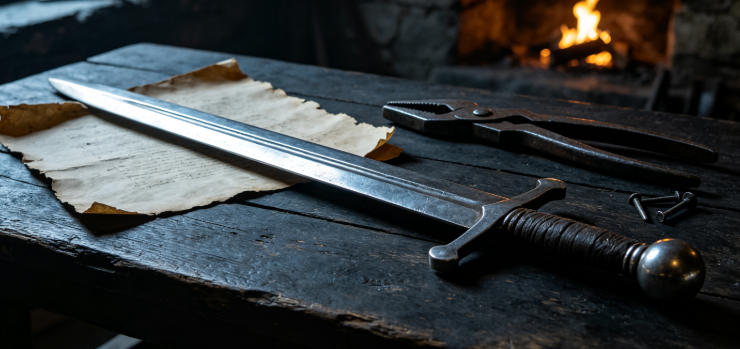
Among the many medieval swords, the hand and a half sword is a classic weapon known for its combination of power, balance, and versatility. Unlike a traditional one-handed sword that relies primarily on single-hand control, it also differs from a large two-handed sword that generally requires both hands. This gives the hand and a half sword a unique position in medieval weapon design.
The hand and a half sword is commonly known as a “bastard sword” and is often described as a versatile European sword that sits between a one-handed sword and a true two-handed weapon.
What makes this sword particularly interesting to medieval warriors, historical weapon enthusiasts, and modern collectors is not simply its long blade. The real strength of the hand and a half sword comes from the careful balance between blade length, weight distribution, grip design, cutting power, and thrusting ability.
So, what exactly is a hand and a half sword? Why can it combine power with maneuverability? And what role did this versatile medieval sword play in warfare?
The Origin and Development of the Hand and a Half Sword
What Is a Hand and a Half Sword?
As its name suggests, a hand and a half sword is a sword that can be used with either one or two hands. It is therefore often described as a “bastard sword” or “one-and-a-half sword.”
Its dimensions generally fall between those of a traditional one-handed sword and a larger two-handed sword. A typical hand and a half sword features a relatively long blade combined with a grip that provides enough room for two-handed use. Overall sword length could reach around 120 cm in some examples, although dimensions varied considerably depending on the period, region, and individual sword type.
This design gives the user several options. The sword can be used with one hand, controlled with both hands, employed for powerful cutting attacks, and used for precise thrusting. Its adaptable design also allows the user to adjust to different combat distances and situations.
This high level of versatility made the hand and a half sword an important type of weapon in the development of medieval European swords.
Why Is the Bastard Sword Also Called a Hand and a Half Sword?
People searching for hand and a half sword vs bastard sword often wonder whether these are actually two different weapons.
In many modern discussions, bastard sword is used to describe a hand and a half sword. However, historical terminology was not always standardized, and different periods, sources, museums, and researchers may use these terms differently.
The word “bastard” in this historical context does not carry the same modern meaning. Instead, it can be understood as describing a sword that does not fit neatly into the category of a traditional one-handed sword or a full-sized two-handed sword.
In simple terms:
One-handed sword flexibility + two-handed sword control = Hand and a Half Sword
This distinctive combination helps explain why the hand and a half sword remained an important and versatile European sword design.

The Role of the Hand and a Half Sword in Medieval Warfare
During medieval warfare, weapons had to adapt to constantly changing combat environments. Warriors could fight on foot, on horseback, in close combat, or in complicated battlefield conditions where different weapons were required.
The major advantage of the hand and a half sword was its ability to accommodate several different combat requirements. When used with one hand, it could be combined with a shield while allowing greater freedom of movement and could also be practical for mounted combat. When used with both hands, it provided greater control over the blade, increased cutting power, improved thrusting stability, and allowed the user to manage the longer blade more effectively.
For this reason, the medieval longsword concept represented by the hand and a half sword was not simply about making a sword longer. Its real value was flexibility and adaptability.
For warriors who needed to quickly adjust their fighting method according to battlefield conditions, the hand and a half sword offered a practical combination of reach, power, and control. This helped make it an important part of the history of European medieval weapons.
How Did Hand and a Half Sword Design Evolve?
As medieval military technology developed, sword design also continued to change.
Earlier long swords often placed greater emphasis on strength and durability. As armor technology, combat techniques, and metalworking developed, swordsmiths began paying more attention to the overall balance and handling characteristics of a weapon.
During the later medieval period, many hand and a half swords displayed several important design developments. Blades became more elongated, weight distribution became more carefully controlled, sword points became increasingly suitable for thrusting, grips became longer, and overall balance improved.
Advances in forging and heat-treatment techniques allowed swordsmiths to reduce unnecessary weight while maintaining blade strength.
Therefore, a high-quality hand and a half sword did not necessarily need to be extremely heavy to be powerful.
Instead, effective medieval sword design focused on finding the right relationship between weight, strength, balance, and handling.
Hand and a Half Sword Structure Explained
To understand where the power of a hand and a half sword comes from, it is important to examine its basic construction.
A complete sword generally consists of the blade, grip, guard, and pommel. Each component can directly influence how the weapon feels and performs in the hand.
Blade: The Core of Power and Versatility
The blade of a hand and a half sword is generally relatively long and may feature different designs depending on its intended purpose.
A well-designed sword blade is not simply a thick piece of steel.
Traditional blades often become narrower toward the point, creating a tapered profile. This helps reduce unnecessary weight toward the tip while maintaining strength closer to the guard.
This construction can improve handling, thrusting performance, and cutting efficiency.
A hand and a half sword can therefore be used for both slashing and thrusting, giving it a broader range of applications than weapons designed primarily around a single attack method.
This combination of cutting and thrusting capability is one of the most important characteristics of this versatile medieval sword.
Grip: More Than Just a Place to Hold the Sword
The grip is one of the most distinctive components of a hand and a half sword. Compared with a conventional one-handed sword, it has a longer handle that allows the user to change their grip depending on the combat situation.
With one hand, the sword can be moved more freely, making it easier to change direction and perform quick movements. With both hands, the user gains greater control, a more stable blade path, increased cutting power, and improved thrusting stability.
This dual-mode operation makes the hand and a half sword a highly adaptable European sword.
From the perspective of modern collectors and historical weapon researchers, grip length is also an important factor when identifying whether a sword can reasonably be described as a hand and a half sword. A properly proportioned grip affects not only how the sword is held but also its center of balance, overall handling, and control.
The Pommel: A Key to Hand and a Half Sword Balance
The pommel is an element that beginners often overlook.
In reality, the pommel plays an important role in the overall balance of a sword.
If the blade becomes longer without sufficient counterweight toward the rear of the grip, the weapon can become excessively blade-heavy and more difficult to control.
The pommel is therefore more than a decorative feature.
From a mechanical perspective, it forms part of the sword's overall balancing system. A well-designed hand and a half sword uses the blade, grip, guard, and pommel together to distribute weight effectively, allowing the weapon to maintain useful cutting power while remaining relatively controllable.
Cross-Guard: An Important Protective Element of Medieval Swords
The cross-guard, also known as a guard, is an important component positioned between the blade and grip.
Its most obvious purpose is to protect the user's hand.
During sword-to-sword contact, an opponent's blade could slide down toward the hand. Without a guard, this could create a serious risk of injury.
The cross-guard therefore serves several functions, including protecting the hand, helping control the blade, strengthening the sword's structure, and contributing to overall balance.
The cross-shaped guard became one of the most recognizable design features of many European medieval swords.
Although hand and a half sword guards appeared in different forms and styles, their basic purpose remained the same: to help the user control the weapon while providing protection for the hand.
Where Does the Power of a Hand and a Half Sword Come From?
Weight Distribution Determines Sword Handling
Many people assume that a heavier sword must automatically deliver greater striking power. In reality, sword performance is closely connected to weight distribution.
A relatively light sword with a well-designed center of balance can often be easier to control than a heavier sword with poor weight distribution.
The advantage of the hand and a half sword is that its different components can work together to create a balance between power and precision. Important factors include blade length, blade thickness, tip weight, guard weight, pommel weight, and the overall center of balance.
When these elements are properly proportioned, the sword can feel more natural and responsive in the hand. Instead of relying entirely on arm strength to control the entire blade, the user can take advantage of the sword's own weight, balance, and momentum to create smoother movements.
This is one of the key reasons why the hand and a half sword can maintain a strong balance between power, speed, and maneuverability.
Sword Swing Mechanics: Why Is the Hand and a Half Sword Powerful?
From a basic physics perspective, a sword generates momentum as it moves through a swing.
A longer blade allows the tip to travel through a larger arc during a swing, potentially increasing reach and contributing to cutting momentum.
However, an excessively long blade can also become more difficult to control and maneuver quickly.
The hand and a half sword was designed to find a practical balance between these two factors.
Its longer blade can provide greater reach and cutting potential, while its relatively adaptable grip allows the user to maintain control. At the same time, it can be easier to handle than some much larger two-handed swords.
As a result, the hand and a half sword offers an effective combination of power and maneuverability.
This is why modern historical sword enthusiasts often regard it as one of the most representative examples of a versatile medieval sword.
Thrusting Ability: More Than Just a Cutting Sword
Another important advantage of the hand and a half sword is its strong thrusting capability. While some sword types were designed primarily around cutting, the blade geometry of many hand and a half swords allowed them to perform both cutting and thrusting actions.
The relatively long blade and tapered point could provide effective linear attacks, while a two-handed grip could further improve control over the blade.
As a result, this sword could accommodate different combat situations, including longer-range thrusts, medium-range cuts, close-range control, defensive movements, and counterattacks.
This combination of cutting and thrusting capability gave the hand and a half sword a distinctive position within the wider development of medieval weapons.

Who Is the Hand and a Half Sword Suitable For?
From a modern perspective, the hand and a half sword continues to attract attention from medieval weapon collectors, European sword enthusiasts, historical reenactors, martial arts researchers, fantasy fans, and historical sword model collectors.
Its lasting popularity comes from more than its appearance. The hand and a half sword represents the medieval swordsmith's understanding of materials, strength, balance, and human movement.
For modern collectors, a well-designed hand and a half sword can also demonstrate many important elements of traditional sword craftsmanship, including proper blade proportions, a stable center of balance, high carbon steel construction, durable grip design, full tang construction, hand-forged craftsmanship, and classic European medieval sword aesthetics.
Together, these factors influence the overall quality and handling characteristics of a medieval sword, making the hand and a half sword an enduring subject of interest for historical weapon collectors and European sword enthusiasts.
Hand and a Half Sword vs Other Medieval Swords
Compared with a conventional one-handed sword, the hand and a half sword generally offers a longer grip and greater attack range.
Compared with a large two-handed sword, it can provide greater flexibility and adaptability.
| Sword Type | Main Characteristics |
|---|---|
| One-Handed Sword | Flexible and lightweight, often suitable for use with a shield |
| Hand and a Half Sword | Can be used with one or two hands, balancing power and versatility |
| Two-Handed Sword | Large attack range but generally requires both hands |
| Longsword | Longer blade with an emphasis on reach and blade control |
When people search for hand and a half sword vs longsword, however, it is important to remember that historical sword terminology was not as standardized as modern product categories.
Different periods, museum classifications, and modern researchers may use these terms differently.
Overall, the defining characteristic of the hand and a half sword remains clear: it is a medieval sword designed to provide flexible control through both one-handed and two-handed use.
The Historical Significance of the Hand and a Half Sword
The value of the hand and a half sword goes far beyond its distinctive appearance. It represents an important stage in the development of medieval European sword design.
Swordsmiths were not simply trying to create longer, heavier, or sharper weapons. Instead, they increasingly focused on balancing different performance characteristics.
A successful sword needed to consider power, speed, control, weight, balance, and durability at the same time.
The hand and a half sword is a classic example of this design philosophy. It combines the flexibility of a one-handed sword with the increased control available through two-handed use, giving it considerable adaptability in different combat situations.
From medieval battlefields to modern historical research, this sword type remains an important part of the study of European medieval swords, historical swords, and medieval weapons.
Conclusion: Why Is the Hand and a Half Sword Still Popular Today?
From a historical perspective, the hand and a half sword represents an important development in medieval sword design.
It combines the flexibility of a one-handed sword with many of the control and power advantages associated with two-handed use.
Through careful consideration of blade length, weight distribution, grip design, and pommel balance, this sword can achieve an effective relationship between striking power and maneuverability.
Whether described as a hand and a half sword, bastard sword, or a particular type of medieval longsword, its core value remains the same.
It was designed to adapt to different combat environments.
It could be used with one hand or controlled with both hands; it could perform powerful cuts as well as precise thrusts; and it could provide substantial reach while maintaining a useful degree of maneuverability.
For these reasons, the hand and a half sword remains one of the most recognizable and interesting types of medieval swords, European historical weapons, and historical sword collectibles.
For anyone interested in medieval swords, historical weapons, European swords, or the hand and a half sword itself, studying its structure and balance provides more than an understanding of a single weapon. It also offers insight into the craftsmanship, engineering, and design intelligence behind medieval sword making.

