


Ancient Greek Swords: History, Types, and Legendary Greek Weapons
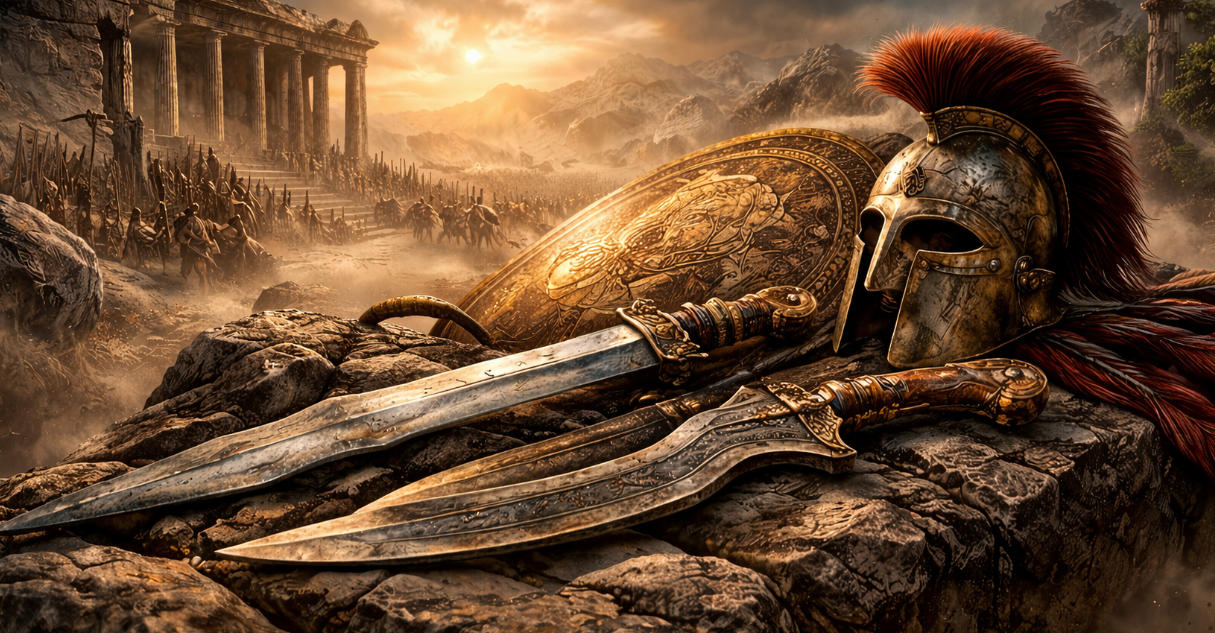
What Are Greek Swords and How Did They Shape Ancient Warfare?
The weapons of ancient Greece not only transformed the battlefield but also profoundly influenced the development of Western military history. Among the many ancient greek weapons, ancient greek swords stood out as a core element, combining elegant design, exceptional performance, and symbolic significance, making them indispensable companions for Greek warriors.
Whether in city-state wars, resisting Persian invasions, or during the campaigns of Alexander the Great, greek swords alongside other greek weapons played a pivotal role in shaping Greek civilization and empire.
Origins and Development of Greek Swords
The history of Greek swords dates back to the Mycenaean civilization (around 1600–1100 BCE), when weapons were primarily made of bronze. Early greek sword blades were wide and heavy, designed for close combat and especially effective in the tightly packed phalanx formations. During this period, Greek military tactics relied on dense formations and short-range charges, so swords had to balance durability with lethality.
With the advent of the Iron Age (around 1200 BCE onward), iron ancient greek swords gradually replaced bronze ones. Iron blades were stronger, lighter, and could maintain sharper edges for longer periods, greatly improving a warrior’s mobility and combat efficiency. The emergence of iron swords also increased the tactical flexibility of ancient greek weapons, allowing infantry to act independently in the phalanx and perform counterattacks or breakthroughs with swords.
During the Classical period, ancient greek swords became more refined, and various types of short swords and curved blades, such as the Xiphos and Kopis, were developed to meet different combat and troop needs. The Xiphos, with its double-edged straight blade, was ideal for stabbing and slashing, while the Kopis featured a curved blade, delivering powerful strikes during cavalry charges or duels. This diversity in design allowed Greek warriors across infantry, cavalry, and light troops to fight flexibly, creating multi-layered tactical systems.
Moreover, the evolution of Greek swords reflected not only technological progress but also Greek society’s emphasis on warfare and honor. Each greek sword was more than a weapon—it was a symbol of status and courage. Young soldiers demonstrated their bravery and loyalty through mastering swordsmanship, and finely crafted swords often represented the honor of a warrior’s family.
In summary, from the bronze swords of the Mycenaean era to the iron ancient greek swords of the Classical period, Greek swords underwent material innovations, design improvements, and tactical advancements. They enhanced individual combat effectiveness and transformed Greek military strategy, cementing Greece’s place in ancient military history.

Typical Types of Greek Swords
Greek swords came in various forms, each designed for specific tactical purposes. They were not only battlefield tools but also exemplified Greek artistry and martial sophistication. The most representative types are the Xiphos and Kopis, differing in design, function, and symbolic meaning.
1. Xiphos (Greek Short Sword)
The Xiphos is the most iconic of swords greek, typically 50–70 cm long with a double-edged straight blade, suitable for stabbing and slashing. It served as the primary secondary weapon for Greek heavy infantry (Hoplites).
- Design Features: Double-edged straight blade, medium width, moderate weight, balancing speed and striking power.
- Tactical Use: Soldiers used the long spear (dory) to engage enemies at a distance; when opponents closed in, the Xiphos became the main weapon for close combat and clearing enemies in melee.
- Cultural Symbol: Xiphos represented courage and honor. Young warriors proved bravery and loyalty through mastering its use.
- Versatility: Effective in dense infantry combat, urban skirmishes, and even naval encounters, offering high flexibility.
The Xiphos’ balanced design allowed rapid stabbing and efficient sweeping in melee, making it an indispensable part of Greek military tactics.
2. Kopis (Curved Greek Sword)
Unlike the straight Xiphos, the Kopis has a forward-curved blade with the center of gravity toward the tip, optimized for chopping. Its design offered significant advantages in charges and cavalry engagements, making it a classic example of ancient greek weapons.
- Design Features: Curved blade, heavy tip for powerful strikes, broad edge to counter shields and armor.
- Tactical Use: Used by cavalry or shock troops during charges, often in combination with spears or shields to deliver devastating blows.
- Cultural Symbol: Kopis emphasized strength and efficiency, representing valor and aggression; it frequently appears in Greek epic tales.
- Versatility: Effective not only for cavalry but also for open-field attacks against heavily armored infantry, breaking enemy formations quickly.
The Kopis’ curved design enhanced chopping power and reshaped Greek combat techniques, complementing the Xiphos. While Xiphos focused on speed and versatility, Kopis emphasized force, together providing balanced battlefield options.
Greek Swords and Combined Tactics with Other Weapons
On the Greek battlefield, a single weapon rarely exploited full tactical potential. Warriors often combined multiple greek weapons to create effective strategies.
Heavy Infantry Tactics
Greek heavy infantry (Hoplites) used the spear (dory) as the main weapon and a greek sword as a backup. They formed dense “Phalanx” formations, working closely with shields (aspis) to resist enemy forces.
- Spears were used for initial engagement.
- Once in close combat, swords became the primary tool for stabbing and slashing.
- Discipline and teamwork were essential to the phalanx’s effectiveness.
This approach highlighted not just weaponry but also the combination of strict training and team coordination as core strengths of Greek armies.

Craftsmanship and Materials of Greek Swords
Early ancient greek swords were primarily cast from copper and bronze, metals that were easy to shape yet sturdy enough for combat. Bronze blades were often hammered and repeatedly quenched, creating dense and resilient swords. However, bronze was relatively soft and could wear down against heavy armor, prompting Greek craftsmen to refine their sword-making techniques.
With the Iron Age, iron greek swords became mainstream. Iron provided balanced weight, durability, and longer-lasting sharp edges. Some high-end blades incorporated bronze inlays or layered forging techniques to enhance durability and artistic value.
Greek swordsmiths meticulously executed each step when crafting swords greek:
- Smelting and Forging: Heating metals to high temperatures, making them malleable, then hammering repeatedly into the desired shape.
- Heat Treatment and Quenching: Rapid cooling strengthened the blade while maintaining flexibility to prevent breakage.
- Polishing and Sharpening: Achieved a razor-sharp edge and smooth surface, combining aesthetics and practicality.
- Decoration and Engraving: High-status ancient greek swords often featured bronze, gold, silver, or gemstone inlays, reflecting prestige.
This meticulous craftsmanship ensured ancient greek weapons excelled in combat, combining lethality with maneuverability. Proper balance and weight distribution allowed warriors to strike with speed and precision, making the greek sword a blend of art and science.
Moreover, finely crafted swords greek carried social and cultural significance. Beautifully made swords symbolized courage, honor, and family status. Legendary blades sometimes became heirlooms, representing heroic spirit and historical legacy.
From material selection to forging techniques, Greek sword craftsmanship reflected the ancient Greeks’ expertise in technology, art, and military strategy, making ancient greek swords not only battlefield tools but also lasting historical and cultural treasures.
Symbolic Meaning of Greek Swords in Warfare and Culture
In Greek society, greek sword was more than a weapon; it represented status and honor. Soldiers with ornate swords were seen as embodiments of bravery, valor, and divine favor.
Greek gods like Athena and Ares were often depicted wielding weapons, reinforcing the role of ancient greek weapons in myths, epic tales, and religious rituals.
Influence of Greek Swords on Later Military Culture
Greek swords and associated tactics had lasting effects on military development. Roman legions adopted and refined greek weapons, creating more sophisticated fighting systems. Medieval and Renaissance European swordsmanship also drew inspiration from Greek philosophy and martial techniques.
Today, Greek swords remain central to historical reenactments, sword enthusiast communities, and museum exhibitions, serving as windows into ancient civilization and combat wisdom.
Why Greek Swords Still Captivate Today
With renewed interest in historical cultures, more scholars, collectors, and enthusiasts study ancient greek swords and greek weapons. They examine craftsmanship, battlefield applications, and cultural context to gain deeper insight into this influential military heritage.
From a military, archaeological, and martial culture perspective, Greek swords remain a classic and essential subject.
Conclusion: How Greek Swords Shaped a Civilization
Greek swords were not only symbols of ancient Greek civilization but also powerful instruments shaping history. As key ancient greek weapons, they decided life and death on the battlefield, represented honor in society, and influenced generations to come.
Studying the design, tactics, craftsmanship, and symbolism of swords greek offers a comprehensive understanding of how Greece leveraged superior weaponry and strategy to build a remarkable civilization.

