


Urumi Sword: India’s Deadliest Whip Blade and Martial Arts Legend
- Posted by COOLKATANA
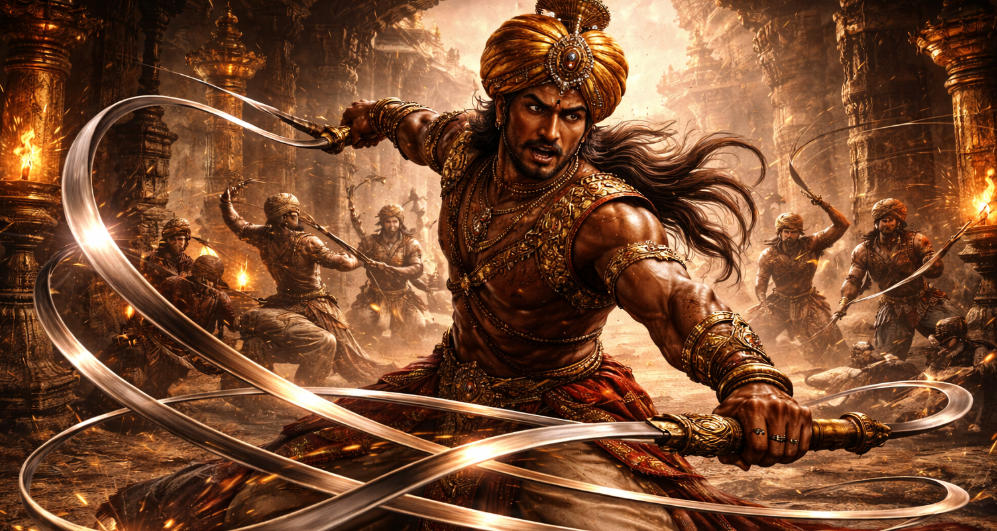
What Makes the Urumi Sword India’s Most Dangerous and Unique Weapon?
In the vast arsenal of exotic weapons throughout history, few can rival the Urumi for its combination of elegant fluidity and terrifying lethality. Originating from southern India, this whip sword is renowned for its extreme difficulty to wield and its unpredictable attack patterns, earning a reputation as one of the deadliest and most challenging weapons ever created.
Today, we delve into the world of the Urumi, uncovering its historical origins, unique construction, and the battlefield prowess that once struck fear into adversaries.
Historical Context: A Millennia-Old Legacy Rooted in Kalaripayattu
Were Urumi actually used?
The Urumi can be traced back thousands of years to southern India, particularly in regions corresponding to modern-day Kerala and Tamil Nadu. As a top-tier weapon in one of the world’s oldest and most sophisticated martial arts systems—Kalaripayattu—the Urumi was more than a combat tool; it embodied the strategic and cultural wisdom of ancient Indian warfare.
This whip sword was considered an anomaly in the evolution of bladed weapons. Ancient Sangam literature mentions elite warriors wielding such flexible steel blades. In Kalaripayattu, the Urumi occupies a highly specialized role: a practitioner must undergo years, sometimes over a decade, of training in hand-to-hand combat, staff, and spear techniques before being entrusted with the 'death ribbon' of a Urumi. This gradual training ensured that only warriors with peak physical and mental discipline could master its unpredictable power.
In South Indian epics and folklore, the Urumi symbolizes both wonder and intimidation. Legends tell of warriors spinning multi-blade Urumis in the midst of enemy ranks, creating a deadly steel whirlwind that could defend against dozens of foes at once. The weapon’s use represented the harmonious union of strength and flexibility, a central philosophy in Kalaripayattu, and its advanced metallurgy and combat principles influenced neighboring regions, leaving a lasting mark on the history of exotic weapons. Even today, the Urumi remains a treasured tactical legacy for martial arts historians.

Design Secrets: Flexible as a Ribbon, Sharp as a Razor
The Urumi’s construction defies the conventions of rigid swords. Made of highly flexible spring steel, the blade is thin and long, often matching the wielder’s arm span.
-
Extreme flexibility: When not in use, the Urumi can be coiled around the waist like a belt, making it highly concealable. Once drawn, it extends into a straight or slightly curved battle-ready state.
-
Multi-blade variants: While commonly single or double-edged, historical examples existed with up to 30 blades running in parallel. When spun, these multi-blade Urumis act like a deadly steel whip, capable of shredding targets.
-
Hilt design: The grip often incorporates a small shield-like guard, inspired by the Firangi sword, protecting the user’s hand during high-speed rotations.
Battlefield Performance: The Ultimate 'Crowd Control' Weapon
In combat, the Urumi is used more like a whip than a conventional sword. Wielders must maintain continuous rotation and circular motion to keep the blade taut and prevent it from collapsing or injuring themselves.
-
360-degree offense and defense: When spun, the Urumi creates a deadly perimeter around the wielder, approximately 3–4 meters in diameter. Its flexible blade can bypass shields or rigid defenses, striking targets behind them.
-
Psychological intimidation: The whooshing sound of the blade and flashes of steel create fear before combat even begins.
-
One versus many: The weapon’s sweeping reach makes it ideal for defending against multiple attackers simultaneously, cementing its status as a masterful crowd-control weapon in pre-gunpowder warfare.

The World’s Hardest Weapon to Master: Why It’s So Dangerous
Despite its lethality, the Urumi is a double-edged challenge. Its danger extends to the wielder.
Mastering the Urumi requires years of foundational training in staff and spear techniques before ever handling the flexible blade. Because of its extreme length and lightness, any slight miscalculation or change in wind direction could cause the razor-thin blade to snap back, injuring the user’s neck or limbs. Only practitioners with exceptional mental stability and agility were allowed to wield it in Kalaripayattu traditions.
Modern Perspective: From Silver Screen to Cultural Heritage
Modern films, such as RRR and Baahubali, have reintroduced the Indian Urumi to a global audience, showcasing its advanced tactical concepts. In an age dominated by rigid swords and heavy iron weapons, the craftsmen of southern India developed a design that leveraged elasticity, momentum, and centrifugal force.
Today, the Urumi is primarily preserved in Kalaripayattu performances and as part of intangible cultural heritage programs. It reminds us that in the evolution of bladed weapons, mastery over flexibility and fluidity could produce lethal artistry rivaling brute force.
The legendary Urumi is often called a sword whip, a deadly flexible blade that combines the cutting power of a sword with the fluid movement of a whip, making it one of history’s most unique and difficult weapons to master.
Conclusion
The Urumi is not just an iconic Indian weapon; it is a unique marvel in the history of edged arms. Combining the reach of a whip, the sharpness of a sword, and the fluid motion of flowing water, it represents an extraordinary synthesis of martial skill, physical discipline, and metalwork mastery.
For anyone interested in ancient warfare or exotic weapons, the image of the Urumi spinning like a silver serpent remains one of the most awe-inspiring sights in history. Through the study of this remarkable whip sword, we glimpse the ingenuity of South Indian warriors and their ultimate pursuit of harmonizing body, mind, and blade.
Inspired by its unique flexible blade design, the urumi sword is often described as a sword whip due to its flowing whip-like movements and unusual combat style. Its legendary appearance has also attracted attention from fantasy and gaming fans, including players interested in weapons featured in Elden Ring and other epic combat worlds.

