


Katana vs Ninjato Sword: History, Differences & Real Facts Explained
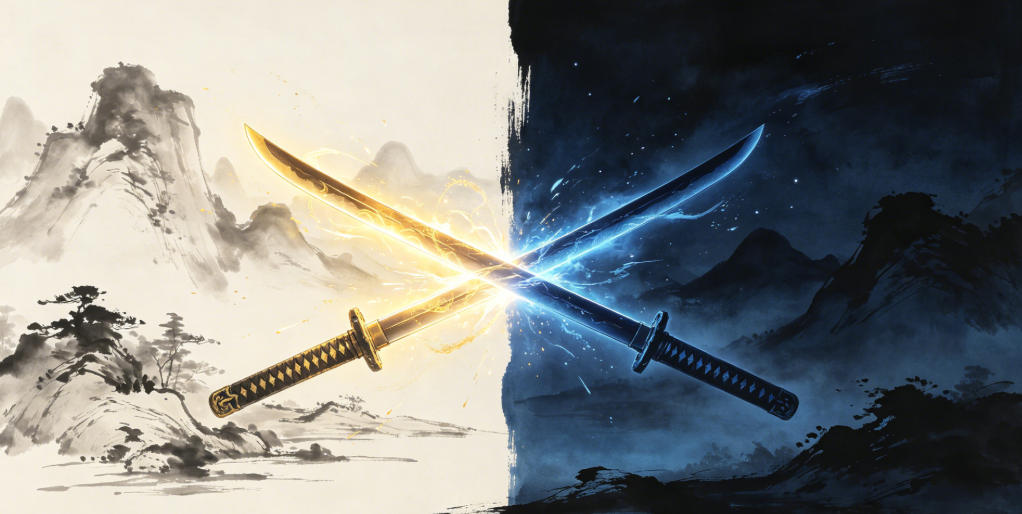
What Is the Difference Between a Katana and a Ninjato Sword?
In the Japanese sword system, Katana and Ninjato sword are often discussed together, but they represent significantly different historical contexts, structural designs, and functional logics.
From a strict historical sword perspective, the Katana is a real combat weapon with a well-documented evolution in craftsmanship, while the Ninjato sword appears more as a modern cultural reconstruction shaped by ninja imagery in popular media.
1. Katana (Japanese Samurai Sword): History and Craftsmanship
The Katana was the standard sidearm of the samurai class, reaching its mature form during the Muromachi to Edo periods and becoming one of the most iconic achievements in Japanese sword-making.
1. Structural Features
Katana design reflects a deep understanding of battlefield efficiency and material mechanics, rather than pure aesthetics.
-
Single-edged curved blade
The curvature (sori) creates a natural cutting trajectory during swings, improving slicing efficiency and reducing resistance on impact. -
Typical length: 60–80 cm
This range offers an optimal balance between reach and speed, suitable for both mounted and infantry combat. -
Two-handed grip (long tsuka)
The extended handle allows for better control, torque generation, and precise blade angle adjustments during strikes. -
Optimized for fast draw and continuous cutting (iaijutsu / kenjutsu)
The Katana is designed for explosive first-strike capability and fluid follow-up techniques in sword combat systems.
2. Forging Process
The Katana’s production system is the core of traditional Japanese swordsmithing, combining metallurgy, thermal treatment, and highly refined handcraft techniques.
It relies on folding forging (tansō / folding) and differential hardening, creating a composite structure: a hard cutting edge with a resilient spine.
Key Processes:
-
Tamahagane steel production
Refined using the traditional Tatara smelting method from iron sand, producing steel with uneven carbon distribution that must be carefully sorted and layered. -
Repeated folding forging
The steel is repeatedly heated, hammered, and folded to remove impurities and homogenize carbon content, improving toughness and creating visible grain patterns (hada). -
Differential hardening (hamon formation)
Clay is applied in varying thickness across the blade before quenching, allowing the edge to harden rapidly while the spine remains flexible, forming the visible temper line (hamon).

3. Combat Function
In real combat systems, the Katana is not just a weapon but a highly optimized tactical tool focused on efficiency, control, and decisive striking.
From the perspective of Japanese sword arts (Kenjutsu / Iaido), its primary value lies in initiating combat and maintaining flow-based engagement.
Key tactical characteristics include:
-
One-strike decisive technique (Ittō Issen)
Combat is designed to be resolved with a single effective cut rather than prolonged exchanges. -
High cutting efficiency
The curved blade enhances slicing motion, allowing smoother penetration into targets with reduced resistance. -
Flow-based combat continuity
The balance and length allow seamless transitions between attack, defense, and follow-up strikes. -
Instant-draw combat principle (Iaido)
The draw itself is part of the attack, emphasizing speed and immediate engagement. -
Mid-range control dominance
The Katana’s length provides control over distance, effectively countering both shorter and longer weapons in close combat scenarios.
Overall, the Katana is designed around a philosophy of rapid, efficient neutralization through controlled motion and energy transfer.
What is a Ninjato Sword?
A Ninjato sword is a modern term used to describe a straight-bladed Japanese-style sword often associated with ninja in popular culture.
It is typically depicted as having:
- A straight or nearly straight blade
- A shorter length than a katana
- A simple, often square guard (tsuba)
- A practical design for stealth-oriented close combat
However, there is an important historical issue:
Historical Reality
There is no solid archaeological or documentary evidence that a standardized ninjato sword was widely used by historical ninja (shinobi). Most historians believe:
- Ninja likely used existing weapons such as wakizashi (short swords), tantō (daggers), or modified tools
- The ninjato as a distinct weapon category largely originates from 20th-century films, anime, and popular media
In short, the ninjato sword is best understood as a modern cultural reconstruction rather than a confirmed historical weapon.
2. Ninjato Sword: Concept and Controversy
The Ninjato sword is generally described as a straight, short sword associated with ninja. However, in academic and historical research, its authenticity remains highly debated and is often considered a modern reinterpretation rather than a standardized historical weapon.
In popular culture, it is often linked to stealth, infiltration, and assassination themes, but historical evidence does not fully support this standardized image.
1. Structural Features (Modern Interpretation)
Modern depictions of the Ninjato sword are largely shaped by films, anime, and martial arts reenactments.
-
Straight blade design
Often considered more suitable for thrusting and confined spaces, though no consistent historical standard exists. -
Shorter blade length
Typically portrayed as shorter than the Katana for improved mobility in indoor or complex environments. Historically, similar roles were more likely filled by wakizashi or tantō. -
Square tsuba (guard)
Often interpreted as a multipurpose structural feature, though this is largely a modern symbolic interpretation. -
Simplified construction
Designed in modern depictions to emphasize practicality and stealth-oriented functionality.

2. Historical Authenticity
Most scholars in Japanese sword history agree that:
- There is no definitive physical or textual evidence of a standardized ninjato sword
- Ninja likely used adaptable and concealable weapons rather than a dedicated sword type
- The modern concept of the ninjato was heavily influenced by 20th-century media
3. Cultural Classification
From a modern cultural perspective, the Ninjato sword is best understood as a:
'Cultural symbolic weapon'
Its significance lies not in historical accuracy but in narrative function:
- Symbol of stealth and secrecy
- Contrast to the samurai Katana
- Visual icon in anime, games, and films
3. Katana vs Ninjato Sword: Structural and Functional Comparison
Blade Geometry
- Katana: Curved blade optimized for cutting efficiency
- Ninjato sword: Straight blade emphasizing thrusting and control
Tactical Role
- Katana: Open combat, dueling, battlefield engagement
- Ninjato sword: Stealth operations, close-range infiltration, rapid response
Technical System
- Katana: Integrated martial systems (Kenjutsu / Iaido)
- Ninjato sword: No unified historical system; largely reconstructed
Manufacturing Complexity
- Katana: High-level traditional craftsmanship with long production cycles
- Ninjato sword: Often simplified in modern reproductions for functionality and cost
4. Cultural Misconceptions
In modern media, the ninjato sword is often portrayed as the “standard ninja weapon,” but this is largely a modern reconstruction.
Common misconceptions include:
- All ninja used straight swords
- The ninjato was an official standardized weapon
- Ninja weapon systems were completely separate from samurai tools
In reality, weapon usage in feudal Japan was highly flexible and situational.
5. Core Difference Between Katana and Ninjato Sword
- Katana: A historically verified samurai weapon system combining craftsmanship and battlefield efficiency
- Ninjato sword: A symbolic weapon concept shaped by modern cultural imagination
Their difference is not about superiority, but about origin:
Historical weapon system vs. culturally reconstructed symbol
Hand Forged Japanese Ninja Sword Folded Steel Black Blade Iron Square Tsuba Blowing Needles

6. Final Conclusion
The comparison between Katana and Ninjato sword is not merely a weapon debate, but a reflection of two different layers of cultural understanding.
- Katana represents a historically grounded evolution of real craftsmanship and warfare
- Ninjato sword represents a modern narrative reconstruction shaped by media and imagination
In essence:
One belongs to history itself,
the other belongs to how history has been reimagined.
-
Posted in
Ninja

