


11 Japanese Sword Types Explained: History, Names & Samurai Blades
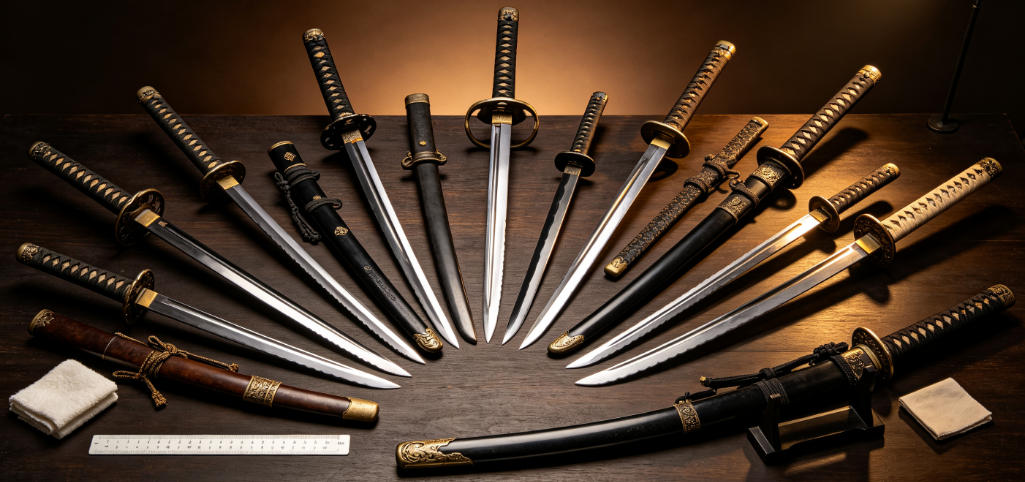
What Are the Different Types of Japanese Swords? A Complete Guide to 11 Samurai Blades
Japanese swords are not only traditional weapons but also important symbols of Japanese history, samurai culture, and craftsmanship. From the swords carried by warriors on ancient battlefields to legendary blades appearing in modern anime, movies, and video games, Japanese swords have experienced centuries of evolution and developed into a rich and diverse system.
For sword enthusiasts who want to learn about different sword types, Japanese swords represent one of the most iconic sword traditions in the world. Many people think of the Katana when they hear 'Japanese sword,' but in reality, Japan has created many different blade designs throughout history.
Depending on their era, purpose, length, and combat style, Japanese swords developed into many categories, including Tachi, Katana, Wakizashi, Tanto, Nodachi, and Naginata. These different sword types not only reflect changes in Japanese warfare but also reveal the lifestyle, social status, and spiritual beliefs of different generations of samurai.
Among all japanese weapons, Japanese swords became famous not only because of their sharp blades and beautiful designs, but also because every sword carries a unique historical story.
The Origins of Japanese Sword Culture: From Ancient Weapons to the Soul of the Samurai
The development of Japanese swords was a long process shaped by centuries of warfare, cultural changes, and technological innovation.
Early Japanese swords were influenced by sword-making traditions from China and the Korean Peninsula, and many early designs featured straight blades. During the Heian period (794–1185), as the samurai class gradually rose in power, Japanese society began to transform, and warfare shifted from aristocratic conflicts to battles between warrior clans.
Because samurai frequently fought on horseback, they needed weapons better suited for mounted combat. Japanese swordsmiths began modifying blade structures, creating stronger curves that improved cutting ability while riding. This period gave rise to Tachi, which became a major turning point in the history of Japanese sword types.
During the Kamakura period (1185–1333), samurai became the dominant force in Japanese society, and sword-making reached a golden age. Many famous swordsmith schools emerged, including:
- Yamashiro School
- Yamato School
- Bizen School
- Soshu School
- Mino School
Traditional Japanese sword-making is a craft that combines technology, artistry, and spiritual discipline. Swordsmiths carefully select high-quality Tamahagane steel and go through complex processes such as repeated folding, forging, heat treatment, polishing, and mounting to create blades with strength, beauty, and performance.
The unique features of Japanese swords, including Hamon (temper line), Jigane (surface grain patterns), and detailed sword fittings, demonstrate that Japanese swords are not merely weapons but also works of art.
In samurai culture, the Japanese sword was known as the 'Soul of the Samurai.' For warriors, a sword represented more than fighting ability. It symbolized:
- Loyalty
- Honor
- Courage
- Responsibility
Many famous swords were passed down through generations as family treasures, becoming important parts of a clan’s history.

11 Main Japanese Sword Types Explained
Throughout Japanese history, different sword designs were created according to changing battlefields, social structures, and practical needs.
The following 11 categories represent some of the most important Japanese sword types.
1. Katana: The Most Famous Japanese Samurai Sword
The Katana is the most recognizable Japanese sword in the world and one of the most iconic Japanese sword types.
It typically features:
- A curved blade
- A single cutting edge
- A long handle
- A design suitable for fast drawing techniques
Compared with the earlier Tachi, the Katana was better suited for close combat on foot, which is why it gradually became the primary weapon of samurai after the Muromachi period.
The greatest advantage of the Katana is its combination of speed and precision. The traditional Japanese sword art of Iaido, which focuses on quick drawing and immediate strikes, was developed around this concept.
During the Edo period, the Katana became more than a weapon. It became a symbol of samurai identity. Warriors often carried the Daisho, a pair consisting of a long Katana and a shorter Wakizashi, representing their social status.
Today, the Katana has gone beyond its historical role and has become one of the most popular samurai sword styles among collectors, anime fans, and Japanese culture enthusiasts worldwide.
2. Tachi: The Classic Sword of Mounted Samurai
The Tachi is an important Japanese sword type that appeared earlier than the Katana and was mainly popular during the late Heian and early Kamakura periods.
Because samurai often fought on horseback, the Tachi was designed for mounted combat. It usually featured:
- A longer blade
- A stronger curve
- A downward hanging carrying style
Many famous historical Japanese swords belong to the Tachi category. They represent not only advanced sword-making skills but also the development of samurai culture.
Today, antique Tachi swords remain highly valuable among Japanese sword collectors because of their historical importance.
3. Wakizashi: The Samurai’s Companion Short Sword
The Wakizashi is a shorter Japanese sword and an essential part of samurai culture.
It was often paired with the Katana in a combination known as Daisho. The Katana represented the 'long sword,' while the Wakizashi represented the 'short sword.'
Because traditional Japanese houses had limited indoor space, long swords were inconvenient indoors. The Wakizashi became an important secondary weapon for samurai.
Its advantages included:
- Easy carrying
- Effective close-range defense
- Flexible indoor use
Beyond combat, the Wakizashi also represented samurai status and became an important symbol of Japanese sword culture.
4. Tanto: The Elegant Japanese Dagger
The Tanto is a traditional Japanese short blade and one of the important types of japanese weapons.
Although smaller than swords such as Katana and Tachi, Tanto were created with the same attention to craftsmanship, requiring forging, heat treatment, and polishing.
Historically, Tanto were used for:
- Self-defense
- Personal carrying
- Ceremonial purposes
Many nobles and samurai owned beautifully decorated Tanto with artistic handles and scabbards.
Today, Tanto remains a popular collectible because of its unique appearance and craftsmanship.
5. Nodachi / Odachi: The Massive Battlefield Sword
Nodachi and Odachi are some of the largest swords in Japanese history and are considered unique examples among Japanese sword types.
Compared with the standard Katana, these oversized swords feature:
- Longer blades
- Greater attack range
- Strong visual impact
During periods of warfare, especially the Sengoku period, large swords like Nodachi were mainly used on open battlefields. Their extended reach made them effective against cavalry and large groups of enemies.
However, due to their enormous size and weight, using an Odachi required exceptional strength and advanced swordsmanship skills. They were difficult to carry, maintain, and forge, which limited their practical use compared with more versatile swords such as the Katana.
Because creating such large blades required a great amount of steel and highly skilled craftsmanship, surviving historical Nodachi swords are extremely valuable today.
In modern anime, movies, and video games, giant swords are often designed as signature weapons for powerful characters. This has made Nodachi one of the most popular fantasy-style blades among collectors searching for unique anime weapon designs.
6. Naginata: The Long-Bladed Weapon of Samurai and Female Warriors
Although Naginata is not technically a traditional sword, it is one of the most representative Japanese bladed weapons and an important part of japanese weapons history.
A Naginata consists of:
- A long wooden shaft
- A curved blade
- A wide attack range
Unlike ordinary swords, the extended handle allowed warriors to attack opponents from a safer distance.
Historically, the Naginata was widely used by:
- Samurai warriors
- Warrior monks
- Female warriors
Especially in Japanese female warrior traditions, the Naginata held a special cultural position. Many women trained with this weapon to protect their homes and families during times of conflict.
This connection made Naginata an important symbol of Japanese martial arts and warrior culture.
Today, Naginata-do, the traditional martial art using Naginata, is still practiced in Japan. It continues to preserve the techniques and philosophy behind this unique weapon.
7. Ken: The Early Straight Sword of Japan
Ken is one of the earliest Japanese sword forms and an important subject when studying Japanese sword types.
Unlike the curved Katana, Ken usually featured a straight blade and often had a double-edged design. It was strongly influenced by ancient Chinese sword traditions and appeared mainly during the Nara period and early Heian period.
Unlike later battlefield swords, Ken often carried ceremonial and spiritual meanings.
In Japanese Buddhist and Shinto traditions, swords were sometimes viewed as sacred objects representing:
- Protection from evil
- Wisdom
- Spiritual strength
Many temples preserved special swords not only as weapons but also as cultural and religious treasures.
Although Ken was eventually replaced by curved swords that were more suitable for samurai warfare, it remains an important link between ancient straight swords and the development of the modern Katana.
8. Chokuto: One of the Earliest Japanese Sword Types
Chokuto is one of the earliest sword designs in Japanese history and an important stage in the evolution of Japanese sword types.
Before the rise of the samurai era, Chokuto was influenced by continental Asian sword designs. It usually featured:
- A straight blade
- Simple structure
- Single or double cutting edges
Unlike the curved Katana, which was designed for faster drawing and more efficient cutting, Chokuto represented an earlier stage of Japanese sword development.
Although modern collectors are more familiar with Katana, Chokuto has great historical significance because it represents the beginning of Japan’s independent sword-making tradition.
The transition from Chokuto to Tachi, and eventually to Katana, reflects how Japanese sword culture continued to evolve through innovation and adaptation.

9. Uchigatana: The Important Step Toward the Modern Katana
Uchigatana played an important role in the development of the Katana.
It became popular during the Muromachi period when Japanese warfare changed significantly.
Earlier samurai mainly fought on horseback, making Tachi the preferred weapon. However, as infantry battles became more common, warriors needed a sword that could be quickly drawn and used immediately in close combat.
This demand led to the development of Uchigatana.
Its main features included:
- More convenient carrying style
- Better suitability for foot combat
- Faster drawing ability
- Improved close-range performance
Over time, Uchigatana evolved into the classic Katana recognized around the world today.
For anyone researching different sword types, Uchigatana represents a crucial bridge between ancient Japanese swords and the legendary samurai sword.
10. Shikomizue: The Hidden Sword Inside a Walking Cane
Shikomizue is one of the most mysterious designs among Japanese weapons.
Unlike traditional swords carried openly by samurai, Shikomizue hides a blade inside what appears to be an ordinary walking cane.
Its unique characteristics include:
- Concealed blade design
- Surprise factor
- Mysterious appearance
Although Shikomizue was not a major battlefield weapon like the Katana or Tachi, it represents the creativity and imagination of Japanese weapon design.
This hidden sword concept has appeared frequently in:
- Movies
- Literature
- Anime
- Fantasy stories
Because of its mysterious style, Shikomizue has also inspired many modern anime weapon designs and collectible fantasy swords.
11. Yoroi Doshi: The Japanese Armor-Piercing Dagger
Yoroi Doshi is a specialized Japanese dagger designed specifically for penetrating armor.
Its name literally means “armor piercer.”
During Japan’s Sengoku period, warriors increasingly wore stronger armor. Traditional cutting weapons were not always effective against heavily protected opponents, so swordsmiths created specialized blades like Yoroi Doshi.
Its characteristics include:
- Thick blade construction
- Strong reinforced point
- Powerful piercing ability
Compared with Tanto, which focused more on portability and elegance, Yoroi Doshi emphasized strength and penetration.
This weapon demonstrates how Japanese sword design continuously adapted according to battlefield requirements.
The Historical Meaning and Cultural Value of Different Japanese Sword Types
The beauty of Japanese swords comes not only from their appearance and craftsmanship but also from the history and philosophy behind them.
Different sword types represent different periods of Japanese society:
Tachi represents the era of mounted samurai warriors and the early development of warrior culture.
Katana represents the mature samurai tradition and became a symbol of Japanese warrior spirit.
Wakizashi reflects samurai identity, social status, and daily life.
Tanto demonstrates the detailed craftsmanship and artistic value of small Japanese blades.
Nodachi symbolizes battlefield strength and powerful warrior imagery.
Naginata represents Japanese martial arts and the tradition of female warriors.
Together, these different sword types create a complete picture of Japanese sword culture.
They are not only historical weapons but also important symbols of Japanese art, philosophy, and heritage.
Japanese Swords in Modern Anime, Movies, and Video Games
Today, Japanese swords are no longer limited to museums, historical collections, and martial arts.
With the worldwide popularity of Anime, Manga, video games, and movies, Japanese swords have become some of the most recognizable symbols in global pop culture.
Many fictional characters use specially designed blades, including:
- Character-defining Katana
- Fantasy swords with supernatural abilities
- Legendary weapons connected to personal stories
These creations have introduced millions of people to Japanese sword culture and increased worldwide interest in Japanese weapons.
In anime and fantasy worlds, a sword is often more than a simple weapon. It can represent:
- Family heritage
- Teacher and student relationships
- Personal beliefs
- Character growth
This is why many fans collect anime sword replica products. They are not only purchasing a decorative item but also preserving memories and emotions connected to their favorite characters and stories.
How to Choose the Right Japanese Sword for Collection
For collectors interested in Japanese blades, understanding different sword types is the first step.
The ideal choice depends on personal interests.
For traditional samurai culture:
The Katana remains the most iconic choice.
For historical Japanese warriors:
Tachi and Nodachi provide stronger historical character.
For smaller and elegant collections:
Wakizashi and Tanto are excellent display options.
For anime and fantasy fans:
Unique anime weapon designs and anime sword replica collections offer a connection to fictional worlds.
Besides design, craftsmanship is also important.
A high-quality Japanese sword usually focuses on:
- Steel quality
- Blade structure
- Balance
- Sword fittings
- Handmade details
Popular materials include:
1095 High Carbon Steel, known for excellent hardness and a traditional sword feel.
T10 Steel, appreciated for durability, toughness, and balanced performance.
Damascus Steel, famous for its beautiful layered patterns and artistic appearance.
Conclusion: Exploring the World of Different Sword Types
From ancient Chokuto, to samurai-era Tachi and Katana, to modern Japanese sword replicas, Japanese blades have experienced thousands of years of development.
Every type of Japanese sword carries its own historical background, design philosophy, and cultural meaning.
Learning about these sword types is not only about understanding weapons, but also about exploring Japanese history, samurai philosophy, and traditional craftsmanship.
Whether you are interested in japanese weapons, collecting Japanese swords, or admiring legendary blades from anime and fantasy worlds, Japanese sword culture offers a fascinating connection between the past and present, history and imagination.
A Japanese sword represents more than the sharpness of forged steel. It carries centuries of pursuit for courage, honor, beauty, discipline, and spiritual strength.

