The Naginata is a traditional Japanese pole weapon consisting of a wooden shaft—typically over 1.5 meters long—and a curved blade mounted at the end. The blade resembles a scythe or crescent shape and is designed primarily for sweeping and slashing attacks.
The word “Naginata” comes from the Japanese verb nagi-harau, meaning “to mow down” or “to sweep away,” perfectly describing its wide attack range and sweeping combat capability.
During the Sengoku period and throughout Japan’s feudal era, the Naginata became a crucial battlefield weapon. Its extended reach allowed infantry and mounted warriors alike to control space, disrupt enemy formations, and defend against cavalry charges. Its versatility made it both a practical weapon and an essential component of martial training systems, influencing what later became Naginatajutsu (the classical combat art) and Naginata-do (the modern martial way).
II. Historical Origins and Development
1. Strategic Role on the Battlefield
The Naginata’s history dates back to the Heian period (around the 10th century). It reached peak battlefield use during the Kamakura and Sengoku periods. As a pole weapon, it was particularly effective in formation combat and in countering cavalry.
Its long reach, wide sweeping capability, and ability to break enemy lines made it a favored weapon among both infantry and mounted warriors. In chaotic battlefield environments, the Naginata allowed fighters to maintain distance while striking multiple opponents.
2. The Naginata and the Samurai Class
Although the Naginata is often associated today with female warriors (Onna-Bugeisha), it was not originally exclusive to women.
Many male Samurai used the Naginata extensively, especially in combination with other weapons such as the Yari (spear) and Tachi. It offered an effective balance between long-range sweeping attacks and close-range defensive control.
On the battlefield, it served not only as an offensive weapon but also as a tactical tool for protecting formations, disrupting enemy advances, and supporting allies.
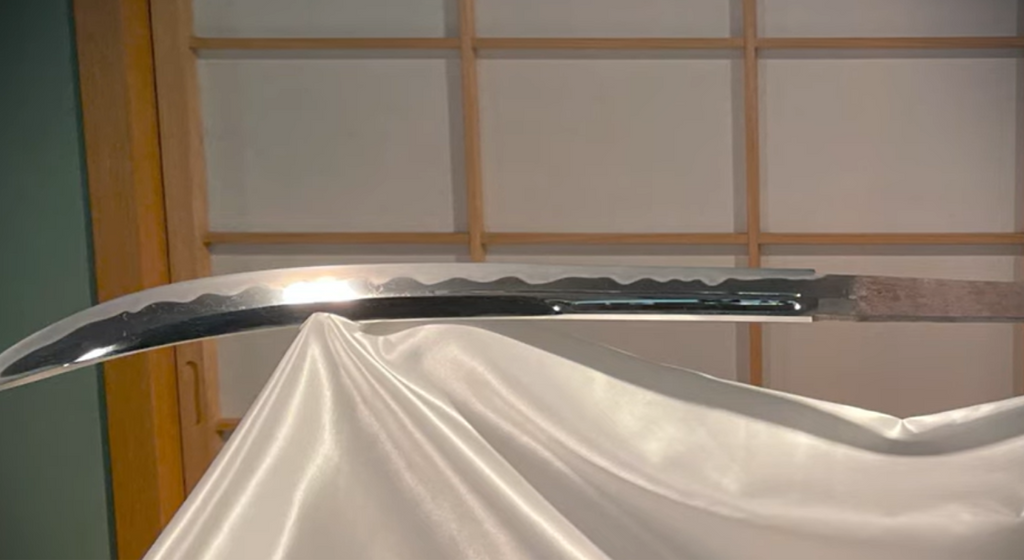
III. Structure and Technical Characteristics
1. Distinctive Design: Long Shaft and Curved Blade
The Naginata’s structure is easily recognizable and differs significantly from other traditional Japanese weapons:
-
Long Shaft (Pole): Made of hardened wood and typically over 1.5 meters long, providing extended reach and flexibility in both attack and defense.
-
Curved Blade: The arched blade enhances sweeping and slashing motions, increasing striking range and cutting efficiency.
This design allows smooth transitions between offense and defense. The wielder can manage distance, respond to multiple opponents, and create defensive depth during combat.
2. Core Techniques and Combat Movements
Naginata techniques emphasize not only blade handling but also coordinated footwork and body control. Classic movements include:
-
Sweep: Wide horizontal strikes to clear space or strike multiple opponents
-
Diagonal Slash: Angled cutting motions to expand attack angles
-
Thrust: Forward piercing attacks using the blade’s tip
-
Block and Parry: Defensive maneuvers using both the shaft and blade
These techniques allow effective responses against weapons such as the Yari (spear), Tanto (dagger), or Katana. Training emphasizes speed, rhythm, fluidity, and continuity of motion, blending tactical awareness with physical discipline.
IV. The Naginata in Japanese Martial Arts
As warfare evolved, the Naginata transitioned from a battlefield weapon to a vehicle for martial training and spiritual cultivation.
Today, it is practiced in two primary forms:
-
Naginatajutsu: Traditional classical combat techniques
-
Naginata-do: A modern martial art focusing on discipline, etiquette, mental concentration, and technical refinement
In dojos, the Naginata is not only studied for practical skill but also as a practice in etiquette, focus, posture, and martial spirit.
V. The Naginata and the Onna-Bugeisha Tradition
Throughout Japanese history, female warriors known as Onna-Bugeisha were often depicted as skilled Naginata practitioners. In feudal society, they served both as defenders of their households and as battlefield supporters.
During times of conflict—particularly in the Sengoku period—aristocratic women received formal Naginata training to defend castles and protect family honor. The weapon’s long reach and sweeping capacity made it ideal for defensive combat within confined spaces.
As a result, the Naginata became closely associated with courage, resilience, and wisdom. Historical paintings and records often portray women wielding the weapon in defense of their homes and clans. Over time, it evolved into a powerful cultural symbol of female strength and independence, frequently represented in literature, anime, film, and martial arts demonstrations.
VI. Modern Naginata-Do and Competitive Sport
In the modern era, Naginata practice has spread globally as a martial art and competitive sport.
Modern Naginata-do emphasizes:
-
Technical precision and formal etiquette
-
Expression of Bushido (the Samurai code of honor)
-
Ranking systems and structured tournaments
Naginata competitions are held internationally, supported by dedicated martial arts organizations. In Japan, it is also incorporated into school physical education programs and continues to grow in popularity across Europe, the Americas, and other regions.
VII. Cultural Meaning and Symbolism
As one of Japan’s iconic traditional weapons, the Naginata represents far more than a combat tool. It symbolizes:
-
Samurai spirit and honor
-
Discipline, focus, and perseverance
-
Historical continuity and cultural identity
-
Female empowerment and self-defense tradition
For historians, martial artists, and cultural enthusiasts, the Naginata stands as a compelling example of how a weapon can evolve from battlefield necessity to a refined expression of martial philosophy.
Hand Forged Japanese 47inch Naginata Sword 1095 High Carbon Steel Blade Alloy Tsuba

VIII. Conclusion: From Battlefield Weapon to Martial Symbol
The Naginata has journeyed from the battlefields of medieval Japan to the training halls of modern martial arts. Combining practical combat function, ritual etiquette, and symbolic meaning, it remains a vital part of Japanese martial heritage.
Whether you are a researcher of Japanese weapons, a martial arts practitioner, or a history enthusiast, the Naginata offers a complete narrative—from warfare technique to spiritual cultivation—worthy of deeper exploration.