


Takeda Shingen: The Tiger of Kai and Legendary Samurai Warrior
- Posted by COOLKATANA
Who Was Takeda Shingen, the Tiger of Kai, and Why Was He So Powerful?
Among the many legendary figures of Japan’s Sengoku Period, one warrior became famous for his exceptional military talent, powerful leadership, and unique samurai spirit. He was known throughout history as 'The Tiger of Kai.'
He was Takeda Shingen(武田信玄), one of the most famous Daimyo in Japanese history.
As the 19th head of the Takeda clan, Takeda Shingen was not only a brilliant military strategist but also a key figure who influenced the course of Japan’s Warring States era. Leading the powerful Takeda army, he built a dominant force in central Japan, earning the respect of legendary figures such as Oda Nobunaga and Uesugi Kenshin.
Even today, Takeda Shingen Samurai, his iconic red Samurai Armor, famous war banners, and legendary battlefield strategies remain popular topics among Japanese history enthusiasts, samurai culture researchers, and sword collectors.
Who Was Takeda Shingen?
Takeda Shingen (1521–1573), originally named Takeda Harunobu, was born in Kai Province and became one of the most influential Daimyo during Japan’s Sengoku Period.
After inheriting leadership of the Takeda clan from his father, Takeda Nobutora, he strengthened the clan through political reforms, military expansion, and advanced strategic planning. Under his leadership, the Takeda family transformed from a regional power into one of the strongest military forces in Japan.
Later, he adopted the Buddhist name 'Shingen,' and became widely known as Takeda Shingen.
His power base was located in the ancient region of Kai, which is now part of modern-day Yamanashi Prefecture. Because of his overwhelming military strength and strategic brilliance, he earned the legendary title:
'The Tiger of Kai.'
This title represented not only his fierce personality but also his powerful control over the battlefield and his reputation as one of Japan’s greatest warriors.

Takeda Shingen and the Sengoku Period: The Rise of a Powerful Daimyo
The Sengoku Period was an era of constant warfare, where powerful Daimyo competed for territory and influence across Japan.
During this chaotic period, the Takeda clan rapidly expanded its power through a highly disciplined military system and elite warrior forces.
The Takeda Shingen Samurai Army became famous for its strict organization, battlefield discipline, and exceptional combat ability.
One of the most famous elements of his army was:
Takeda Cavalry
The Takeda clan controlled one of the most powerful mounted samurai forces in Japan.
These warrior cavalry units were known for:
- Rapid battlefield charges
- Advanced formations
- Strong teamwork
- Excellent combat skills
They became one of the most feared military forces of the Sengoku era.
Takeda Shingen also followed the famous military philosophy known as:
Fūrinkazan (風林火山)
This phrase came from the ancient Chinese military classic The Art of War by Sun Tzu:
'Swift as the wind, gentle as the forest, fierce as fire, immovable as the mountain.'
The famous battle banner represented the ideals of the Takeda army:
- Move as quickly as the wind
- Advance like a silent forest
- Attack fiercely like fire
- Defend firmly like a mountain
This strategy helped the Takeda Shingen Samurai Army become one of the most powerful forces in Japanese history.
Takeda Shingen was also famous for his belief:
'People are the castle, people are the walls, people are the stone foundation.'
This philosophy showed his unique approach to leadership — valuing loyal followers and strong relationships over relying only on physical defenses.
The Battle of Kawanakajima: The Legendary Rivalry Between Takeda Shingen and Uesugi Kenshin
When discussing Takeda Shingen, it is impossible to ignore one of the most famous conflicts in Japanese history:
The Battle of Kawanakajima
This series of battles took place between Takeda Shingen and Uesugi Kenshin, the powerful Daimyo of Echigo.
The two legendary warriors fought repeatedly over control of Shinano Province, making their rivalry one of the most famous stories of the Sengoku Period.
The most famous confrontation was the Fifth Battle of Kawanakajima in 1561.
According to historical accounts and legends:
- Uesugi Kenshin personally charged into the Takeda headquarters
- Takeda Shingen defended himself while commanding the army with his war fan
- The two legendary samurai leaders faced each other directly on the battlefield
Although neither side achieved complete victory, the battle became one of the greatest examples of samurai warfare.
Today, Takeda Shingen vs Uesugi Kenshin remains a popular subject in Japanese history books, movies, anime, and video games.
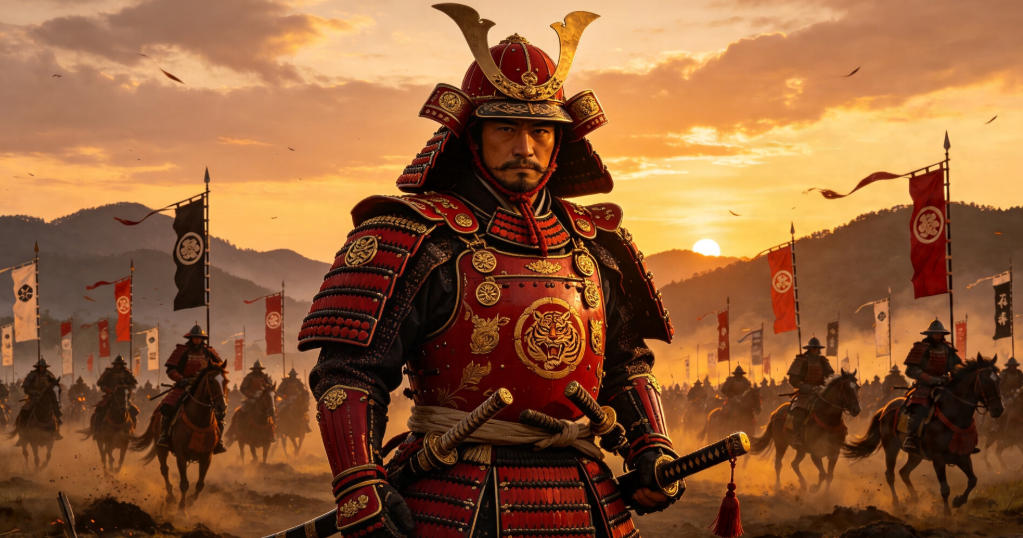
Takeda Shingen Armor: The Legend of the Red Samurai Armor
Beyond his military achievements, Takeda Shingen Armor has also become an important symbol among modern collectors.
Traditional artwork often portrays Takeda Shingen wearing impressive red samurai armor, including:
- Red Dō-maru armor (Red Samurai Armor)
- Large samurai helmet (Samurai Helmet / Kabuto)
- White fur decorations
- The famous Takeda clan crest
These elements represented not only his social status but also the power and identity of the Takeda army.
Among his most recognizable equipment is the:
Takeda Shingen Helmet
It is considered one of the most distinctive designs in Japanese samurai armor history.
Today, many samurai armor replicas, historical collectibles, and movie props are inspired by Takeda Shingen’s legendary appearance.
Takeda Shingen Sword: The Blade of a Legendary Samurai Leader
As a powerful Sengoku Daimyo, the Takeda Shingen Sword is also a popular topic among sword collectors.
Although historical records provide different accounts regarding his exact personal sword, the Japanese sword (Japanese Katana) represented the identity, honor, and authority of a samurai leader.
During the Sengoku Period, a Katana was not merely a weapon. It represented:
- Samurai status
- Clan honor
- Bushido Code
- Warrior spirit
Today, many sword enthusiasts collect Takeda Shingen Katana Replica swords as a way to celebrate the legacy of this legendary Japanese warrior.
Takeda Shingen and Bushido: The Samurai Spirit of a Legendary Warrior
Although the formal concept of Bushido Code developed later in Japanese history, Takeda Shingen’s actions reflected many traditional samurai values.
Loyalty
He valued strong relationships with his retainers and built a powerful Takeda warrior network.
Honor
He believed samurai should respect promises, responsibility, and duty.
Strategy
Instead of relying only on brute strength, he emphasized intelligence, diplomacy, and careful military planning.
These qualities made Takeda Shingen Samurai an enduring symbol of Japanese warrior culture.

Why Is Takeda Shingen Called The Tiger of Kai?
Among the many legendary Daimyo of the Sengoku Period, Takeda Shingen earned the title “The Tiger of Kai” because of his unmatched military talent, powerful army, and enormous influence on Japanese history.
This nickname represented more than his courage and battlefield strength. It reflected his strategic intelligence, leadership ability, and the respect he commanded throughout Japan.
Takeda Shingen was considered one of the greatest military commanders of the Sengoku era. Through military reforms, political strategies, and careful territorial management, he transformed Kai Province from a regional domain into one of Japan’s strongest military powers.
The “Tiger” title was also closely connected to the strength of the Takeda Cavalry. His mounted samurai forces were known for discipline, speed, and devastating battlefield charges.
During the famous Battle of Kawanakajima, the Takeda army demonstrated extraordinary tactical ability under his leadership, supported by talented generals such as:
- Yamamoto Kansuke
- Baba Nobuharu
- Yamagata Masakage
The Takeda army was not successful only because of military power, but also because of its organization, strategy, and strong leadership.
Takeda Shingen’s influence also changed the future of Japan. In 1572, he launched a western campaign and defeated Tokugawa Ieyasu at the famous Battle of Mikatagahara.
This victory proved the strength of the Takeda forces and showed that Shingen was one of the few leaders capable of challenging the ambitions of Oda Nobunaga and other powerful Daimyo.
Many historians believe that if Takeda Shingen had not died in 1573, the process of Japanese unification might have taken a completely different path.
Although the word 'Tiger' represents strength and ferocity, for Takeda Shingen it also symbolized wisdom, leadership, and political ability. Through economic reforms, legal systems, and clan management, he turned Kai into one of the most stable and powerful regions of the Sengoku Period.
His Takeda Shingen Armor, Takeda Shingen Helmet, Fūrinkazan banner, and legendary military strategies remain important symbols of Japanese samurai culture.
Hundreds of years later, Takeda Shingen is still remembered as one of Japan’s greatest samurai warriors.
Because of his extraordinary military genius, powerful Takeda army, and historical influence, he remains forever known as:
The Tiger of Kai — The Legendary Tiger of Japan’s Sengoku Era.
Takeda Shingen Legacy: The Lasting Influence of the Tiger of Kai
In 1573, Takeda Shingen passed away.
Although his life ended, his influence continued for centuries.
His military strategies, leadership philosophy, and samurai image have been preserved through:
- Japanese history books
- Movies and television dramas
- Anime
- Video games
- Samurai culture studies
Popular works such as Nobunaga’s Ambition and Samurai Warriors continue to portray Takeda Shingen as one of the most important figures of Japan’s Sengoku Period.
Today, people still celebrate his legacy through collectibles such as:
- Takeda Shingen Armor
- Takeda Shingen Helmet
- Takeda Shingen Sword
- Takeda Shingen Samurai Figure
These items allow history lovers and collectors to connect with the spirit of this legendary warrior.
Conclusion: Takeda Shingen — The Eternal Tiger of Kai
Takeda Shingen was not only a Sengoku Daimyo but also one of the most legendary figures in Japanese samurai history.
His military genius, iconic red samurai armor, powerful Takeda cavalry, and legendary rivalry with Uesugi Kenshin created a heroic image that has survived for centuries.
From the Sengoku Period Samurai era to modern popular culture, the story of The Tiger of Kai continues to inspire countless history enthusiasts.
For those who love Japanese history, samurai culture, and traditional sword collecting, Takeda Shingen is more than just a name — he represents an eternal legend of honor, warfare, strategy, and the spirit of the samurai.

