


What Makes Ninja Swords Unique? History Behind Japan’s Shadow Warriors
What Is the Real Story of Ninjas and Their Legendary Swords?
1. The Origins of Ninjas: Warriors in the Shadows
The night was dark and thick with mist, and only the occasional call of an owl echoed through the forest. Amid this silence, a figure moved effortlessly across the rooftops, blending almost completely with the shadows. It was no illusion—it was a ninja, one of the most mysterious figures in Japanese history.
During Japan’s Sengoku period (15th–17th century), a time of constant war and intrigue, samurai fought honorably on the battlefield, wielding swords as symbols of status and courage. Yet in the shadows, another group influenced the course of conflict in entirely different ways. They sought no fame or fortune—they simply completed the missions that could not be revealed. These were the ninja (Ninja).
The earliest ninja originated in the Iga and Koga regions, areas with rugged terrain and dense forests, ideal for stealth and concealment. Over time, the people of Iga and Koga developed unique survival skills: blending into the environment, masking their presence, and turning even trees and mist into weapons. From this, the two famous ninja schools emerged: Iga-ryu and Koga-ryu.
A true ninja could approach a target silently and vanish in an instant. They trained in Shinobi-iri (stealth techniques) for silent movement, Taijutsu (body techniques) for hand-to-hand combat, and mastered herbs, traps, and deception to outwit enemies. Some call them assassins; others, spies—but those who truly understand know that ninja were strategists, guardians of their own creed, thriving in darkness.
Unlike samurai who fought in the sunlight, ninja embraced the shadows. They sought no honor, only the completion of their mission. They had no battlefield, yet they never ceased fighting. This is why ninja remain one of the most enigmatic and respected groups in Japanese history.
2. The Formation of Ninja Culture: Children of a Warring Era
It was an age of blood and fire—Japan during the Sengoku period. Daimyo vied for power, conspiracies ran rampant, and countless hidden threats lurked behind every castle wall. By day, samurai wore armor and brandished swords to display loyalty; by night, ninja infiltrated enemy camps, altering outcomes in silence.
Ninja were not born—they were forged in the chaos of war. In the forests of Iga and Koga, young apprentices were trained from childhood to become “silent shadows” of the night. Their training was grueling: they learned to leap silently between branches, detect faint scents in the dark, and measure life and death by heartbeats.
They mastered Shinobi-iri, moving as quietly as falling leaves, blending their breath with the wind. A true ninja could move through a room of sleeping enemies without alerting a single one. They honed Taijutsu, using leverage and precise strikes to defeat opponents even without weapons. They studied Ninjutsu, the soul of the ninja: disguise, poison, traps, intelligence gathering—nothing was beyond their art.
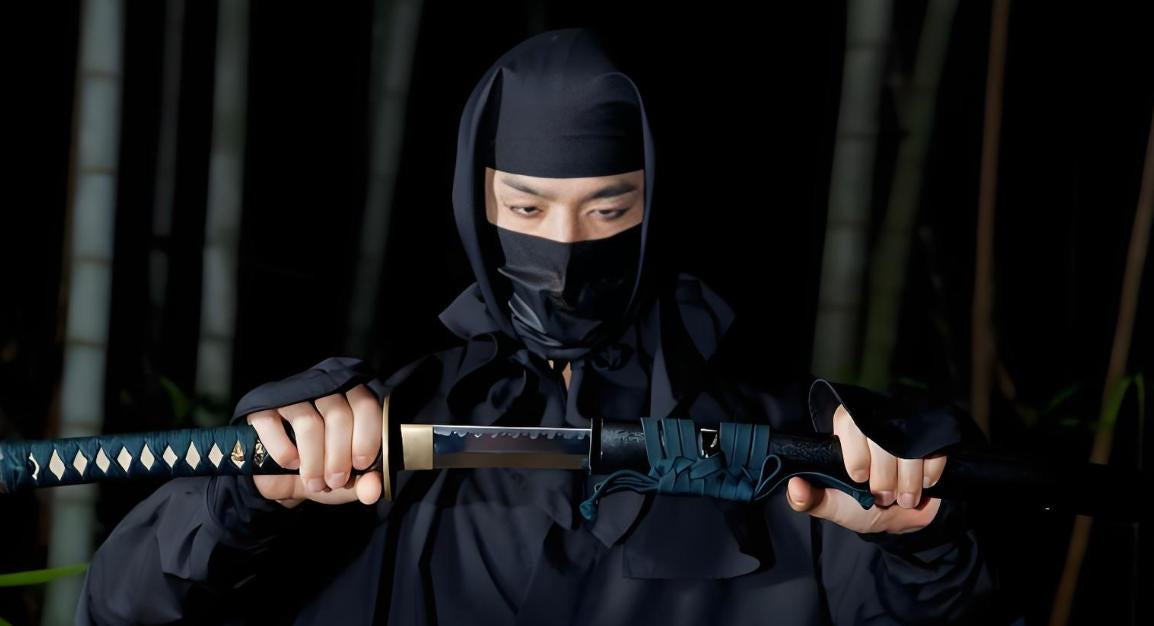
And above all, they mastered Heihō (weapon techniques). Among the many ninja tools, the most iconic was the low-profile yet deadly Ninja-to. Unlike the samurai’s curved sword, the ninja sword was shorter, straighter, and designed for practicality. Its straight blade allowed for quick drawing, while its compact length enabled precise strikes even in tight spaces. To a ninja, it was not just a weapon—it was a versatile survival tool. The scabbard could serve as a blowpipe, a rope hook, or aid in climbing walls.
Imagine a black-clad ninja infiltrating an enemy camp under the moonlight. The blade of his short, straight sword glints briefly, a flash in the darkness. No unnecessary movements, no sound—only a whisper of wind. At that moment, ninja and sword were one: swift, silent, and lethal.
It was this combination of practicality and secrecy that defined ninja culture. They sought not glory but survival. And the simple ninja sword became a symbol of their creed—sharp, silent, resilient, yet devastating in the decisive moment.

3. The Evolution of Ninja Weapons: From Tools of War to Cultural Icons
The night was the ninja’s greatest ally. Every weapon they carried could mean life or death. Unlike samurai, who fought openly, ninja weapons emphasized stealth and efficiency—they had to achieve maximum effect with minimal noise.
Early ninja tools were simple but ingenious:
-
Shuriken (throwing stars) were small, light, and could be hidden in sleeves;
-
Kunai, originally digging tools, doubled as stabbing weapons;
-
Kusarigama, chains with sickles, could entangle enemies or disarm them;
-
Even smoke bombs and mechanical traps could instantly change the outcome of an encounter.
In the hands of a ninja, these tools seemed alive. Rocks, bamboo, ropes—they could all become extensions of the warrior.
Among all ninja tools, the most symbolic was the Ninja Katana / Ninja Chokuto. Unlike the samurai katana(https://en.wikipedia.org/wiki/Katana), which emphasizes curved elegance and flowing technique, the ninja sword embodies pure practicality: straight blade, sharp edge, square guard, and often a hidden compartment in the scabbard. Its design was born from necessity, allowing fast draws, precise strikes, and maneuverability in confined spaces. The scabbard could even assist in climbing or carrying small items.
Legend tells of an Iga ninja who infiltrated an enemy camp under moonlight with only a ninja sword and a few shuriken, completing an impossible mission. The blade emitted a faint metallic hum, cold and fleeting, much like the ninja themselves—unseen, unforgettable.
As the smoke of the Sengoku battles cleared, the presence of ninja faded from history. Yet their weapons and spirit lived on, becoming a cherished part of Japanese culture. Today, ninja swords are no longer mere tools of war; they have become icons of Japanese traditional weaponry, prized by collectors for craftsmanship and history, appreciated by martial artists for balance and feel, and admired by fans and cultural enthusiasts for the spirit they represent: stealth, wisdom, and resilience.
The ninja sword’s edge now transcends the darkness of night, bridging past and present. It represents not just the shadows of war, but a tribute to tradition, skill, and the enduring legacy of the ninja.
Differences Between Katana and Ninja Sword
The difference between a katana and a ninja sword (Ninja Sword) mainly lies in their design, purpose, and historical background. The katana has a longer, slightly curved blade with a round guard, designed for two-handed grip and powerful strikes. It was the main weapon for samurai in open combat and symbolizes the spirit and honor of Bushido. In contrast, the ninja sword is usually shorter and straight, with a simple or square guard, optimized for quick, single-handed draws. It’s ideal for stealth, assassination, or use in confined spaces, reflecting versatility. Historically, katana were used by samurai emphasizing strength and precision, while ninja swords were designed for stealth, agility, and practicality. Today, katana are mainly used for martial arts training, demonstrations, and collections, whereas ninja swords are suitable for training, cutting practice, cosplay, and collecting, embodying the unique cultural style and spirit of ninjas.
4. The Modern Revival of Ninjas
In modern times, ninjas have transcended history to become an important symbol of Japanese culture. Whether in anime (https://en.wikipedia.org/wiki/Anime), movies, or games, the ninja image is highly popular.
From the classic anime Naruto to films like Ninja Assassin, and in modern martial arts or cosplay, ninja swords and ninjutsu have become a medium of cross-cultural exchange.
Today, hand-forged ninja swords (Hand Forged Ninja Sword) are not only collectible masterpieces but also represent courage and the spirit of endurance.

5. The Rebirth of the Modern Ninja Sword: Craftsmanship Meets Steel
In real weapon-making, modern artisans combine ancient forging techniques with contemporary metallurgy to redefine the sharpness and beauty of ninja swords.
With time, ninjas have become a symbol of Japanese culture, and their weapons—ninja swords (Ninja-to / Ninja Chokuto)—have been reborn through modern craftsmanship. Today, master swordsmiths combine hand-forging techniques with high-temperature metal treatment to recreate the hidden sharpness that once prowled the night.
In real weapon-making, artisans no longer just replicate old swords; they use higher-quality steel (https://en.wikipedia.org/wiki/Steel) and precise heat treatment to craft swords suitable for training, battle practice, and display. Each sword reflects the artisan’s spirit and cultural belief.
One highly praised example is:
Hand Forged Japanese Ninja Chokuto Sword 1095 High Carbon Steel Iron Tsuba Black Saya
This hand-forged Japanese Ninja Chokuto is crafted from premium 1095 high carbon steel, known for its hardness, long-lasting sharpness, and excellent toughness, making it ideal for a real ninja sword (Real Ninja Sword). The blade is straight and sharp, with evenly flowing edges, perfectly capturing the speed and precision sought by historical Japanese ninjas.
The iron tsuba (guard) and black saya (scabbard) give it a striking, mysterious combat appearance. The full tang construction ensures blade stability, able to withstand intense training and cutting tests, making it a true battle-ready ninja sword (Battle Ready Katana).
This is not just a handmade ninja sword (Handmade Ninja Sword) but also a piece of Japanese traditional weapon art. Whether you are a history-focused collector or an anime enthusiast, this sword allows you to experience the spirit and craftsmanship of the ninja passed down since the Sengoku era.
Brands like COOLKATANA’s MangaKatana Ninja Sword series exemplify this blend of tradition and modernity, offering realistic structure, exquisite craftsmanship, and cultural authenticity, making them a top choice for collectors.

6. Cultural Value and Collecting Significance
The ninja sword is more than a weapon; it symbolizes stealth, intelligence, and courage. Collecting a hand-forged ninja sword is like preserving a piece of Japanese history.
For martial artists, it is a companion for training and meditation;
For collectors, it is a fusion of art and craftsmanship;
For anime and game fans, it is a bridge connecting fantasy and reality.
Today, professional brands like MangaKatana use high-temperature forging and traditional polishing techniques to revitalize the ninja sword. Each sword is not merely a weapon but a tribute to history.
7. Conclusion
From warriors in the shadows to modern cultural icons, ninjas represent not just strength and speed but also the philosophy of “winning with intelligence”.
A high-carbon steel Ninja Chokuto embodies centuries of Japanese sword-making techniques and the essence of ninja culture. Whether used as a collector’s piece, training sword, or cultural display, it carries deep history and unique aesthetics.
Hand-forged ninja swords are not just sharp blades—they are the legacy of the ninja spirit.

