


Arabian Scimitar Meaning, Craftsmanship & Cultural Legacy Explained
- โพสต์โดย COOLKATANA
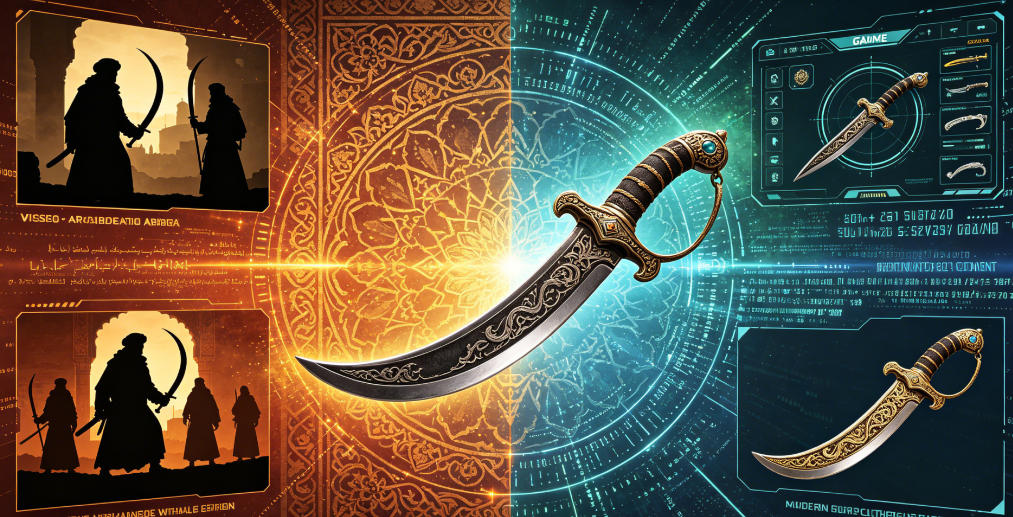
What Is an Arabian Scimitar and Why Is It So Famous in History and Modern Culture?
In the world of historical cold weapons, the scimitar (curved sword) stands as one of the most iconic blade types. It appears throughout the military history of the Middle East, Persia, and the Ottoman Empire, while also influencing modern films, games, and the collectible weapon market. With its distinctive curved blade and exceptional cutting performance, the Arabian scimitar has become a symbol of speed, power, and precision.
This article explores scimitar meaning, historical development, structural design, forging techniques, and modern collecting value, enriched with high-search-volume keywords and long-tail SEO terms.
1. What Is the Meaning of Scimitar?
In search contexts, scimitar meaning usually refers to a basic definition: a single-edged, outwardly curved Middle Eastern-style sword (curved sword) known for its cutting efficiency and iconic blade shape.
However, from a weapon classification perspective, 'scimitar' is not a single specific sword type. Instead, it is a general term describing a family of curved blades developed across different regions, including the Arabian Scimitar, Persian Shamshir, and Ottoman Kilij. While each has unique structural variations, they all share a core design logic: optimizing mounted combat efficiency through curved geometry.
Structurally, scimitars typically feature a single-edged blade (single-edged blade), a pronounced curved blade design, and a forward-shifted balance point that enhances cutting momentum. This makes them ideal for cavalry combat scenarios rather than thrusting attacks.
Therefore, scimitar meaning goes beyond 'curved sword' as a literal translation—it represents a fusion of tactical evolution and weapon design philosophy: a cutting-focused system optimized for speed, mobility, and mounted warfare. In historical context, it symbolizes the military culture of the Middle East and Eurasia, while in modern usage it is widely associated with fantasy media and collectible swords.

2. Historical Origins and Development of the Arabian Scimitar
The Arabian scimitar can be traced back to the Islamic Golden Age (7th–12th century), a period when warfare in the Middle East and Central Asia transitioned from infantry-based combat to highly mobile cavalry warfare. During this shift, straight swords gradually revealed limitations in mounted combat, such as inefficient cutting angles and slower follow-up strikes, leading to the evolution of curved blade systems.
As cavalry warfare became dominant, scimitar-type weapons replaced straight swords as primary battlefield equipment. This era marked the rise of Middle Eastern cavalry weapons, where curved blades significantly improved cutting efficiency during high-speed charges. The curved geometry allowed riders to strike more naturally from horseback while maximizing slashing impact through a draw-cut motion.
During the later Islamic Golden Age, advancements in metallurgy and military engineering led to the systematic evolution of Islamic curved swords history, where weapons were no longer just tools of war but also expressions of craftsmanship and identity. This period played a crucial role in the broader Arabian sword evolution, shaping some of the most recognizable blade forms in history.
By the Ottoman Empire period, the Kilij reached its peak development, featuring a more pronounced curvature and a widened tip design that increased both cutting power and penetration. This stage represents the highest level of integration between weapon design and battlefield strategy in the entire scimitar tradition.
Throughout its evolution, the scimitar was never just a weapon form—it became a cultural symbol representing warrior identity, honor, and authority across Middle Eastern and Eurasian civilizations.
3. Scimitar Design: Why Is It So Effective?
The effectiveness of the scimitar comes from its scientifically optimized structure.
1. Curved Blade Geometry
The curved blade is not decorative but functional:
- Improves cutting angles
- Enhances draw-cut efficiency
- Reduces air resistance for faster swings
This structure significantly increases lethality during mounted combat.
2. Single-Edged Blade Design
Compared to double-edged swords, the scimitar offers:
- Lighter weight
- Stronger structural concentration
- Easier maintenance and sharpening
This makes it a highly practical battlefield weapon.
3. Forward Balance Point
The blade’s weight is shifted toward the front:
- Increases cutting momentum
- Enhances impact force
- Improves sweeping attacks from horseback
This gives it a clear advantage in 'curved sword vs straight sword' comparisons.
4. Guard and Handle Design
Traditional Arabian scimitars typically include:
- Simple guards to reduce recoil injury
- Wooden or bone handles
- Leather wrapping for better grip stability

4. Hand Forging Craftsmanship: How Is a Scimitar Made?
Modern high-end collectible scimitars are often recreated using traditional forging techniques that balance historical authenticity with artistic value.
1. Hand Forged Scimitar
Hand forging is the foundation of scimitar production:
- Repeated heating and forging cycles
- Removal of internal impurities
- Improved structural density and toughness
In the collectible market, keywords like hand forged scimitar for sale are commonly used to reflect demand for authentic craftsmanship.
2. Damascus Steel Scimitar
Damascus steel is one of the most searched-for categories in modern blade culture. It is created through layered forging, producing unique wave-like patterns on the blade surface while balancing hardness and flexibility.
Key properties include:
- Layered forging creates distinctive patterns
- Balanced hardness and toughness
- High aesthetic and collectible value
Common long-tail keywords include damascus scimitar sword handmade, patterned steel curved sword, and high carbon damascus sword replica, reflecting strong demand for craftsmanship, visual design, and replica quality.
3. Heat Treatment
Heat treatment determines final performance:
- Quenching: increases hardness
- Tempering: improves toughness
- Polishing: enhances sharpness and appearance
4. Full Hand Finishing
Final finishing ensures balance and visual perfection:
- Blade alignment for cutting stability
- Balance adjustment for smoother handling
- Hand-carved detailing for historical aesthetics
5. Scimitar in Modern Culture
Today, the scimitar is not only a weapon but also a cultural symbol.
Film & Literature
Commonly appears in:
- Middle Eastern epic films
- Fantasy adventure worlds
- Desert civilization storytelling
It is often used as:
- Commander’s weapon
- Villain boss signature blade
- Legendary hero sword
Gaming Culture
In games, scimitars are often featured as:
- Dexterity-based weapons
- Desert faction equipment
- Rare loot items
Collectibles Market
Modern uses include:
- Cold weapon collections
- Display and decoration
- Martial arts performance props
6. Conclusion: The Scimitar as a Symbol of Civilization
From the linguistic interpretation of scimitar meaning, to its historical evolution and modern Damascus steel craftsmanship, the Arabian scimitar remains a timeless fusion of speed, power, and artistry.
It is not merely a battlefield weapon, but a cultural artifact that reflects centuries of technological evolution and artistic refinement.

