


Kusanagi Sword: History, Myth & Cultural Significance of Japan’s Blade
What is the Kusanagi Sword and Why is it Japan’s Legendary Sacred Weapon?
In Japanese mythology and cultural history, the Kusanagi sword is revered as one of the most legendary weapons. This sword is not only a divine weapon in myth but also a crucial symbol of imperial authority in Japan. From its mythological origins and cultural significance to its historical importance, kusanagi no tsurugi transcends the status of an ordinary weapon.
This article provides a comprehensive analysis of kusanagi, kusanagi-no-tsurugi, kusanagi no tsurugi, exploring its legendary origins, cultural symbolism, and historical significance in Japan.
1. What is the Kusanagi Sword?
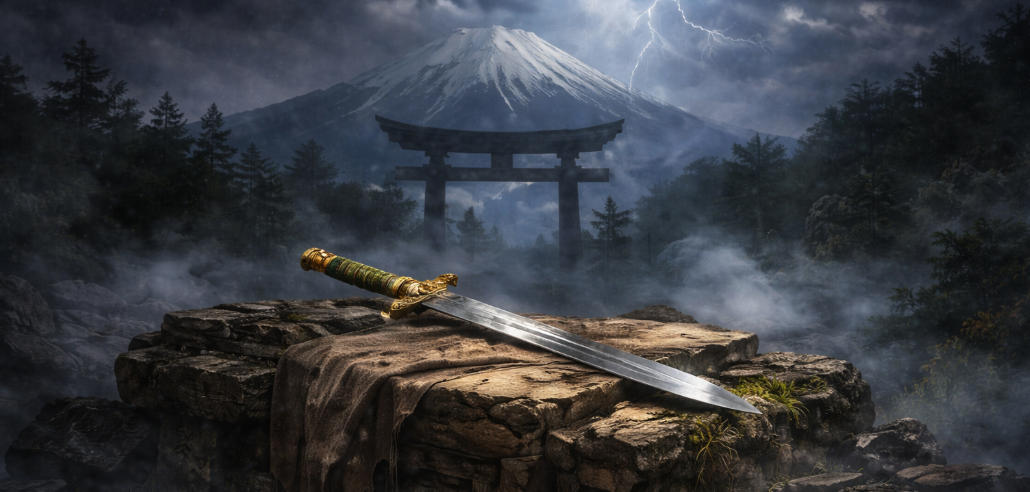
Kusanagi (草薙剑), fully named kusanagi-no-tsurugi, literally means 'Grass-Cutting Sword' and is one of Japan’s most iconic legendary weapons. As an ancient 'straight sword' (tsurugi), its design differs significantly from the curved samurai swords (katana) familiar today. It is closer to an early double-edged straight sword, emphasizing thrusting and basic cutting capabilities.
From a weapons development perspective, kusanagi no tsurugi represents a typical form of Japan’s early metal weaponry. Before swords evolved into the familiar curved form, straight swords like this were suitable for ceremonial, symbolic, and combat purposes, reflecting Japan’s early metallurgy and weapon-making skills.
However, the true value of the Kusanagi sword goes far beyond its physical form. It is listed among Japan’s Three Sacred Treasures (Sanshu no Jingi), alongside the Yata no Kagami (mirror) and Yasakani no Magatama (jade jewel), holding immense cultural and political significance. Together, these three sacred treasures symbolize imperial legitimacy:
- Kusanagi sword (kusanagi-no-tsurugi) — symbolizes courage and martial power
- Yata no Kagami — symbolizes wisdom and truth
- Yasakani no Magatama — symbolizes benevolence and authority
In traditional Japanese thought, these treasures represent not only power itself but also the 'divine mandate' and the concept of 'god-granted rule.' Therefore, kusanagi no tsurugi is seen as a vital link between the mythological realm and earthly authority, underscoring the emperor’s legitimacy.
Additionally, the sword has long been enshrined in Shinto shrines and rarely displayed, a secrecy that further enhances its sacred aura. For many, the Kusanagi sword is not just a historical artifact but a cultural symbol spanning millennia, embodying Japanese mythology, faith, and national identity.
From myth to reality, kusanagi, kusanagi-no-tsurugi, kusanagi no tsurugi has become more than just a sword’s name; it represents 'divine power and legitimate rule.'

2. The Mythological Origins of Kusanagi-no-Tsurugi
The Yamata no Orochi Legend
The most well-known origin story of kusanagi no tsurugi comes from Japanese mythology, a tale rich with divinity and heroism.
Legend has it that the storm god Susanoo was exiled from Takamagahara (the High Plain of Heaven) and descended to the human world. He encountered an elderly couple whose daughter was to be devoured by the monstrous Yamata no Orochi (Eight-Headed Serpent). To save her, Susanoo devised a clever plan, using strong sake to intoxicate the serpent, then slew it.
Upon cutting open the serpent’s tail, Susanoo discovered an extraordinarily sharp sword — the weapon later known as Kusanagi sword.
This sword was originally named:
👉 Ame-no-Murakumo-no-Tsurugi
'Ame-no-Murakumo' symbolizes the heavens and divine realm, marking the sword as a sacred artifact beyond the mortal world. Susanoo then presented the sword to his sister, the sun goddess Amaterasu, as a gesture of reconciliation. This act not only repaired divine relations but also established kusanagi-no-tsurugi as a symbol of divine authority.
The Origin of the Name 'Kusanagi'
The name 'kusanagi' comes from another legendary hero, Yamato Takeru, transforming the sword from a divine weapon to a hero’s blade.
According to legend, during Yamato Takeru’s expedition, he was trapped in an enemy ambush where the surrounding grasslands were set ablaze. In a desperate moment, he used kusanagi no tsurugi to cut through the grass, redirecting the flames with the wind, and successfully escaped.
This heroic feat gave the sword its name — 'Grass-Cutting Sword' (Kusanagi).
This story enhanced the sword’s practical and symbolic value, imbuing it with deeper cultural meaning:
- ⚔️ Wisdom and courage combined — relying on judgment as much as strength
- 🔥 Mastery over natural forces — interaction between humans and nature
- 👑 Symbol of heroic destiny — bridging divine myth and human legend
Extending Mythological Significance
From the Yamata no Orochi to Yamato Takeru, the narrative of kusanagi, kusanagi-no-tsurugi, kusanagi no tsurugi follows a “God → Human → Royal Power” progression:
- Originates with the deity (Susanoo)
- Transferred within the divine realm (Amaterasu)
- Used by a human hero (Yamato Takeru)
This layered succession makes kusanagi sword more than a weapon; it is a core symbol connecting myth, heroism, and national power.
Through these legends, kusanagi no tsurugi transcends the scope of a sword, representing 'divine power, heroic spirit, and pivotal destiny,' which explains why it remains one of the most mysterious legendary swords even today.
3. Kusanagi Sword and Japanese Imperial Authority
Kusanagi-no-tsurugi is a key symbol of Japanese imperial authority.
As one of the Three Sacred Treasures, it represents:
- ⚔️ Courage
- 👑 Legitimacy of rule
- 🔥 Divine authority
Traditionally, the sword embodies the emperor’s power, holding immense sacred significance. It is usually enshrined in Shinto shrines, rarely displayed, and thus enveloped in mystery.
4. Cultural Significance and Symbolism of Kusanagi
🌸 Beyond a Weapon: Spiritual Symbolism
Unlike ordinary swords, the Kusanagi sword functions as a cultural icon:
- Represents heroism and courage
- Embodies the struggle between humans and natural forces
- Reflects the fusion of myth and reality
It is more than a combat tool; it carries spiritual and religious weight.
🎎 National Identity and Mythological System
Kusanagi no tsurugi has deep cultural influence in Japan:
- Featured in ancient texts and mythological systems
- Closely associated with Amaterasu’s mythology
- An essential symbol of imperial succession
It has become an integral part of Japanese cultural identity.
5. The Mystery of Kusanagi’s True Form
Despite its fame, the actual appearance of kusanagi-no-tsurugi remains a mystery. This “invisibility” enhances its legendary status.
Based on historical records and academic conjecture, the sword likely has the following features:
- Length around 80 cm — typical of ancient straight swords
- Overall shape resembles an iris leaf — long and slightly tapering
- Prominent central ridge — strengthening structure and thrusting ability
These descriptions suggest kusanagi no tsurugi was likely an early double-edged straight sword (tsurugi), rather than a curved katana. Its design emphasizes symbolic and ceremonial use more than practical combat.
Unlike other historical swords, Kusanagi has never been publicly displayed or fully documented. According to tradition, it remains enshrined and sacred, rarely seen even during important ceremonies.
This secrecy has several impacts:
- 🔍 Historical authenticity is difficult to verify
- 👁️ Enhances divine authority — invisibility reinforces its sacred status
- 📜 Legends continue to evolve — multiple versions enrich its imagery
In short, its unseen nature allows kusanagi-no-tsurugi to remain a timeless symbol shaped by imagination and faith.

6. Kusanagi in Modern Culture
In modern society, the Kusanagi sword has transcended Japanese mythology to become a global cultural symbol.
🎮 Iconic Weapon in Anime and Games
'Kusanagi' frequently appears in anime and games, often depicted as a 'most powerful weapon' or 'divine gear,' such as:
- Final Fantasy series — high-tier weapon
- Metal Gear Solid — high-tech weapon named Kusanagi
- Naruto — a powerful sword with special abilities
These works bring kusanagi no tsurugi from traditional myth into global youth culture, making it a symbol of legendary weaponry.
🎬 Symbolism in Film and Pop Culture
In film and literature, the Kusanagi sword often represents:
- Mystery and lost power
- Heritage of ancient civilizations
- Crucial tool in a hero’s destiny
Its name carries strong cultural recognition, making it a central element for world-building.
🗡️ Collecting and Exhibition Value
With growing global interest in historical weapons and Japanese culture, Kusanagi sword has become a popular collectible. While the real kusanagi-no-tsurugi is enshrined and untouchable, artisans and cultural institutions have created high-quality replicas that allow people to experience the sword’s allure:
- Materials — high-carbon steel, alloy steel, or Damascus steel for sharpness and durability
- Craftsmanship — faithful to myth and historical descriptions, with intricate engraving and decoration
- Educational and cultural insight — studying replicas provides understanding of ancient Japanese sword culture, mythological heritage, and ceremonial significance
- Display and decoration — used in museums, cultural events, or private collections as a prominent cultural symbol
🌏 Global Cultural Symbol
Today, Kusanagi has transcended Japanese borders, becoming synonymous with 'legendary sword' worldwide:
- In Japanese cultural promotion, it symbolizes divine power and imperial legitimacy
- In international anime, games, and films, it represents 'mystery, power, and heroic spirit'
- Among collectors and weapon enthusiasts, replicas serve as a bridge to study ancient weapon design, mythology, and craftsmanship
Its cultural value spans history, modernity, reality, and fantasy, keeping kusanagi no tsurugi relevant and legendary.
🔹 Summary
From mythological origins and heroic legends to modern cultural influence, kusanagi, kusanagi-no-tsurugi, kusanagi no tsurugi is more than a weapon. It is a cultural emblem, a historical legacy, and a bridge for global cultural exchange. Its mystery, legend, and symbolic power make it the most story-rich and influential sword among Japan’s Three Sacred Treasures.
7. Conclusion: The True Significance of Kusanagi
Kusanagi, kusanagi-no-tsurugi, kusanagi no tsurugi is far more than a weapon.
It symbolizes:
- The fusion of myth and history
- The combination of power and faith
- The core spirit of Japanese culture
From mythological tales to imperial symbolism to modern cultural impact, this sword continues to captivate across millennia.
If there is a sword in the world that truly represents the pinnacle of 'mythical weaponry,' the Kusanagi sword is undoubtedly one of the most iconic examples.

