


Toyotomi Clan Red Samurai Armor Inspired by Sengoku Power and Legacy
Why Did Toyotomi Hideyoshi’s Red Samurai Armor Symbolize Sengoku Power?
Toyotomi Clan Red Samurai Armor: A Tribute to Japan's Sengoku Hero
Toyotomi Hideyoshi (Toyotomi Hideyoshi) is one of the most legendary figures of Japan’s Sengoku period. Rising from a low-ranking foot soldier in the Oda clan, he eventually unified Japan and became one of the “Three Great Heroes of the Sengoku Era.” His intelligence, courage, and leadership continue to be celebrated to this day. The Toyotomi Clan Red Samurai Armor is inspired by Hideyoshi’s remarkable history, crafted as a high-end samurai armor replica that combines historical authenticity and artistic value, paying homage to the achievements of this Sengoku hero.
Legend of the Sengoku Era: The Rise of Toyotomi Hideyoshi
Toyotomi Hideyoshi (1536–1598), originally named Kinoshita Toukichirou, was born into a poor peasant family in Owari Province (modern-day Aichi Prefecture). Losing his father at a young age, he came from humble beginnings but relied on exceptional intelligence and unwavering determination to forge a legendary life. As a youth, he worked as an apprentice and laborer in local temples and shops, yet he never stopped learning, studying military strategy and etiquette to gradually demonstrate remarkable organizational skills and insight.
As a young man, he joined the ranks of Oda Nobunaga, participating in key battles such as the Battle of Okehazama and the Battle of Nagashino. Not only was he a capable battlefield commander, but he also managed logistics and military administration, quickly earning Nobunaga’s trust. Rising from a low-ranking soldier to a key general, he became instrumental in Nobunaga’s campaign to unify Japan.
In 1582, following the assassination of Oda Nobunaga in the Incident at Honnō-ji, the Sengoku period plunged into chaos. Hideyoshi showcased exceptional political and military acumen, swiftly defeating Akechi Mitsuhide and consolidating power and prestige. Through a series of strategic maneuvers and military campaigns, he gradually eliminated regional rivals, achieving de facto unification of Japan. By 1590, he conquered the Hojo clan at Odawara, marking the end of the Sengoku period and solidifying the Toyotomi family’s rule.
Hideyoshi was not only a military genius but also an outstanding politician and reformer. He implemented the Taikō land surveys, re-measuring land and standardizing taxation to stabilize the national economy. He oversaw the construction of the magnificent Osaka Castle, which became a political, military, and economic center. His policies, such as separating soldiers from farmers, limited the abuse of power by samurai, laying the foundation for social order during the later Edo period.
Beyond politics and warfare, Hideyoshi valued culture and diplomacy. He promoted the development of tea ceremonies, received envoys from Ming China and Korea, and sought to stabilize foreign relations through diplomacy. His passion for the arts ensured that Sengoku-era Japan was not only militarily powerful but also culturally flourishing.
Even though the Toyotomi clan eventually declined after the Siege of Osaka, Toyotomi Hideyoshi remains one of the most important rulers in Japanese history. His story inspires generations: regardless of humble origins, one can change their destiny through wisdom, courage, and vision, creating a legendary life.

The History and Symbolism of Samurai Armor
In traditional Japanese samurai culture, “Yoroi / Gusoku” (samurai armor) was not only battlefield protection but also a symbol of a samurai’s status, honor, and family heritage. Since the Heian period, samurai have worn armor in battle, and during the Sengoku period, as feudal lords fought for dominance, armor design became increasingly intricate and diverse.
During the Sengoku era, armor evolved from simple plate and leather designs to iron-and-leather lamellar armor (Okegawa-do) and lighter, more flexible chain-and-plate types (Kikko-do) to accommodate highly mobile combat. Helmets (Kabuto), shoulder guards (Sode), arm guards (Kote), and chest plates (Do) not only offered protection but also reflected the wearer’s family status and warrior spirit. Helmets often featured decorative crests and family mon (emblems), symbolizing honor, bravery, and loyalty—key identifiers of a samurai’s status.
Beyond functionality, samurai armor was highly artistic. Colors, lacquer finishes, cord bindings (Odoshi), and intricate carvings reflected the craftsmanship of Japanese artisans. Different regions and families had distinctive styles, with color symbolism playing a major role: red armor often represented courage and glory, while black armor conveyed authority and power.
What is the rarest samurai armor?
The rarest samurai armor typically refers to pieces that are historically scarce, uniquely crafted, or closely associated with famous samurai. Some of the most notable include:
-
Oda Nobunaga’s Armor
As one of the most legendary Sengoku lords, the number of armors used by Nobunaga is extremely limited. Most have been lost or are preserved in museums, making original pieces incredibly rare. -
Toyotomi Hideyoshi’s Red Samurai Armor (Toyotomi Clan Red Armor)
Hideyoshi’s armor, with its red lacquer symbolizing courage and authority, is historically scarce and considered a prized collectible. While modern replicas exist, authentic historical pieces are extremely rare. -
Tokugawa Ieyasu’s Armor
As the founder of the Tokugawa shogunate, Ieyasu’s armor is both scarce and exquisitely crafted, symbolizing family power and ruling authority. -
Specially Custom-Made Armor
Some armors were custom-designed for specific battles or ceremonies, featuring gold, silver, or intricate carvings. These are extremely limited in number and highly valuable.
In general, the rarest samurai armors share these characteristics: used by historical figures, made with unique materials or colors, exquisitely crafted, and extremely limited in existence. For collectors and history enthusiasts, such armors are more than battlefield gear—they are tangible symbols of culture and history.
Toyotomi Clan Red Samurai Armor: A Perfect Fusion of History and Craftsmanship
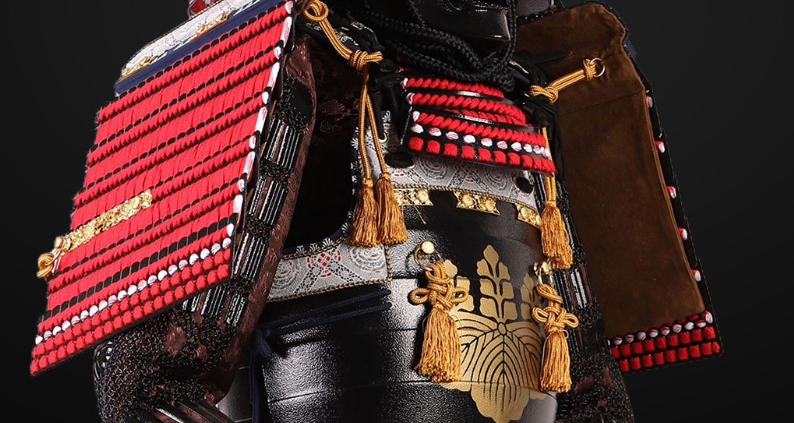
The Toyotomi Clan Red Samurai Armor is a heartfelt recreation of Toyotomi Hideyoshi and his family’s history, perfectly blending traditional Sengoku-period samurai armor craftsmanship with modern production techniques. Each set is meticulously handcrafted by experienced artisans using high-quality metals, fine fabrics, and durable lacquer finishes, faithfully reproducing the authentic structure of Sengoku-era armor while achieving exceptional attention to detail.
The armor’s red lacquer symbolizes the honor and courage of the Toyotomi clan. Every cord (Odoshi) is carefully woven, ensuring both durability and comfort for the wearer. The helmet’s design draws inspiration from the Toyotomi family crest and Sengoku-era warrior headgear. Intricate horns, curves, and carvings not only create a striking aesthetic but also convey the wearer’s authority and status. Layered designs on the shoulder guards and chest plate enhance protection while reflecting the mobility and combat readiness of a battlefield samurai.
Additionally, this armor offers both collection and display value. Whether for historical reenactments, museum exhibitions, film productions, or cosplay, it vividly showcases the splendor of Sengoku-period samurai. Beyond being a functional replica, it is a work of art, carrying the Toyotomi family’s historical legacy and the essence of traditional Japanese samurai culture.

The Symbolism of the Bright Red Lacquer
The bright red lacquer not only adds visual appeal but also represents status and power. In Sengoku-era Japan, red symbolized courage, honor, and the indomitable spirit of the samurai, making the wearer stand out on the battlefield. Red also reflects the authority and prestige of the Toyotomi clan, highlighting the wearer’s distinguished status and combat determination. Historically, red armor was often reserved for high-ranking generals, used not only in battle but also in ceremonies to demonstrate samurai honor.
Moreover, the lacquer serves a practical purpose, providing corrosion and rust resistance. Multiple lacquer layers form a protective surface, enhancing durability and visual impact, ensuring the wearer stands out with valor and commanding presence.
Traditional Cord Craftsmanship and Detail Design
The armor employs traditional cord weaving (Odoshi) techniques using silk or leather, creating a sturdy, layered structure. Every cord is carefully selected and handwoven, ensuring durability while maintaining comfort and flexibility. Shoulder guards (Sode), arm guards (Kote), and the chest plate (Do) are connected through cords, offering mobility and a visually rich, layered appearance.
The helmet (Kabuto) draws inspiration from the Toyotomi family crest and Sengoku-era warrior headgear. Its horns and curves are carefully designed to be both aesthetically pleasing and authoritative. Small details, such as metal rivets, openwork carvings, and family crests (Mon), are all handcrafted, showcasing the exquisite skill and cultural depth of traditional Japanese craftsmanship.
Functionality and Display Value of This Collectible Samurai Armor
This Sengoku-era samurai armor collectible is not only a beautiful historical replica but also practical and valuable for collectors. It is suitable for historical reenactments, museum exhibitions, film production, cosplay, and high-end themed events. Each set comes with a black lacquer display box and stand for safe storage and presentation, making it a centerpiece wherever it is displayed.
As a collectible, this armor embodies the majesty and artistry of samurai culture while allowing people to experience the history of the Sengoku period firsthand. Whether for samurai enthusiasts, history collectors, or film production teams, this armor perfectly conveys the courage and glory of Sengoku warriors, becoming an important piece in preserving traditional Japanese culture.
Why Choose COOLKATANA’s Toyotomi Clan Samurai Armor?
-
Highly Accurate Historical Reproduction: This armor is designed based on historical references of Toyotomi Hideyoshi and his family, faithfully recreating the structure and wearing method of Sengoku-period armor. Every chest plate, shoulder guard, and helmet curve is proportionally accurate, allowing the wearer to feel the weight and cultural significance of history.
-
Exquisite Handcrafted Quality: Each set is handcrafted by skilled Japanese artisans using premium metals, silk, and durable lacquer. The handwoven cords (Odoshi) ensure stability and flexibility, showcasing traditional Japanese craftsmanship. Every detail—from helmet engravings to layered shoulder plates—is meticulously executed, combining beauty and functionality.
-
Symbol of Samurai Honor: The red lacquer not only creates visual impact but also symbolizes the authority, courage, and honor of the Toyotomi clan. Wearing this armor reflects the resilience, bravery, and indomitable spirit of Sengoku-era samurai, providing collectors and exhibitors with a profound sense of historical and cultural immersion.
-
Versatile for Multiple Scenarios: This armor is ideal for high-end collections, historical displays, museum exhibitions, as well as film production, themed events, cosplay, and historical reenactments. Whether displayed in a private collection or used in cultural exhibitions, it commands attention, reflecting the dignity of Sengoku samurai armor.
-
Collectible Value and Cultural Legacy: As a piece with both artistic and historical value, this Toyotomi Clan Red Samurai Armor is more than a beautiful work of art—it is a vessel of history. Collecting it allows one to experience the spirit of Japan’s Sengoku warriors while appreciating cultural heritage, making it a treasured item for history enthusiasts, samurai culture lovers, and collectors.
Handmade Life Size Yoroi,Takeda Clan Red Samurai Armor With Kuro Kuwagata Helmet

Conclusion
The Toyotomi Clan Red Samurai Armor is not only an exquisite work of art but also a vivid recreation of history and cultural heritage. It allows us to appreciate the artistry of Sengoku-period samurai armor while experiencing the power and charm of Toyotomi Hideyoshi’s legendary life. Whether for collection, display, or historical reenactment, this armor becomes a cherished treasure for samurai culture enthusiasts and history buffs, offering a unique aesthetic and historical experience.

