


What Is a Full Tang Blade? Structure, Benefits & Buying Guide
- โพสต์โดย COOLKATANA
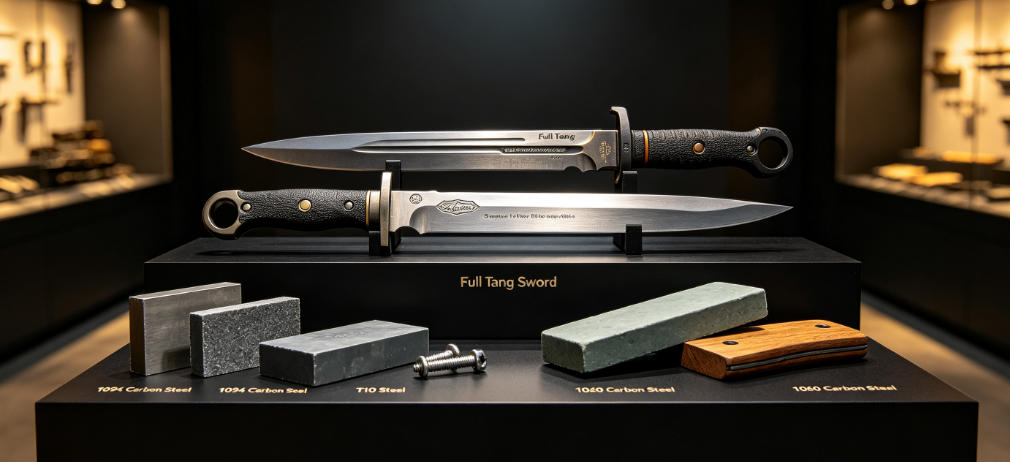
What Is a Full Tang Blade and Why Is It Important for a Quality Knife or Sword?
In the world of sword culture and modern knife manufacturing, Full Tang is one of the most important standards for evaluating the quality, durability, and structural reliability of a blade. Whether it is a traditional Samurai Sword, a medieval European sword, a survival knife, or a modern handmade blade, Full Tang design represents a stronger, more stable, and professional approach to weapon construction.
For sword collectors, outdoor enthusiasts, and anyone who values high-quality blades, understanding what a Full Tang Blade is can help determine the true quality of a knife or sword while also revealing the engineering principles behind its design.
Many people believe that the quality of a blade mainly depends on sharpness or steel type. However, the internal structure of a weapon plays an equally important role. A blade made from premium steel but built with a weak connection between the blade and handle may not withstand long-term use. In contrast, a blade with Full Tang Construction creates a much stronger and more integrated structure between the blade and handle.
Today, keywords such as full tang knife, full tang sword, full tang katana, and what is full tang blade are becoming increasingly popular in the global knife and sword market because more users are paying attention to structural design rather than appearance alone.
What Is a Full Tang Blade?
A Full Tang Blade is a high-strength blade construction where the steel extends from the blade tip all the way to the end of the handle, running completely through the grip area and forming a unified blade structure.
Simply put, the blade and handle are not separate components connected by a small joint. Instead, the blade steel continues through the entire handle, creating one continuous piece of metal.
A complete sword or knife usually consists of several main parts:
- Blade – The sharpened cutting portion of the weapon
- Tang – The extended steel section that connects the blade to the handle
- Handle – The gripping area used by the wielder
- Pommel – The end piece of the handle, often used for balance and decoration
In many standard knife designs, the blade steel only extends partially into the handle and is attached through a smaller connecting section. However, a Full Tang design means that the steel continues throughout the entire handle, allowing the blade, neck, and internal handle structure to form a strong continuous unit.
The biggest advantage of this design is that it reduces weak points between the blade and handle. When a sword or knife experiences forces such as impact, chopping pressure, or twisting stress, a Full Tang structure distributes the force more evenly across the entire steel body instead of concentrating stress in one small connection area.
Compared with traditional partial structures, a Full Tang Blade usually provides:
- Higher overall strength: The continuous steel structure can withstand greater impact and reduces the risk of blade breakage or handle failure.
- Better impact resistance: Full Tang construction provides more stable performance during cutting, chopping, and heavy-duty use.
- Improved weight balance: The extended steel structure creates a more natural balance between blade and handle, improving control and handling.
- Longer service life: A stronger one-piece structure reduces damage caused by long-term use.
Because of these advantages, Full Tang has become an important quality standard recognized by professional bladesmiths, outdoor users, and sword collectors.
Whether it is a Full Tang Knife, Full Tang Sword, or a modern Full Tang Katana, this construction represents stronger craftsmanship and higher performance requirements.

Why Is Full Tang Construction Stronger?
During use, swords and knives experience many different types of forces, including:
- Impact force from cutting
- Centrifugal force during swinging
- Pressure caused by blade collisions
- Twisting forces during movement
If the connection between the blade and handle is weak, long-term stress may cause problems such as:
- Loose handles
- Bent blades
- Structural failure
- Blade separation
The advantage of a Full Tang Blade is that it allows force to travel through the entire steel structure more efficiently.
When the blade receives impact, the force is distributed throughout the full length of the steel instead of being concentrated at one weak point. This significantly improves structural stability and reduces the chance of failure.
This is why many professional tools and weapons, including:
- Full Tang Survival Knife
- Hunting Knife
- Bushcraft Knife
- Full Tang Sword
often use this type of construction.
The History of Full Tang: From Traditional Weapons to Modern Knives
Although Full Tang is a commonly used technical term in modern knife manufacturing, the concept of creating a strong connection between the blade and handle has existed throughout human weapon history.
Ancient craftsmen understood an important principle very early:
A weapon should not only be sharp — it must also have a reliable and durable structure.
In medieval Europe, high-quality swords used by knights often featured a long Tang that extended into the handle. The blade steel continued through the grip area and was secured with methods such as riveting and pommel fastening.
This design allowed swords to withstand the intense forces of medieval combat, including:
- Sword-to-sword impacts
- Shield collisions
- Powerful cutting movements
- Long periods of battlefield use
A strong tang structure was essential because a sword failure during combat could be life-threatening.
Full Tang Concepts in Traditional Japanese Swords
Traditional Japanese swords also contain a similar structural concept.
One of the most important parts of a Japanese sword is the:
Nakago (茎)
The Nakago is the extended section of the blade that enters the handle.
Unlike modern visible Full Tang designs, traditional Japanese swords usually hide the tang inside the wooden handle. The blade is secured through several traditional components, including:
- Mekugi (目釘) – Bamboo retaining pin
- Tsuka (柄) – Sword handle
- Samegawa (鮫皮) – Ray skin handle wrapping
- Tsuka-Ito (柄糸) – Traditional handle wrapping cord
This system allows the sword blade to remain firmly connected while maintaining the traditional appearance and balance of the katana.
Although the traditional Japanese sword tang system and modern Full Tang Construction are not exactly the same, they share the same fundamental principle:
The internal blade structure determines the stability, durability, and performance of a weapon.
Full Tang vs Partial Tang: What Is the Difference?
When learning about blade construction, one of the most common questions is:
What is the difference between Full Tang and Partial Tang?
The main difference is how far the blade steel extends into the handle.
Full Tang Construction
A Full Tang Blade is considered one of the strongest and most reliable blade structures available today.
Its main characteristics include:
- Steel extends through the entire handle
- Stronger connection between blade and grip
- Better weight distribution
- Higher resistance to impact
- Longer service life
Full Tang designs are commonly found in:
- Premium knives
- Handmade swords
- Outdoor survival tools
- Functional katana
- Professional blades
Because the blade and handle form a unified structure, Full Tang provides greater confidence during demanding applications.
Partial Tang Construction
A Partial Tang means the blade steel only extends into part of the handle.
Common types include:
Half Tang
A Half Tang extends approximately halfway into the handle.
This design is often used for lightweight knives or less demanding applications.
Rat Tail Tang
A Rat Tail Tang uses a narrow steel extension that runs through the handle.
It is commonly found in some decorative swords and lower-cost designs.
Hidden Tang
A Hidden Tang is completely enclosed inside the handle, making it invisible from the outside.
This style is often seen in traditional blades where appearance and historical authenticity are important.
These structures are not always low quality. Many traditional weapons and decorative blades use partial tang designs successfully.
However, for applications requiring high impact resistance, such as heavy cutting, outdoor survival, or functional swords, Full Tang generally provides better structural reliability.
Why Is Full Tang Blade More Popular?
The popularity of Full Tang Blade comes from several important advantages.
First, Full Tang provides superior durability.
For a knife or sword, sharpness is only one part of performance. A truly high-quality blade must also withstand force and maintain structural stability during repeated use.
A great blade requires:
- Sharp cutting ability
- Strong materials
- Reliable construction
- Proper balance
Full Tang design helps achieve these goals by creating a stronger connection between every part of the weapon.
Better Balance and Handling
Another major advantage of Full Tang construction is improved balance.
In sword and knife design, one important factor is the:
Balance Point
The position of the balance point determines how a blade feels during movement.
If too much weight is concentrated near the blade tip:
- Swinging becomes tiring
- Control becomes more difficult
If too much weight is concentrated near the handle:
- Cutting power may decrease
- The blade may feel less natural
A Full Tang structure allows the weight of the steel to extend naturally through the handle, creating a more balanced design.
This improves:
- Grip comfort
- Movement control
- Swinging smoothness
- Overall user experience
This is why many:
- Custom Swords
- Handmade Katanas
- Full Tang Knives
are highly valued by collectors and professional users.
Full Tang Katana: Why Modern Samurai Swords Use Full Tang Designs
In the modern sword market, Full Tang Katana has become one of the most searched and popular terms among sword enthusiasts.
Traditional Japanese swords use the Nakago (tang) system, where the blade extends into the handle and is secured through traditional fittings.
Modern Full Tang Katana designs often strengthen this connection even further by creating a more complete steel structure throughout the handle.
A high-quality Full Tang Katana usually provides:
- Stronger overall construction
- More secure handle connection
- Better weight distribution
- More realistic sword handling experience
For collectors interested in:
- Samurai Sword
- Anime Katana
- Custom Katana
Full Tang construction is an important factor when evaluating sword quality.
Common Materials Used for Full Tang Blade
The performance of a Full Tang Blade depends not only on its construction but also on the quality of the steel used. Throughout history and modern blade manufacturing, different types of steel have been selected based on their hardness, toughness, edge retention, and flexibility.
1095 Carbon Steel
1095 Carbon Steel is one of the most classic materials used in knife and sword manufacturing.
It is known for:
- High hardness
- Excellent edge retention
- Good heat treatment performance
- Traditional blade-making characteristics
Because of these advantages, 1095 carbon steel is widely used for:
- Survival knives
- Handmade knives
- Functional swords
- Traditional-style blades
When combined with a Full Tang Construction, 1095 steel can provide both strong cutting performance and reliable durability.
T10 Steel
T10 Steel is one of the most popular materials used in modern katana manufacturing.
It features:
- High carbon content
- Excellent wear resistance
- Strong edge retention
- Good hardness after heat treatment
Many high-quality Full Tang Katana designs use T10 steel because it provides a balance between strength, sharpness, and durability.
For collectors looking for realistic and functional Japanese swords, T10 steel combined with Full Tang construction is often considered a premium choice.
1060 Carbon Steel
1060 Carbon Steel is another popular steel option for sword manufacturing.
Compared with harder steels, 1060 provides:
- Better toughness
- Good flexibility
- Balanced performance
It is commonly used for:
- Functional katana
- Training swords
- Historical sword replicas
- Collector blades
Its balanced characteristics make it suitable for users who want a combination of durability and practical performance.
What Are Full Tang Blades Used For?
Because of their excellent structural strength, Full Tang designs are widely used in many different fields.

Outdoor Survival
A Full Tang Survival Knife is one of the most trusted choices among outdoor enthusiasts.
Because the blade and handle are connected as one solid structure, it can handle demanding outdoor tasks such as:
- Cutting branches
- Preparing firewood
- Camping activities
- Wilderness survival situations
In outdoor environments, reliability is often more important than appearance, making Full Tang one of the preferred designs.
Hunting Knives
Hunting knives often experience heavy pressure during use.
A weak connection between blade and handle can create safety risks, especially when applying force.
A Full Tang Hunting Knife provides:
- Better strength
- More reliable performance
- Improved control
- Longer durability
This makes it popular among hunters and outdoor professionals.
Sword Collecting
For collectors, a Full Tang design adds both practical and historical value.
A sword featuring:
- Custom Sword construction
- Samurai Sword design
- Medieval Sword structure
is not only visually attractive but also demonstrates more authentic engineering principles.
Many collectors prefer Full Tang swords because they represent a stronger connection between traditional craftsmanship and modern manufacturing standards.
How to Identify Whether a Knife Is Truly Full Tang?
When purchasing a knife or sword, it is important to understand whether the product is genuinely Full Tang.
Here are several ways to check:
1. Check the Handle Construction
A true Full Tang Blade should have steel extending through the entire handle.
In many designs, you can see the steel section between the handle scales, especially on outdoor knives.
This visible structure is often called:
Exposed Tang
It allows users to confirm that the blade and handle are connected as one piece.
2. Examine the Fixing Method
High-quality Full Tang knives usually use strong fixing methods, including:
- Metal rivets
- Pins
- Bolts
- Mechanical fastening systems
These methods help ensure that the handle remains securely attached during long-term use.
3. Check Product Specifications
Professional manufacturers usually clearly describe their construction method.
Look for terms such as:
- Full Tang Construction
- Full Tang Blade
- Full Tang Design
Clear structural information is an important sign of a reliable product.
Why Is Full Tang an Important Standard for High-Quality Blades?
Modern knife and sword collectors no longer focus only on appearance.
Today, buyers pay more attention to:
- Internal structure
- Manufacturing quality
- Handling experience
- Long-term durability
A truly excellent blade requires more than an attractive design.
It needs:
- A sharp edge
- Quality steel
- Strong construction
- Proper weight balance
This is why Full Tang Blade has become a respected standard among sword enthusiasts, craftsmen, and professional users worldwide.
A beautiful blade may attract attention, but a strong internal structure determines whether the weapon can truly stand the test of time.
Handmade Quenched Blue Burnt Flower Blade Katana Sword Spring Steel Samurai Sword Full Tang

Conclusion: Full Tang Blade Represents Reliable Blade Engineering
Full Tang Blade is more than just a technical term in knife manufacturing. It represents a design philosophy focused on strength, stability, and quality.
From Full Tang Knife to Full Tang Katana, this construction method has become an important symbol of modern high-quality blades.
For collectors, outdoor enthusiasts, and anyone interested in sword culture, understanding Full Tang helps them make better decisions when choosing reliable and valuable knives or swords.
A truly exceptional blade needs more than a sharp edge. It requires a strong, complete, and trustworthy core structure.
And that is exactly what Full Tang represents — the connection between the blade’s power, durability, and true craftsmanship.

