


What Is a Katana? History, Design & Japanese Samurai Sword Guide
What Is a Katana and Why Is the Japanese Samurai Sword So Famous?
You may have seen a distinctive Japanese sword in movies, anime, video games, museums, and historical collections. It usually features a slightly curved blade, a single-edged design, a decorative guard, and a traditional scabbard. This iconic sword is the katana.
So, what is a katana? Simply put, a katana is a traditional Japanese single-edged curved sword closely associated with samurai and Japanese sword culture. However, a real Japanese sword is much more than just a “samurai sword.” From its blade material and forging methods to the handle, guard, and scabbard, every part has its own name, purpose, and history.
If you are interested in katana sword, Japanese sword history, samurai sword, katana blade, or want to understand how a katana is made, this guide will introduce its history, construction, materials, uses, collecting value, and place in modern culture.
What Is a Katana?
The Origins and History of the Katana
To understand what is a katana, it is important to look at the development of Japanese swords. The katana did not appear suddenly. It developed gradually through centuries of Japanese sword-making traditions.
Early Japanese swords were closely related to sword types such as the Tachi. As the samurai class became increasingly influential, swords gradually evolved from simple battlefield weapons into important symbols of identity, honor, and social status. During periods when samurai culture flourished, a Japanese sword could serve not only as a weapon but also as a family heirloom and symbol of heritage.
Traditional Japanese sword making required highly skilled swordsmiths. A swordsmith had to select suitable steel, heat and forge the material, shape the blade, and perform specialized heat treatment and polishing. Producing a high-quality katana required years of experience and technical knowledge.
For this reason, a katana can be viewed not only as a weapon but also as a combination of traditional craftsmanship, metallurgy, and Japanese artistic design.
What Are the Main Features of a Katana?
When people think about a katana, the first feature that often comes to mind is its slightly curved blade. However, a traditional katana blade has many other distinctive characteristics.
A traditional katana generally has a single-edged blade with a gentle curve, combined with components such as the Tsuka, Tsuba, and Saya. Blade length, curvature, and construction can vary depending on the historical period, swordsmith, and school.
Katana are sometimes confused with other Japanese sword types such as Tachi, Wakizashi, and Tanto. However, these swords differ in length, shape, mounting, carrying method, and historical use.
A complete Japanese sword may include:
-
Blade — the main cutting component
-
Tsuka — the sword handle
-
Tsuba — the sword guard
-
Nakago — the tang inserted into the handle
-
Mekugi — the peg used to secure the handle
-
Saya — the traditional scabbard
-
Habaki — the metal collar that helps secure the blade in the scabbard
Together, these components influence the appearance, balance, structure, and handling characteristics of a katana.

How Did the Katana Evolve?
From Tachi to Katana
The development of Japanese swords can be traced back to much earlier periods of Japanese history. The Tachi was an important type of Japanese sword and generally featured a more pronounced curve. It was traditionally worn in a manner suitable for mounted combat.
As battlefield conditions and samurai tactics changed, Japanese sword designs also evolved. Sword shapes that were more suitable for drawing and fighting on foot gradually became more important, eventually contributing to the development of the katana familiar today.
This transformation involved more than simply changing blade length. It also involved blade curvature, balance, mounting, and the way the sword was carried.
The Kamakura Period and the Golden Age of Japanese Swords
The Kamakura Period is widely regarded as one of the most important periods in Japanese sword history. The samurai class became increasingly powerful, while Japanese sword-making techniques continued to develop.
Many famous swordsmiths and sword-making schools emerged during this period. Different regions developed their own traditions and styles. The Bizen region, for example, became particularly influential in Japanese sword production.
During this period, Japanese swords developed from practical weapons into objects with significant artistic and historical value. Modern collectors studying katana history still pay close attention to the styles and traditions that developed during this era.
What Steel Is Used to Make a Katana?
What Is Tamahagane?
Traditional Japanese Katana are closely associated with Tamahagane, a traditional Japanese steel produced through the Tatara iron-making process.
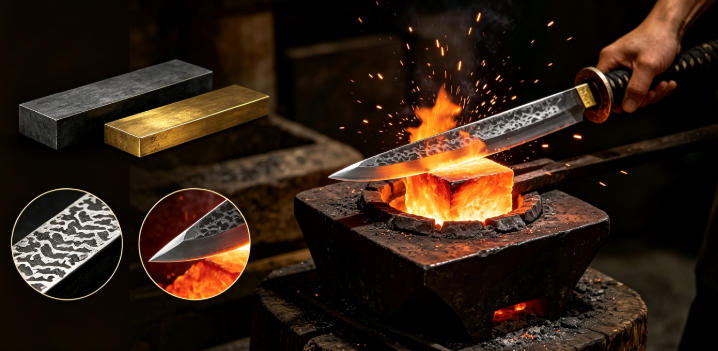
Tamahagane can contain different levels of carbon, so swordsmiths historically selected and processed different pieces of steel for different parts of the blade. Through forging, folding, and combining suitable steel, traditional swordsmiths aimed to create an appropriate balance between hardness and toughness.
This is one reason why traditional katana production is much more than simple metalworking. It combines metallurgy, forging techniques, heat treatment, polishing, and years of practical experience.
Modern katana sword replicas and contemporary swords may use different types of steel, including 1045, 1060, 1095, T10, and Damascus Steel. Different materials can affect the blade's hardness, toughness, appearance, maintenance requirements, and intended use.
Why Is a Katana Folded?
The statement that a katana is “folded thousands of times” is popular, but it is often oversimplified.
Traditional folding was primarily used to improve the uniformity of the steel and help work out impurities in the material. Repeated folding could also create distinctive layered patterns within the steel.
Therefore, a folded steel katana is not necessarily better simply because it has been folded more times. The quality of the original steel, forging temperature, folding technique, heat treatment, and swordsmith's experience all influence the final result.
For modern collectors, this distinction is important. The quality of a katana depends on much more than the number of times the steel was folded. Material quality, blade construction, heat treatment, finishing, and overall craftsmanship all matter.
What Are the Parts of a Katana?
Katana Blade
The katana blade is the central component of the sword. It usually features a characteristic curve and consists of several structural areas.
Traditional Japanese swords often use blade constructions such as Shinogi-zukuri. Different sections of the blade contribute to its strength, cutting characteristics, and overall appearance.
The edge is carefully polished, and some traditional katana feature a distinctive Hamon created through specialized clay tempering and heat treatment. Hamon is one of the most recognizable visual characteristics of Japanese swords and is closely connected to the blade's heat-treatment process.
Tsuka: The Katana Handle
The Tsuka is the handle of a katana. Traditional handles generally consist of a wooden core covered with Samegawa and wrapped with silk or cotton ito.
The Tsuka affects both grip and balance. Traditional Japanese sword handles are carefully designed, from their wrapping patterns to decorative details, and can also reflect different historical styles.
Tsuba: The Katana Guard
The Tsuba is the guard located between the blade and handle.
Although many people think of the Tsuba primarily as a decorative element, it also helps protect the hand and separate the grip from the blade. Historical Tsuba were made in many shapes and styles, including round, oval, and highly decorative designs featuring family crests, natural motifs, and mythological themes.
For collectors of Japanese swords, the Tsuba itself can have significant artistic and historical value.
Nakago and Mekugi
The Nakago is the tang hidden inside the Tsuka and is an essential structural part of the sword.
Traditional Japanese swords may have a swordsmith's inscription, known as a Mei, on the Nakago. For antique Japanese sword collectors, the inscription, patina, tang shape, and historical documentation can all help with researching a sword's origin.
The Mekugi is the peg used to secure the handle to the tang and keep the Tsuka firmly attached.
Why Is a Katana Curved?
This is another common question when people search what is a katana.
The curvature of a katana is not simply an aesthetic feature. Its shape is connected to historical mounted combat, sword-drawing techniques, and cutting movements.
The curved blade could help create a smoother cutting motion while also contributing to the characteristic appearance of Japanese swords.
Traditional Japanese martial arts place great importance on the relationship between drawing, cutting, and returning the sword to its scabbard. In Iaido, for example, the sword's curvature and method of wearing it are important elements of the overall technique.
The curve of a katana is therefore the result of both function and aesthetics.

How Was the Katana Used in Warfare?
The katana has a strong historical connection with the samurai.
However, it was not the only weapon used by Japanese warriors. Depending on the period and battlefield situation, samurai could use polearms, bows, spears, and various other types of Japanese swords.
Over time, the katana became an important symbol of samurai identity. It represented not only combat ability but also social status, personal honor, and cultural identity.
Historical policies such as sword hunts further reinforced the connection between swords and social status. As Japanese society changed, the katana gradually shifted from an everyday battlefield weapon toward a powerful cultural and symbolic object.
Did the Katana Have Meaning Beyond Combat?
The Japanese sword was not simply a weapon of war.
Certain swords were passed down through families as treasured heirlooms and could also appear in ceremonies and important social settings.
Some historically significant Japanese swords have become important cultural properties because of their age, craftsmanship, historical associations, and artistic characteristics.
For collectors, the value of a Japanese sword may come from many factors, including its history, swordsmith, age, condition, blade characteristics, fittings, and cultural background.
This is why modern katana collection attracts not only martial arts enthusiasts but also historians, art collectors, and people interested in Japanese culture.
How Can You Identify a Genuine Katana?
Check the Swordsmith's Signature
If you are considering purchasing a Japanese sword, one of the first things to investigate is its origin.
Traditional Japanese swords may have a swordsmith's signature on the Nakago. For antique swords, this inscription can provide important information about the swordsmith and production history.
However, simply finding an inscription does not automatically prove that a sword is authentic. Proper authentication generally requires examination of the blade, inscription, materials, construction features, fittings, and historical documentation.
Examine the Materials and Craftsmanship
A high-quality katana should demonstrate consistent craftsmanship throughout the blade, Tsuka, Tsuba, Saya, and other fittings.
Traditional swords may display characteristics such as Hamon and Jihada that reflect forging and heat-treatment processes. However, modern replicas are made differently from antique Japanese swords, so authenticity should never be judged from a single visual characteristic.
If you are purchasing a katana replica or decorative samurai sword, pay close attention to its intended use, steel type, Full Tang construction, assembly quality, and seller information.
When Should You Buy a Katana?
Katana Collecting
For collectors, a katana can become an important part of a Japanese sword collection.
Collectors may choose swords according to different themes, including traditional Japanese designs, different steel types, different fittings, Anime Katana, Game Sword, or Fantasy Sword.
Martial Arts Training
The katana is also closely connected with several Japanese martial arts.
Iaido focuses on drawing techniques, controlled movements, posture, and mental concentration. Kendo focuses on swordsmanship training and competitive practice. The training swords and equipment used in different martial arts can vary significantly.
If you intend to purchase a katana for training, choose equipment specifically designed for the intended practice and learn under qualified instruction.
Katana as a Gift
For people interested in Samurai culture, Japanese history, anime, movies, or video games, a katana can also be a distinctive collectible gift.
However, Japanese swords are objects that require responsible ownership and storage. Before purchasing one, always check the laws in your local area regarding ownership, transportation, display, and use.
Are Katanas Legal?
Katana laws vary significantly between countries, states, and local jurisdictions.
Before purchasing a katana sword, check the regulations in your area concerning blade length, possession, carrying, transportation, importation, and collection. Some jurisdictions may have different rules for sharpened swords, antique blades, and swords of specific lengths.
If you are purchasing a Japanese sword replica, you should also understand its intended use and applicable local regulations.
For international buyers, it is also important to check import requirements and the seller's shipping policies. The fact that a katana can be purchased online does not mean it can automatically be carried or used without restrictions everywhere.
How Do You Maintain a Katana?
Cleaning the Katana Blade
Proper maintenance is essential, especially for carbon steel blades.
If a blade is exposed to moisture, sweat, or corrosive substances for an extended period, rust can develop. Traditional Japanese swords are generally maintained using specialized cleaning tools and sword oil.
Avoid aggressively rubbing the blade with rough materials or using unsuitable chemicals. Improper cleaning can damage the blade's surface or finish.
How Should a Katana Be Stored?
The traditional Saya is an important part of katana storage.
For long-term collecting, pay attention to humidity and temperature. Excessive moisture can cause carbon steel to rust, so collectors should aim for a dry and stable storage environment.
If a katana is displayed on a Sword Stand, make sure it is securely positioned and kept away from children or unauthorized users.
The Tsuka, Tsuba, Saya, and other fittings should also be inspected periodically. If you notice looseness, cracks, or damage, seek professional advice before attempting repairs.
How Can You Learn to Use a Katana?
If you are interested in actually learning how to use a katana, you should not simply imitate movements from movies or video games.
Traditional Japanese martial arts emphasize posture, grip, footwork, drawing, returning the sword to the Saya, and controlled movement. Iaido, Kendo, and other related disciplines each have their own training systems.
Beginners should start with basic movements under the guidance of a qualified instructor.
Authentic katana training is not simply about swinging a sword quickly. It emphasizes control, balance, discipline, concentration, and respect for the sword.

The Katana in Anime, Movies, and Video Games
Today, even people who have never studied Japanese history may recognize the katana through movies, anime, and video games.
From classic samurai movies to modern Anime Sword designs and popular Video Game Sword characters, the katana has become an important visual symbol of Japanese warrior culture.
Works such as Ghost of Tsushima, Demon Slayer, Bleach, One Piece, and Rurouni Kenshin have introduced different interpretations of the katana to audiences around the world.
In these stories, some katana are inspired by real Japanese swords, while others have fantasy abilities and fictional designs. Together, however, they have helped increase global interest in Japanese swords, samurai, and Japanese culture.
Katana and Modern Martial Arts
The katana remains connected to Japanese martial arts today.
Kendo uses bamboo swords and protective equipment to practice swordsmanship, while Iaido places greater emphasis on drawing techniques, body control, concentration, and mental discipline.
For modern students, the katana can serve as a gateway to Japanese martial arts, Japanese culture, and the philosophy associated with samurai traditions.
Hand Forged Japanese Samurai Katana Sword Tamahagane Steel Blade Clay Tempered Iron Tsuba

Why Is the Katana Still So Popular?
If you ask what is a katana, the answer is much more than simply “a Japanese samurai sword.”
The katana represents a complex part of Japanese history while reflecting the craftsmanship of traditional swordsmiths, samurai culture, warfare, artistic design, and modern popular culture.
From Tamahagane to Hamon, from the Blade to the Tsuka, and from the Tsuba to the Saya, every component contributes to the unique character of the Japanese sword.
Today, people collect katana for many different reasons. Some are fascinated by samurai sword history, others appreciate Japanese sword craftsmanship, while many collect Anime Katana and Game Sword replicas or became interested in Japanese swords through martial arts, movies, anime, or video games.
Whether you are searching what is a katana for the first time or already have your own katana collection, this iconic Japanese sword is worth exploring from historical, structural, technical, and cultural perspectives.
The reason the katana has remained popular around the world for centuries is not simply because it is an ancient weapon. It connects Japanese history, samurai culture, traditional craftsmanship, and modern popular culture.
Once you understand the blade, handle, guard, tang, and scabbard of a katana, you no longer see it as simply a sword. You see it as a Japanese sword that carries centuries of history, craftsmanship, culture, and tradition.

