


Hook Swords History & Techniques: China’s Real Twin Hook Weapons
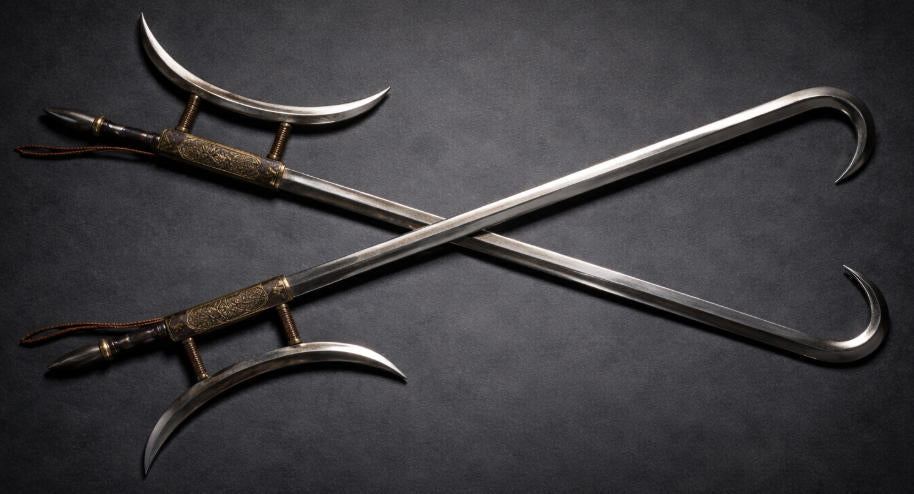
Were China’s Hook Swords Real Weapons or Just Movie Fantasy?
Are Hook Swords Real Battlefield Weapons? Unveiling the History and Lethality of China’s 'Exotic' Twin Hooks Chinese Cold Weapons Explained
Are the Chinese Weapon Hook Swords seen in films like Crouching Tiger, Hidden Dragon or games such as Mortal Kombat purely fictional? Absolutely not.
This article offers an in-depth exploration of one of China’s most unconventional traditional weapons—the Shuang Gou (Twin Hook Swords)—covering their historical origins, unique four-part construction, and their famed disarming techniques. A must-read for cold weapon collectors and martial arts enthusiasts.
In wuxia films and fighting games (such as Kabal in Mortal Kombat), we often encounter a visually striking weapon: a hooked blade at the tip, a crescent-shaped guard near the handle, and a sharp spike at the pommel.
This weapon is commonly known in English as the Hook Sword, and in Chinese as Hu Tou Gou (Tiger Head Hooks) or Shuang Gou (Twin Hooks).
Because of its exaggerated and unconventional design—seemingly defying the logic of standard swords—many modern viewers naturally ask:
'Did hook swords actually exist as historical weapons, or are they merely cinematic inventions?'
Today, CoolKatana reveals the truth behind this mysterious 'exotic weapon' of Chinese martial arts.

What Are Swords with Hooks Called?
Swords with hooks are generally referred to as 'hook swords.'
The most iconic example is the Chinese twin hook swords (Shuang Gou), characterized by outward-curving hooked tips, crescent-shaped side blades near the hand guard, and their use as a paired weapon. They are primarily designed for hooking, trapping, and controlling an opponent’s weapon, and are commonly seen in close-range combat systems and traditional martial arts forms.
In European history, some swords featured small hooks or notches on the blade or guard, usually intended for catching an opponent’s weapon or armor. However, these never evolved into a clearly defined, independent weapon category.
In Japanese traditional weaponry, true hook swords are virtually nonexistent. Most hook-shaped swords seen in anime, games, or fantasy media are inspired by Chinese hook swords or unusual European blade designs.
I. Core Conclusion: They Are Real—But Highly Specialized
Let’s answer the most important question first:
Hook swords (Tiger Hook Swords) are not modern fantasy creations. They are real historical weapons.
They are officially counted among the traditional Chinese “Eighteen Martial Weapons”, and are featured prominently in martial systems such as Northern Shaolin, Seven-Star Praying Mantis, and Baguazhang, where they are regarded as advanced dual-weapon disciplines.
However, their historical role is very different from common battlefield weapons like spears or sabers. Hook swords are best understood as specialized 'tactical' weapons.
1. Weapons for Duelists, Not Military Formations
On ancient battlefields, you would rarely—if ever—see soldiers charging in formation with twin hook swords. This was not due to a lack of lethality, but rather tactical realities:
-
Formation Disruptors: Ancient armies relied on dense formations. Hook sword techniques involve wide hooking arcs, sweeping motions, and weapon entanglement—movements that are extremely dangerous in tight ranks and could easily injure allies. The weapon demands space, making it ideal for single combat, not mass warfare.
-
High Cost and Training Barrier: Crafting functional hook swords requires complex forging, and mastering dual weapons demands exceptional coordination and skill. For generals seeking rapid, cost-effective troop training, long spears and simple sabers were far more practical.
2. A Civilian Martial Arts and Escort Agency Counter-Weapon
The true golden age of hook swords was in late Qing Dynasty China through the Republican era, flourishing within civilian martial circles—especially armed escort agencies (Biao Ju).
-
A Nemesis of Long Weapons: Escort guards often faced bandits armed with spears or staffs. The hooked tips of the weapon allowed practitioners to trap and lock long weapon shafts, instantly closing the distance and neutralizing reach advantage. This embodies the martial principle of
“Using the short to defeat the long; using the unconventional to overcome the orthodox.” -
Comprehensive Personal Defense: For martial artists operating outside formal armies, hook swords combined the functions of a blade, a sword, and even a shield. The crescent guard could parry attacks, making the weapon an exceptionally effective personal defense weapon.
II. Anatomy of Lethality: The Four-in-One Design
What truly makes hook swords an “exotic weapon” is the fact that four distinct killing functions are integrated into a single weapon—a rarity in cold weapon design.
1. The Hook
-
Function: The curved tip is not meant for slashing like a sickle. Its primary purpose is hooking and disarming. It can easily catch an opponent’s spear shaft or blade, and with a sharp pull, strip the weapon from their hands.
2. The Blade
-
Function: The main body of the hook sword is sharpened, allowing it to perform standard cutting, slashing, and parrying actions similar to a straight sword.
3. Crescent Guard
-
Function: This signature crescent-shaped hand guard protects the fingers from incoming strikes, but it is also sharpened. In close-quarters combat, it can be used for pushing cuts and slicing attacks at extremely short range.
4. Spear Tip / Pommel Spike
-
Function: The handle’s base is often finished as a sharp spike. When an opponent closes in, it can be used like a dagger for reverse stabbing techniques.

III. Legendary Technique: 'Linking Hooks' — Instant Range Deception
In the Oscar-winning film Crouching Tiger, Hidden Dragon, one of the most iconic cinematic sequences features Michelle Yeoh as Yu Xiulian dueling against Jade Fox with the Green Destiny sword. In a breathtaking moment, she interlocks the hooks of her twin hook swords, releases one hand, and instantly doubles her attack reach—swinging the weapons like bladed meteor hammers.
In traditional Chinese martial arts, this technique is called 'Linking Hooks' or 'Hook Connection.'
1. Physics and Tactical Surprise (Centrifugal Force & Ambush)
This is not mere theatrical flair—it is a form of tactical deception.
-
Sudden Range Extension: Hook swords are naturally short-range weapons. When an opponent assumes they are out of striking distance, the user exploits centrifugal force to swing the interlocked hooks, instantly expanding the attack radius to nearly 2 meters. This unexpected “range deception” often catches enemies completely off-guard.
-
Sweeping Kill Zone: Once connected, the twin hooks behave like bladed flails or meteor hammers, forming a fan-shaped kill zone, ideal for pushing back multiple attackers or targeting an opponent’s lower body.
2. A High-Risk, High-Reward Finisher
Though visually stunning, this technique is considered a last-resort maneuver in real-life combat.
-
Unstable Connection: The hooks’ engagement relies entirely on centrifugal force. If the swing is interrupted or blocked, the weapons can slip apart, leaving the user temporarily unarmed.
-
Defensive Vulnerability: During the extended swing, the practitioner’s centerline is exposed, creating a momentary defensive gap.
Thus, the 'Linking Hooks' perfectly exemplifies the philosophy of Chinese martial arts:
'A short weapon is dangerous in close quarters; a long weapon commands by leverage.'
Hook swords are the only known weapon capable of simultaneously exploiting short-range risk and long-range leverage in a single design.
IV. Why Modern Collectors Favor Hook Swords
Although we no longer traverse a world of dueling swords and martial bandits, hand-forged hook swords remain highly prized among collectors of cold weapons. They are more than mere tools—they are a tangible symbol of Chinese martial arts culture.
1. The Ultimate Craftsmanship Challenge: Integral Forging
Creating a high-quality hook sword is far more complex than forging a standard straight sword or katana.
-
Complex Geometry: Unlike single-plane blades, hook swords feature four distinct cutting surfaces. Craftsmen must accurately forge the hooked tip and crescent guard while maintaining integral structural integrity.
-
Heat Treatment Balancing Act: Premium high-carbon steel is differentially heat-treated. The hook tip requires high toughness to prevent breakage during weapon entanglement, while the crescent guard and cutting edges require high hardness for maximum cutting efficiency. This delicate balance of hardness and flexibility is a true test of the artisan’s skill.
2. Unique Visual Appeal: Breaking Conventional Aesthetics
Among walls of standard katanas or Chinese straight swords, a pair of twin tiger-head hooks immediately commands attention.
-
Exotic Form: The distinctive hooked tips and crescent guards break traditional weapon lines, presenting a striking geometric elegance.
-
Feng Shui and Symbolism: In Eastern culture, the fierce appearance of hook swords is believed to ward off evil. Displayed crossed in an entryway or study, they signify not only an appreciation for exotic weaponry but also a metaphorical ability to “hook fortune and repel misfortune.”
3. Advanced Martial Arts Practice: Shaolin & Praying Mantis Essence
For martial artists, hook swords are a path to higher-level skill.
-
Body Mechanics and Coordination: Unlike linear swords, hook swords emphasize circular and arc-shaped movements. Training develops wrist rotation strength and full-body coordination.
-
Lineage Legacy: They are a signature weapon in Northern Shaolin and Seven-Star Praying Mantis styles. Mastering techniques like Linking Hooks, Hooking, and Disarming reflects a true understanding of the Chinese martial principle: 'Overcome force with cleverness.'
V. Conclusion
Hook swords are not a fictional fantasy—they are a real historical example of martial ingenuity at its peak.
They demonstrate that ancient weapons were not merely extensions of strength, but also embodiments of strategy and intelligence. Whether you wish to experience the legendary techniques of Shaolin masters or acquire a truly unique metalwork art piece, a pair of finely crafted hook swords is an exceptional choice.

