


Aztec Macuahuitl: The Deadly Obsidian Sword of Mesoamerican Warriors
What Made the Aztec Macuahuitl the Most Fearsome Weapon in Mesoamerica?
In the grand evolution of human melee weapons, few stand out for their unique design and terrifying lethality. Not forged from steel, yet enough to strike fear into the hearts of first-time European colonizers, this weapon is the Macuahuitl, the deadliest obsidian wooden sword of the Aztec civilization. As a symbol of ancient Mesoamerican warfare, the Macuahuitl was not only an efficient combat tool but also a marker of an Aztec warrior’s honor and status.
Today, we delve into the construction, battlefield effectiveness, and historical impact of this 'Obsidian Fang,' revealing the lesser-known truths behind its fearsome reputation.
What Is a Macuahuitl? Unique Construction of This Mesoamerican Weapon
In the ancient Aztec civilization of Mesoamerica, the Macuahuitl reigned supreme on the battlefield. In the Nahuatl language, 'Macuahuitl' combines maitl ('hand') and quahuitl ('wood'), literally meaning 'hand-wood.' But it was far from an ordinary wooden club—it was a clever combination of blunt force and razor-sharp cutting power, a wooden sword inlaid with obsidian, representing the peak of stone-age weaponry.
1. A Perfectly Balanced Core: Hardwoods and Design
The body of the Macuahuitl demonstrates Aztec artisans’ deep understanding of material mechanics. To withstand the rigors of close-quarters combat, its core was typically carved from dense, durable native hardwoods, such as oak, mahogany, or tropical hardwoods.
Shaped like a flat, elongated paddle, the Macuahuitl was primarily a one-handed weapon, about 90–120 cm in length, though historical records mention heavier, two-handed variants exceeding 1.5 meters. Its width matched roughly the span of a hand, and its thickness was carefully balanced to maximize momentum while allowing agility in combat.
2. The Blade of the Soul: Obsidian’s Micro-Wonders
The Macuahuitl’s terror came from the obsidian blades embedded along its sides. Obsidian is a naturally occurring volcanic glass—brittle, yet capable of extraordinary sharpness.
Aztec craftsmen used a technique called “pressure flaking” to produce thin, consistently sharp obsidian shards. Unlike metal blades, obsidian’s amorphous structure allows fracture surfaces that are molecularly sharp, far exceeding the edge of modern surgical scalpels. Mounted on the wooden core, the Macuahuitl didn’t merely cut—it produced devastating lacerations that tore through muscle tissue, causing nearly irreparable wounds.
3. Ingenious Craftsmanship: Blade Placement and Fixing
The Macuahuitl’s sophistication lies in its blade arrangement:
-
Alternating and continuous edges: Deep grooves were carved along both sides of the wooden core, into which obsidian shards were embedded in sequence. Small gaps between shards created a saw-like effect, effectively cutting through leather armor or thick cotton armor (Ichcahuipilli).
-
Strong adhesion techniques: A mixture of natural resin, asphalt, and powdered stone ensured the shards remained firmly in place. Even if a blade fragment broke, the base remained secure.
-
Dual damage mechanism: The wooden core provided significant blunt-force damage, meaning the Macuahuitl could still function as a club even if the obsidian shards fractured. This combination of cutting and crushing made it a versatile weapon against varied opponents.
As a masterpiece of Mesoamerican melee weaponry, the Macuahuitl reflects not only the Aztecs’ extreme utilization of natural resources but also their war philosophy—lethal yet ingeniously designed to maintain resilience akin to metal weapons.

Lethality: Is Obsidian Sharper Than Steel?
Spanish conquistadors left numerous accounts describing the Macuahuitl’s terrifying effectiveness. Bernal Díaz del Castillo famously witnessed an Aztec warrior cleaving off the head of a Spanish horse with a single strike. While possibly exaggerated, such accounts illustrate the weapon’s lethal power in close combat.
The serrated obsidian edges tore through flesh, making wounds difficult to heal and causing massive blood loss. In Aztec warfare, such injuries were tactically advantageous, as warriors often captured rather than killed elite enemies for sacrificial purposes. The Macuahuitl’s design made disabling opponents—cutting muscles and tendons—a devastatingly effective strategy.
Battlefield Tactics: How Aztec Warriors Wielded the Obsidian Weapon
In combat, the Macuahuith combined power with precision. Warriors often paired it with a round shield to block projectiles or spears, then closed in for lethal strikes.
Its multifunctionality made it extremely versatile: the wooden core provided blunt-force damage, and even if the obsidian shards broke, the weapon could still function effectively. However, its brittle obsidian blades could shatter against Spanish steel armor or shields, highlighting the limitations of stone-age weaponry against metal defenses—ultimately influencing the outcome of Mesoamerican battlefields.
Religion and Status: Beyond Mere Killing
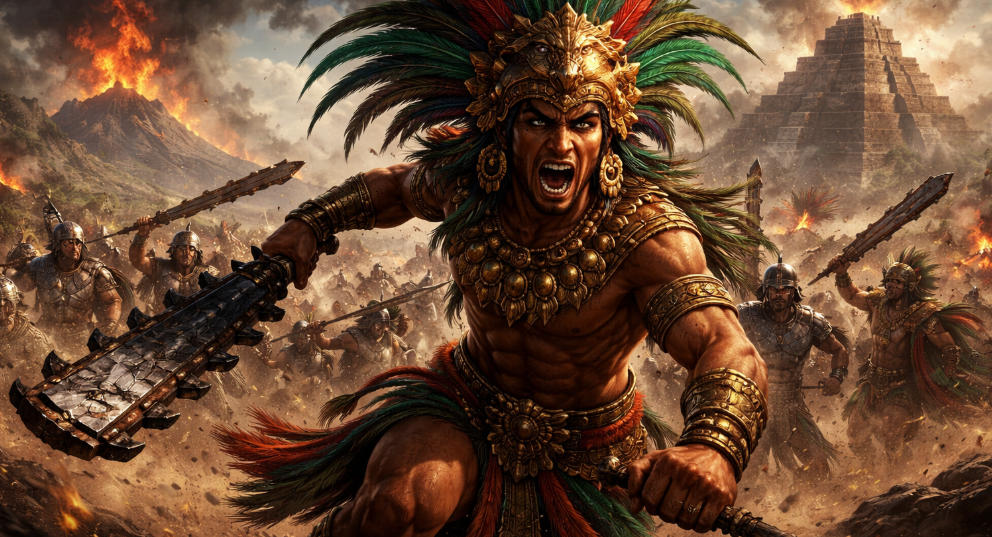
For an Aztec Eagle or Jaguar warrior, a finely decorated Macuahuitl symbolized prestige. Many featured intricate carvings of feathered serpents or war gods, with hilts adorned with rare feathers. Weapons were seen as extensions of divine authority, and combat was both a political and sacred act.
Obsidian, considered the crystallized blood of the earth, embedded in wood symbolized life and death, hardness and flexibility. The Macuahuitl held ceremonial significance in addition to battlefield function.
Modern Perspective: Cultural Legacy and Surviving Artifacts
Unfortunately, most original Macuahuitls deteriorated or were destroyed after the fall of the Aztec Empire. The last known original was housed in the Royal Armory in Madrid but was lost in a fire in 1884.
Despite this, the Macuahuitl’s legacy endures in popular culture—from Age of Empires to Civilization VI, and fantasy media—representing a mysterious and deadly Mesoamerican weapon. Modern craftspeople and experimental archaeologists attempt to recreate it, seeking to replicate the fearsome elegance of the 'obsidian fang' on the battlefield.
Conclusion: The Indelible Obsidian Edge
The Macuahuitl symbolizes the military power of the Aztec Empire and the zenith of ancient craftsmanship with natural materials. It demonstrates how a civilization without steel achieved peak melee lethality through ingenuity and skill.
Though it vanished from history, the Macuahuitl’s warfare philosophy, cultural significance, and place in Mesoamerican weapon evolution continue to captivate historians. This weapon, forged from volcanic glass and hardwood, remains one of humanity’s most unique and deadly arms.

