


Black Friday: Classic Katana vs Battle Ready Katana Guide
Which Katana Should You Buy This Black Friday: Classic or Battle Ready?
When people first discover Japanese swords, they are often attracted by the elegant curve of the blade, the beautiful hamon, and the simple yet powerful appearance of the sword as a whole. However, a truly collectible and historically meaningful samurai sword is about much more than simply looking like a katana. From the development of Japanese swords during the Heian period to the blades carried by samurai during the Sengoku period, and eventually to their role today as collectibles, martial arts equipment, and cultural symbols, the katana has gone through a fascinating evolution.
In today's market, Classic Katana and Battle Ready Katana are two of the most popular categories. The former focuses more on traditional aesthetics, craftsmanship, and cultural value, while the latter places greater emphasis on structural strength, durability, and practical training. For anyone looking to buy a real katana, hand forged katana, battle ready katana for sale, or custom katana, the most important question is not simply "Which katana is the best?" but rather, "Which type of katana is best for my needs?" In this guide, we will explore the history of Japanese swords, samurai culture, steel types, forging methods, heat treatment, hamon, handle construction, and modern applications to explain the differences between Classic Katana and Battle Ready Katana.
Why Did the Japanese Sword Become a Symbol of the Samurai Spirit?
Throughout Japanese history, the sword was much more than a weapon. As the samurai class developed and became an important part of Japanese society, the Japanese sword became increasingly associated with identity, honor, responsibility, status, and personal discipline. The famous expression that a sword was the "soul of the samurai" has become deeply embedded in popular culture. Although the modern interpretation of this idea is often romanticized, it reflects the special position that swords held within samurai society. A samurai did not simply carry a sword for combat; the sword could also communicate his social position, family identity, and allegiance.
The development of the Japanese sword was not an overnight process. Early Japanese swordmaking was influenced by sword technologies introduced from mainland Asia. As Japanese warfare, mounted combat, and ironworking techniques evolved, swordsmiths gradually developed blade shapes better suited to local conditions and fighting methods. By the late Heian period, the curved blade associated with the Japanese sword had become increasingly established. During the Kamakura period, Japanese swordmaking reached another important stage of development, with famous swordsmithing traditions and schools emerging across Japan.
During the Sengoku period, continuous warfare created enormous demand for weapons, and swords became an essential part of samurai equipment. Later, during the peaceful Edo period, the role of the sword gradually shifted from primarily a battlefield weapon toward a symbol of status, etiquette, craftsmanship, and cultural identity. This long history explains why the modern Japanese katana can simultaneously represent a weapon, an artistic craft, and an important cultural tradition.
Classic Katana: A Continuation of Traditional Japanese Sword Aesthetics
The Classic Katana is closely associated with the traditional aesthetics of the Japanese sword. It emphasizes blade proportions, hamon, tsuba, tsuka, saya, and the visual harmony of the entire sword. For collectors, the value of a Classic Katana is not determined solely by sharpness. Instead, attention is often given to how successfully the sword captures the design philosophy and craftsmanship associated with traditional Japanese swords.
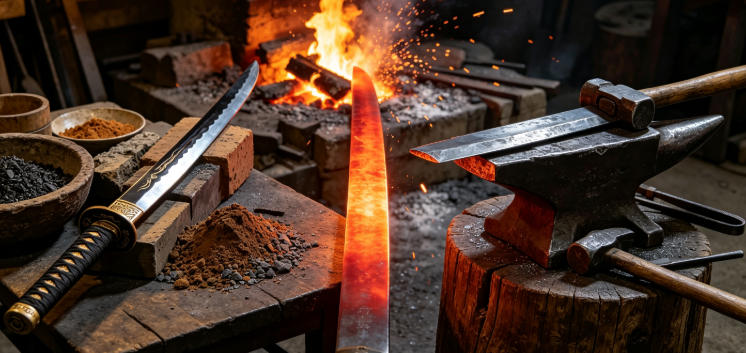
Historically, Japanese swordmaking was an extremely sophisticated craft. A swordsmith had to transform raw material through heating, forging, shaping, heat treatment, polishing, and finishing before a blade could become a complete sword. Modern hand forged katana may benefit from more consistent contemporary metallurgy, but the fundamental concept of shaping steel through controlled heat and hammering remains an important part of the traditional aesthetic.
One fascinating characteristic of traditional Japanese swords is that swordsmiths did not necessarily seek identical hardness throughout the entire blade. The cutting edge needed sufficient hardness to maintain a sharp edge, while other parts of the blade needed an appropriate degree of toughness to help reduce the risk of catastrophic failure. This balance between hardness and toughness became one of the defining principles behind Japanese sword heat treatment.

T10 High Carbon Steel and Damascus Steel Katana
Modern Classic Katana can be made using a variety of steels, including T10 High Carbon Steel, 1095 high carbon steel, 1060 carbon steel, and Damascus Steel Katana. T10 is a high-carbon tool steel that can achieve good hardness and edge retention when properly heat treated, making it a popular choice for modern katana. For collectors who want to combine traditional Japanese sword aesthetics with modern steel technology, a T10 Katana can be an appealing option.
The Damascus Steel Katana, meanwhile, is particularly popular among collectors who appreciate distinctive blade patterns. Damascus-style patterns can create complex visual layers across the blade and produce an attractive appearance when viewed under different lighting conditions. Modern Damascus steel should not simply be treated as identical to every historical form of Damascus steel or ancient pattern-welded blades. Nevertheless, from a modern collecting perspective, a beautiful Damascus pattern can significantly enhance the artistic character of a katana.
This is also one of the important differences between a Classic Katana and an ordinary decorative sword. A quality collectible katana should not rely only on an attractive blade. The blade, handle, fittings, and saya should work together as a coherent design.
Clay Tempering: Why Does a Katana Have a Beautiful Hamon?
If you closely examine a high-quality katana, you may notice a distinctive line running along the edge of the blade. This is known as the hamon.
Hamon is closely connected with the traditional heat treatment process used in Japanese swordmaking. In traditional clay tempering, clay is applied to different areas of the blade in different thicknesses before the sword is heated and rapidly cooled. Because the edge and spine cool at different rates, they can develop different metallurgical characteristics and hardness levels. After polishing, the resulting transition can become visible as a hamon.
There is an interesting distinction here. For collectors, the hamon is an important aesthetic feature. For swordsmiths, however, it is primarily the visible result of a carefully controlled heat-treatment process. In other words, a genuine hamon is not simply a decorative line painted onto the blade. It is connected to forging, clay application, heating, quenching, and polishing.
When you see a hand forged katana with a well-defined natural hamon, you are also seeing evidence of the swordsmith's control over the heat-treatment process. Different swordsmithing traditions can pursue different hamon styles, including straight lines, regular waves, irregular patterns, and more complex formations. This contributes to the unique character of individual blades.
Tsuka, Samegawa, Ito and Saya: A Katana Is More Than Its Blade
Many consumers focus almost entirely on the blade when purchasing a samurai sword, but the handle and scabbard are equally important to the overall character of a Japanese sword.
The handle is known as the tsuka. Traditionally, it is built around a wooden core and may be covered with samegawa, traditionally associated with ray skin, before being wrapped with ito, the traditional cord wrapping. A properly constructed tsuka is not only visually attractive but also designed to provide a stable and secure grip.
The scabbard is called the saya. Traditional saya are generally made from wood and finished with lacquer or other surface treatments. The saya protects the blade while also contributing significantly to the appearance of the complete katana. Even a beautiful blade can lose much of its visual impact if it is paired with poorly proportioned or poorly finished fittings.
The tsuba, or sword guard, sits between the blade and handle. In addition to its protective function, it became an important form of Japanese decorative art. Historical tsuba can feature an enormous range of subjects, including plants, animals, family crests, landscapes, mythical creatures, and symbolic motifs.
For this reason, a truly attractive Classic Katana should be considered as a complete system of blade, hamon, tsuba, tsuka, and saya rather than simply a beautiful piece of steel.
Battle Ready Katana: From Collecting to Functionality
Compared with a Classic Katana, a Battle Ready Katana places greater emphasis on practical function and structural reliability. In the modern sword market, "Battle Ready" is generally used to describe swords designed with stronger construction and intended for appropriate training or cutting applications. However, consumers should understand that "Battle Ready" is not a magical guarantee of quality. The actual quality of a functional katana depends on specific factors such as steel type, heat treatment, blade construction, handle attachment, weight, and balance.
The Battle Ready category discussed in the original comparison includes 9260 spring steel katana and 1095 high carbon steel katana. 9260 spring steel is known for its flexibility and toughness when properly treated, making it a popular option for designs that emphasize durability. 1095 high carbon steel, on the other hand, is widely known for its ability to achieve high hardness and good edge performance when correctly heat treated.
However, the name of the steel alone cannot determine the final performance of a sword. Two blades made from the same 1095 steel can perform very differently if their heat treatment, blade geometry, construction quality, and manufacturing processes differ. Therefore, if you are searching for a battle ready katana for sale, do not focus only on terms such as '1095 katana' or '9260 katana.' You should also investigate the heat treatment, tang construction, blade geometry, and intended use.
9260 Spring Steel Katana: Why Is Toughness Important?
The characteristics of 9260 spring steel can partly be understood from its name. Spring steel is valued for its elasticity and toughness. When properly heat treated, it can tolerate a certain amount of flex and return toward its original shape, making it attractive for sword designs where durability is an important consideration.
This creates an interesting contrast with the common assumption that 'harder is always better.' For a functional sword, maximum hardness is not necessarily the only goal. A katana needs an appropriate balance between hardness, toughness, flexibility, and structural stability.
Therefore, when choosing a 9260 spring steel katana, it is better to view 9260 as a steel option that emphasizes toughness and resilience rather than simply assuming that 9260 is automatically superior to every other steel.
1095 High Carbon Steel Katana: A Different Approach to Hardness and Sharpness
The 1095 high carbon steel katana is one of the most widely recognized steel options in the modern sword market. 1095 is a high-carbon steel that can achieve relatively high hardness and good edge retention when properly heat treated, which is why it is frequently used for functional knives and sword replicas.
However, hardness and toughness are not the same thing. For a katana, proper heat treatment is often much more important than simply choosing a particular steel name. A quality battle ready sword should have an appropriate balance between edge hardness and overall toughness.
This is why experienced buyers should look beyond questions such as 'Is 1095 better than 9260?' A more useful question is: 'Which steel and heat-treatment approach is better suited to my intended use?'
Tameshigiri: The Traditional Art of Japanese Sword Cutting
If collecting represents one side of the katana experience, tameshigiri represents another.
Tameshigiri is commonly translated as test cutting. Historically, cutting tests were used to evaluate sword performance. In modern martial arts environments, tameshigiri is more commonly practiced as a controlled cutting exercise, often involving targets such as tatami omote.
Proper tameshigiri is much more than simply swinging a sword at an object. Cutting angle, body alignment, grip, movement, timing, and technique all influence the result. Even a high-quality battle ready katana can be damaged if it is used incorrectly, and improper technique can create serious safety risks.
For modern buyers, a sword described as suitable for tameshigiri should therefore be understood as a sword specifically manufactured and designated for an appropriate cutting application. It should not be interpreted as permission to use a sword casually or irresponsibly.
Classic Katana vs Battle Ready Katana: Why Are There Two Different Approaches?
The distinction between these two categories can actually be understood through the history of the Japanese sword.
During periods of warfare, swords primarily needed to fulfill practical combat requirements. During periods of peace, Japanese swords increasingly gained artistic, ceremonial, and status-related significance. In the modern era, katana have developed further into collectibles, martial arts equipment, historical artifacts, and powerful symbols within anime, manga, film, and video games.
Therefore, Classic Katana and Battle Ready Katana should not simply be viewed as 'good swords' versus 'bad swords.' They represent different priorities.
Classic Katana is closer to a cultural and artistic object that can be admired and collected, while Battle Ready Katana places greater emphasis on structure, durability, and function.
If you appreciate hamon, Damascus patterns, traditional tsuba, detailed saya, and Japanese sword history, a Classic Katana may better suit your collecting interests. If you care more about durability, handling, blade geometry, and appropriate cutting practice, a Battle Ready Katana deserves closer attention.
Classic Katana vs Battle Ready Katana: Which One Should You Choose?
| Feature | Classic Katana | Battle Ready Katana |
|---|---|---|
| Primary purpose | Collection, art, traditional culture | Function, training, cutting practice |
| Design focus | Aesthetics and cultural value | Strength and durability |
| Common steel | T10, Damascus Steel, etc. | 9260, 1095, etc. |
| Hand Forged | Common | Common |
| Clay Tempering | Available on selected models | Depends on the model |
| Hamon | Major visual and craftsmanship feature | May combine aesthetics with function |
| Collecting | ★★★★★ | ★★★★ |
| Training | ★★★ | ★★★★★ |
| Tameshigiri | Depends on the specific model | Better suited when explicitly designed for it |
| Cosplay | ★★★★★ | ★★★ |
| Cultural value | ★★★★★ | ★★★★ |
If you are primarily a collector, the Classic Edition is often the more natural choice. If you are a martial arts enthusiast, you should pay greater attention to the actual specifications and construction of a Battle Ready Katana. The original comparison similarly positions Classic Edition models toward collecting, historical appreciation, and Iaido, while Battle Ready models focus more on intensive training and tameshigiri.
Why Is a Full Tang Katana Worth Considering?
For a functional katana, full tang is another important keyword for many buyers. The tang is the portion of the blade that extends into the handle. For any sword expected to withstand mechanical stress, the connection between the blade and handle is naturally important.
However, 'full tang' should not be treated as the only measurement of sword quality. Steel type, heat treatment, handle construction, fitting quality, and overall engineering should all be considered together.
If you are searching for a best full tang katana, full tang samurai sword, or battle ready full tang katana, always examine the complete product specifications instead of relying solely on a keyword in the product title.

Samurai Sword and Bushido: Why Does the Katana Still Have Cultural Meaning?
One of the most fascinating aspects of the Japanese sword is its lasting connection with culture.
Values associated with the samurai, including loyalty, honor, responsibility, discipline, and personal conduct, later became strongly associated with the concept of Bushido, or 'the way of the warrior.' Although modern interpretations of Bushido can differ significantly from historical samurai practices, the image of the katana as a symbol of samurai identity has become deeply embedded in global culture.
From historical novels and films to modern anime, manga, and video games, the katana has become one of the most recognizable visual symbols of the Japanese warrior.
This is one reason people today purchase a samurai sword even when they have no intention of using it as a weapon. For many collectors, the sword represents history, craftsmanship, cultural appreciation, or a connection with a favorite fictional world.
From this perspective, the value of a Classic Katana cannot be measured only by steel hardness. Its hamon, tsuba, tsuka, saya, craftsmanship, and overall design all contribute to its collectible character.
Custom Katana: Combining History With Personal Style
If a standard design does not meet your preferences, a custom katana provides another option.
Modern custom katana services can allow collectors to choose elements such as blade steel, hamon pattern, tsuba style, tsuka color, samegawa, ito, saya finish, and engraving.
For example, collectors who prefer traditional Japanese aesthetics might choose a dark saya, classic hamon, and understated tsuba. Fans of anime and fantasy swords, meanwhile, may prefer distinctive colors, fittings, and decorative details to create a more personalized custom samurai sword.
In a broader sense, customization also echoes an old tradition of Japanese sword culture. Historically, samurai and families could select different sword fittings based on their status, taste, family identity, and crest. A modern custom sword therefore does more than simply change its color—it can turn the katana into a highly personal collectible.
Black Friday Katana Shopping: What Should You Look For?
Black Friday is often a popular time to shop for samurai swords, katana swords, Damascus katana, 1095 katana, T10 katana, and sword accessories. However, a discount should never be the only reason to purchase a sword.
Before buying a katana, compare important specifications such as steel type, blade length, weight, balance, hamon, tsuka, saya, tang construction, heat treatment, and intended use.
This is particularly important when searching for a battle ready katana for sale. Make sure you understand whether a particular model is intended primarily as a display sword, cosplay sword, training sword, or functional sword designed for a specific cutting application.
If your main goal is collecting, a beautifully crafted Classic Katana may provide more satisfaction than simply choosing the sword with the highest hardness. If your goal is martial arts training, meanwhile, construction, balance, durability, and manufacturer specifications deserve greater attention.
Black Friday Exclusive: Get Authentic Katanas Now!
This Black Friday, COOLKATANA offers exclusive benefits:
-
Limited-Time Discounts: Enjoy 15%-20% OFF with no promo code required and discover popular swords such as the Zoro Ichimonji Sword / Wado Ichimonji.
-
Bonus Gifts: Selected purchases may include a high-quality sword bag or display stand, adding extra value to your collection and improving your sword display.
What Is the Best Katana?
If someone asks, 'What is the best katana?' there is no universal answer.
For a history enthusiast, the best katana might be a Classic Katana with an elegant hamon and traditional fittings. For a martial arts practitioner, the most important qualities may be reliable construction, appropriate balance, and suitability for training. For an anime collector, the ideal sword could instead be a highly accurate replica of a favorite fictional character's weapon.
Therefore, best katana is not an absolute concept. It depends on what you want from your sword.
If you want to collect and appreciate Japanese sword culture, a Classic Katana may be the right choice. If you are interested in functionality and appropriate martial arts training, a Battle Ready Katana may be more suitable. If you want a sword that reflects your individual personality and aesthetic preferences, a custom katana offers greater creative freedom.

Conclusion: Classic Represents Tradition, Battle Ready Represents Function
From swords carried by historical samurai to Japanese swords displayed in modern collectors' homes, the katana has traveled through centuries of history. It has served as a battlefield weapon, a symbol of samurai status, an object of craftsmanship, and today, a cultural bridge connecting history, art, traditional craftsmanship, and modern popular culture.
The Classic Katana continues the aesthetic traditions of Japanese swordmaking. It emphasizes hand forged craftsmanship, hamon, clay tempering, traditional fittings, and cultural value. The Battle Ready Katana, meanwhile, places greater emphasis on steel, heat treatment, construction, durability, and balance, making it attractive to collectors and martial arts enthusiasts who are interested in functional sword design.
Whether you ultimately choose a T10 High Carbon Steel Katana, Damascus Steel Katana, 9260 Spring Steel Katana, 1095 High Carbon Steel Katana, or a completely personalized custom katana, the most important thing is to understand its materials, manufacturing process, construction, and intended purpose.
A good katana is more than a sharp blade, and it is more than a beautiful collectible. It represents centuries of Japanese swordmaking knowledge—the relationship between fire, steel, shape, craftsmanship, and aesthetics. It also provides a modern way to explore Japanese sword culture, samurai history, and traditional craftsmanship.
Classic or Battle Ready? There is no single correct answer. The best katana is the one that matches your purpose, aesthetic preferences, and passion for samurai sword culture.

