


Merlin Sword in the Stone: Is It Real or Just a Legend?
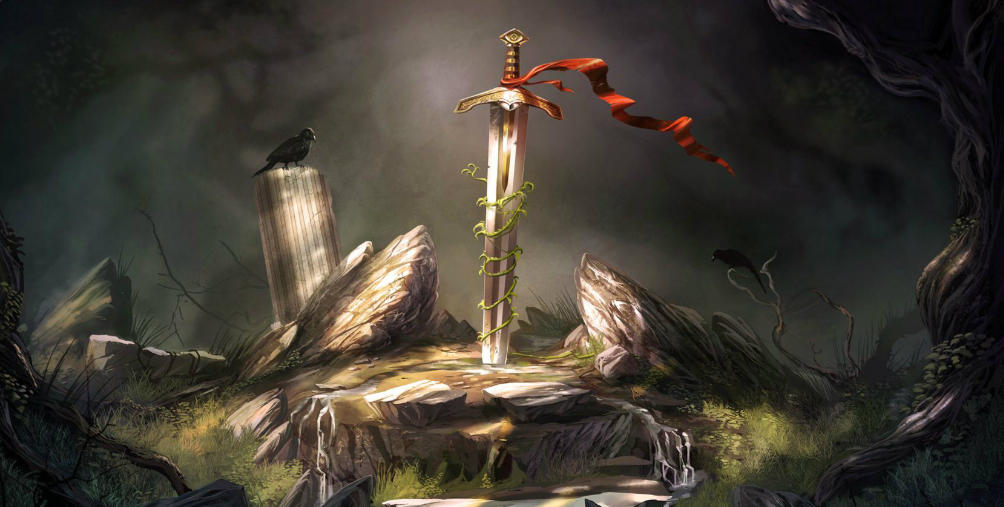
Is the Merlin Sword in the Stone Real or Just a Legend?
In the world of Arthurian legend, swords have never been merely weapons. They represent royal power, destiny, magic, courage, and heroic identity. Among them, the Merlin sword is a particularly fascinating and controversial subject. Compared with the famous Excalibur, Merlin’s sword may not be as widely recognized in modern popular culture, but it has a close connection with Merlin, King Arthur, Camelot, and the legendary Sword in the Stone.
When people search for merlin sword in the stone, they often have a very direct question: Was the Sword in the Stone actually Merlin’s sword? Did Merlin forge the sword himself? Is it the same weapon as Excalibur? These questions may seem simple, but a closer look at Arthurian legend reveals that different medieval texts provide different descriptions of these stories.
In modern movies, television shows, video games, and fantasy stories, Merlin is often portrayed as a powerful wizard, and his sword may be given magical abilities. However, from the perspective of traditional literature, “Merlin’s Sword” does not have one single, universally accepted legend in the same way that Excalibur does. What makes the subject so fascinating is the complicated relationship between Merlin, the Sword in the Stone, Excalibur, and Arthurian mythology.
What Is the Merlin Sword?
The Merlin sword is generally understood as a mysterious legendary sword associated with the wizard Merlin. In modern fantasy works, it may be portrayed as a legendary sword with magical powers and connected with wisdom, prophecy, protection, or even healing.
However, from the perspective of traditional Arthurian legend, it is important to distinguish between medieval literary traditions and modern fictional adaptations. Merlin is certainly one of the most important magical figures in the Arthurian stories, but there is no single historical weapon consistently identified across all Arthurian texts as “Merlin’s Sword.”
This is what makes the phrase merlin sword in the stone particularly interesting. Modern readers often connect Merlin, Arthur, and the Sword in the Stone, but different versions of the story vary in their descriptions of who created the sword, who pulled it from its resting place, and whether it was actually Excalibur.
Therefore, the best way to understand the Merlin sword is not simply to ask whether it was real or fictional, but to explore how the idea developed through different versions of Arthurian mythology.
Merlin and the Legend of King Arthur
To understand the Merlin sword, we first need to understand Merlin himself.
Merlin is one of the most famous wizards and prophets in the King Arthur tradition. He is commonly portrayed as Arthur’s mentor, advisor, and guide to the supernatural world. In many literary adaptations, Merlin helps Arthur understand his destiny and plays an important role in the establishment of his kingdom.
The character of Merlin combines several identities, including wizard, prophet, wise man, and magical advisor. Because of this, weapons associated with Merlin in modern fantasy are often given supernatural or symbolic qualities.
In Arthurian legend, swords frequently serve as symbols of legitimacy and identity. The most famous example is the Sword in the Stone. Arthur’s ability to remove the sword demonstrates that he is the rightful king.
This story eventually became one of the most recognizable episodes in Arthurian literature.
What Does Merlin Sword in the Stone Actually Mean?
The phrase merlin sword in the stone is one of the concepts that can easily cause confusion when people research Arthurian stories.
Modern popular culture frequently places Merlin, Arthur, and the Sword in the Stone within the same storyline. As a result, some people assume that Merlin owned a magical sword that was placed inside a stone, or that Merlin himself was the rightful owner of the legendary sword.
However, in the classic Sword in the Stone story, Arthur is the central figure. The sword functions as a test to determine who has the legitimate right to become king. Robert de Boron, writing around the late 12th or early 13th century, helped develop this famous episode. In some early versions, the sword was associated with an anvil rather than the stone familiar to modern audiences. Later traditions developed the iconic image of a sword embedded in a stone.
Therefore, strictly speaking, the Sword in the Stone should not simply be called Merlin’s sword.
Nevertheless, Merlin remains closely connected to the story. In many modern adaptations, he is portrayed as an important figure guiding Arthur toward his destiny. This naturally connects Merlin’s character with the Sword in the Stone.

Are the Sword in the Stone and Excalibur the Same Sword?
This is one of the most frequently asked questions about Arthurian swords.
The Sword in the Stone and Excalibur are often treated as the same weapon in modern movies, television shows, and video games. However, in many medieval literary traditions, they are not necessarily the same sword.
The Sword in the Stone became an important part of Arthur’s origin story, while later traditions increasingly distinguished it from Excalibur. In the tradition associated with Thomas Malory, Arthur’s first sword eventually breaks, after which Merlin guides him to the Lady of the Lake, who gives him Excalibur.
This distinction is especially important when researching merlin sword in the stone. Modern fantasy adaptations often combine different elements of Arthurian stories, while medieval literature does not always present the same version of events.
Understanding these differences makes the history of Arthurian legend even more fascinating.
Excalibur: The Most Famous Sword of King Arthur
When discussing the Merlin sword, it is almost impossible to avoid Excalibur.
Excalibur is the most famous legendary sword associated with King Arthur and one of the most recognizable magical weapons in Arthurian legend. Its name, origin, and method of acquisition vary across different literary traditions. In some stories, it is connected with the Sword in the Stone, while in others Arthur receives it later from the Lady of the Lake.
Excalibur represents much more than an ordinary medieval sword. It symbolizes Arthur’s royal authority, strength, and legendary status.
In some traditions, Excalibur’s scabbard also possesses supernatural abilities. Unlike an ordinary scabbard, the magical scabbard protects Arthur from losing blood because of wounds. This further establishes Excalibur as a powerful magical sword.
What Is the Relationship Between Merlin and Excalibur?
Merlin is not consistently described as the owner of Excalibur, but he plays an important role in Arthur’s legendary journey.
In different versions of Arthurian mythology, Merlin acts as a guide and advisor. He helps Arthur understand his destiny and participates in important events surrounding the formation of Camelot.
This is why modern adaptations often place Merlin and Excalibur together. The familiar fantasy combination includes a young King Arthur, the mysterious Merlin, the magical sword Excalibur, and the legendary kingdom of Camelot.
However, it is important to distinguish between the idea that 'Merlin owns Excalibur' and the more traditional concept of Merlin as Arthur’s magical advisor.
The Magical Powers of the Merlin Sword
Modern literature and fantasy media often give the Merlin sword supernatural abilities.
Some fictional stories describe such a sword as possessing powers related to prophecy, magic enhancement, protection, or healing. These ideas fit naturally with Merlin’s image as a powerful wizard with knowledge of prophecy and magic.
However, these abilities are more closely associated with later fantasy interpretations than with one consistent medieval tradition.
This distinction matters because Arthurian legend developed over many centuries. Different authors introduced new characters, magical objects, and supernatural elements. As a result, the modern concept of the Merlin sword can be viewed as a cultural image shaped by multiple periods of storytelling.
Was the Merlin Sword a Real Historical Weapon?
If the question is whether history has confirmed a specific sword belonging to Merlin, there is currently no reliable archaeological evidence proving that such a weapon existed.
Merlin himself stands somewhere between history and legend. While historians have extensively studied the historical background of Britain and early medieval warfare, no authenticated artifact has been identified as Merlin’s Sword.
For this reason, the Merlin sword is best understood as a legendary weapon rather than an archaeological object with a confirmed historical identity.
That does not make the story historically meaningless. On the contrary, Arthurian legends provide valuable insight into how medieval societies imagined kingship, heroism, magic, knights, and destiny.
Archaeological Clues About the Merlin Sword
Although no genuine Merlin Sword has been discovered, Britain and Wales have produced many archaeological finds involving ancient and medieval swords, weapons, and metal artifacts.
These archaeological discoveries help researchers understand historical sword designs, metallurgy, craftsmanship, and warfare.
However, finding an ancient sword from the appropriate period does not automatically make it Merlin’s sword. A historical weapon must not be identified with a legendary character without reliable evidence.
If archaeologists were to discover a sword with unusual inscriptions, distinctive decoration, or a direct connection to Welsh folklore, it could provide valuable material for further research. Even then, multiple forms of evidence would be necessary.
Therefore, discussions about the Merlin sword should always distinguish between archaeological evidence and legendary tradition.
Merlin, Welsh Legends, and the Sword
The story of Merlin has strong connections with Wales and older Celtic traditions.
In Welsh traditions, Arthurian characters and heroic stories developed through oral and literary transmission before becoming part of the broader European Arthurian tradition.
Swords often carry special symbolic meanings in these stories. A sword can represent royal authority, heroic lineage, destiny, or supernatural power.
For this reason, the Merlin sword is not simply a question about a weapon. It also involves the development of Celtic mythology, Welsh folklore, and medieval literature.
Studying these traditions helps explain why an ordinary sword could eventually become a legendary magical artifact.
Why Could Only Arthur Pull the Sword from the Stone?
The central meaning of the Sword in the Stone is not really the sword itself. It is about determining who has the right to become king.
The seemingly impossible challenge allows Arthur to prove his identity. Other knights and nobles fail to remove the sword, while the young Arthur succeeds.
The sword therefore functions as a symbolic test.
Its importance does not come simply from Arthur being physically stronger. Instead, the sword confirms his royal destiny. This is why the Sword in the Stone became one of the most influential storytelling concepts in Western fantasy: only the destined hero can claim the legendary weapon.
What Role Does Merlin Play in the Sword in the Stone Story?
Although Merlin is not consistently presented as the owner of the Sword in the Stone, he remains deeply connected to Arthur’s destiny.
In many versions of the Arthurian story, Merlin serves as one of the key figures guiding Arthur toward kingship. He represents wisdom, prophecy, and supernatural knowledge, while Arthur represents courage, leadership, and royal authority.
If Arthur is the legendary king, Merlin can be viewed as the mysterious wisdom behind the king.
This is one reason modern films and television shows frequently connect Merlin with the Sword in the Stone. Although the exact details differ between versions, Merlin’s role as Arthur’s advisor and magical guide has become firmly established in popular culture.
The Merlin Sword and Camelot
Camelot is one of the most important locations in Arthurian legend and has become a symbol of Arthur’s kingdom, the Knights of the Round Table, and the ideals of medieval chivalry.
In modern imagination, Camelot is often portrayed as a magical medieval kingdom filled with knights, castles, legendary weapons, and supernatural adventures.
Merlin, Arthur, Guinevere, Lancelot, and Excalibur all contribute to this legendary world.
Therefore, when people search for merlin sword in the stone, they are often searching for more than a single weapon. They are exploring a much larger Arthurian world, where swords, kingship, magic, and destiny are interconnected.
Avalon and the Legendary Sword
Besides Camelot, Avalon is another mysterious and important location in Arthurian tradition.
In later legends, Avalon becomes associated with Excalibur, the Lady of the Lake, and Arthur’s final fate.
This transforms the Arthurian sword from an ordinary medieval weapon into a symbol connecting the mortal world with a magical realm.
Merlin’s mysterious identity also fits naturally into this supernatural landscape. Avalon, the Sword in the Stone, Excalibur, and other magical elements all contribute to the enduring fantasy atmosphere of Arthurian stories.

Merlin Sword and the Lady of the Lake
The Lady of the Lake is another iconic figure in Arthurian legend.
In many traditions, Arthur receives Excalibur from the Lady of the Lake. She presents the legendary sword from the water, giving Arthur a weapon associated with supernatural power.
This creates an interesting contrast with the Sword in the Stone.
The Sword in the Stone proves Arthur’s royal destiny through a test, while Excalibur becomes an important symbol of his power through a supernatural gift.
Thus, the Sword in the Stone, Excalibur, Merlin, and the Lady of the Lake belong to different but interconnected Arthurian sword traditions.
Is the Merlin Sword Excalibur?
This is one of the most important questions to answer directly.
The Merlin sword is not consistently identified as Excalibur in Arthurian tradition.
Modern fantasy media often combines Merlin, Excalibur, and the Sword in the Stone into a single storyline. This can make it appear as though all three elements belong to one consistent tradition.
However, in classical Arthurian literature, Arthur’s Sword in the Stone and the later Excalibur can be treated as separate weapons. The tradition associated with Malory is particularly important because it preserves the distinction between Arthur’s first sword and the sword later associated with the Lady of the Lake.
So, if someone asks, 'Is Merlin’s sword Excalibur?' the most accurate answer is that different works provide different interpretations. Traditional Arthurian literature does not establish one universal identity of 'Merlin’s Sword = Excalibur.'
The Modern Cultural Influence of the Merlin Sword
Modern movies, television series, comic books, video games, and fantasy novels have extensively reimagined the Merlin Sword.
In modern stories, Merlin is often portrayed as a powerful wizard, while the sword may be designed as a magical weapon capable of releasing supernatural energy, protecting its wielder, or representing a character’s identity.
This has made the Merlin sword an appealing concept within modern fantasy sword culture.
At the same time, the Sword in the Stone has become one of the most recognizable narrative templates in fantasy. Countless modern stories use the idea that only the true hero or rightful ruler can pull a legendary sword from its resting place, even when the story itself has nothing directly to do with King Arthur.
Is a Merlin Sword Replica Worth Collecting?
Because the Merlin Sword belongs primarily to legendary and literary traditions, a modern Merlin sword replica is generally better understood as a fantasy sword or Arthurian-inspired collectible rather than an authentic historical artifact.
For collectors, important factors can include the overall sword design, blade shape, hilt construction, engraving, and historical inspiration.
Those who want a design closer to Arthurian legend may prefer a medieval-style sword with a crossguard, long blade, and traditional medieval pommel.
Collectors who prefer fantasy aesthetics may instead choose a sword featuring magical runes, decorative guards, elaborate engravings, or other legendary elements.
How Should We Understand the Authenticity of the Merlin Sword?
The most important thing when discussing the Merlin sword is to distinguish between historical authenticity and cultural authenticity.
From an archaeological perspective, there is currently no reliable evidence proving that Merlin owned a specific historical magical sword.
From the perspective of Arthurian legend, Merlin is one of the most important figures in the stories of Arthur, Camelot, magic, and destiny.
From a cultural perspective, the Merlin Sword has become a recognizable legendary weapon and fantasy symbol.
Therefore, it may not be a historically authenticated weapon that can be displayed in a museum as Merlin’s actual sword, but it is undeniably a real and influential cultural symbol that has existed in European literature and storytelling for centuries.
Why Is the Merlin Sword So Fascinating?
The appeal of the Merlin sword comes largely from its mystery.
Excalibur represents kingship, the Sword in the Stone represents destiny, while the Merlin Sword is more easily associated with wisdom, magic, prophecy, and hidden power.
Rather than being simply another medieval sword, it can be imagined as an artifact connecting the ordinary world with the supernatural realm.
This is also why the stories of Merlin, Arthur, and Excalibur continue to be retold hundreds of years after the earliest Arthurian traditions emerged.
Merlin Sword in the Stone: Fact or Fiction?
If we simplify the question to “Is the merlin sword in the stone real?” the answer needs to be considered from several perspectives.
From the standpoint of historical evidence, there is no reliable proof that Merlin possessed an identifiable magical sword.
From the perspective of Arthurian legend, the Sword in the Stone is a major legendary motif, with its central purpose being to establish Arthur’s right to the throne.
From the perspective of literary history, the Sword in the Stone developed gradually within medieval Arthurian literature, with the tradition associated with Robert de Boron being an important stage in its development.
From the perspective of modern popular culture, Merlin, Arthur, Excalibur, and the Sword in the Stone are frequently combined and reinterpreted. This has created the modern image of the Merlin sword.
In other words, the Merlin Sword may not be a historically proven weapon, but it has become a genuine and enduring symbol within legendary culture.
Conclusion: Exploring the Legend of Merlin Sword in the Stone
From the Merlin sword to merlin sword in the stone, these concepts represent a storytelling tradition that has evolved over hundreds of years.
The Sword in the Stone represents Arthur’s destiny and royal legitimacy, Excalibur symbolizes the power of the legendary king, and Merlin represents wisdom, prophecy, and magic. Different medieval texts provide different explanations of these swords and their origins, so the Sword in the Stone, Excalibur, and Merlin Sword should not automatically be treated as the same weapon.
These differences are precisely what make Arthurian sword legends so fascinating.
Today, whether you are a fan of King Arthur, a fantasy sword collector, a researcher of Arthurian mythology, or simply someone interested in merlin sword in the stone because of movies and video games, these legendary weapons provide an excellent starting point for exploring Camelot, Avalon, the Lady of the Lake, Merlin, and Excalibur.
The Merlin Sword may never have been proven to exist as a historical weapon, but the ideas it represents—magic, wisdom, destiny, and heroism—have become an enduring part of Western legendary culture.

