


Scabbard vs Sheath: What’s the Difference? Katana Scabbard Guide
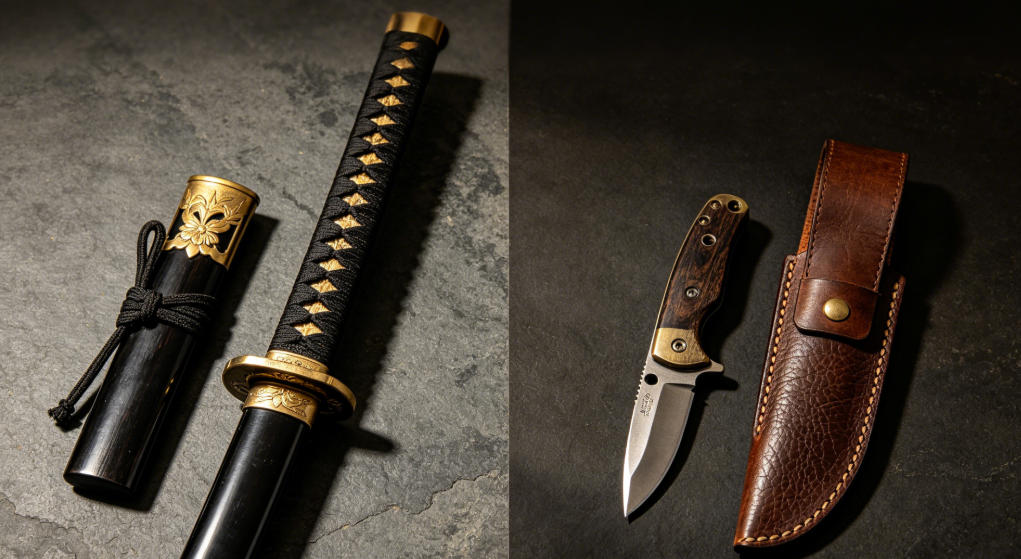
What Is the Difference Between a Scabbard and a Sheath? A Complete Guide to Sword Scabbards
For people interested in Japanese swords, samurai swords, historical weapon collections, and outdoor knives, two English words often cause confusion: scabbard and sheath.
Many people simply translate both words as '刀鞘' or 'knife cover' and assume they mean the same thing. However, in sword culture and English usage, these two terms represent different concepts.
So, what is the difference between a sheath and a scabbard?
Why do Japanese warriors use a katana scabbard, while hunters usually carry knives with a knife sheath?
This article will explore the world of blade protection through scabbard definition, scabbard meaning, historical development, craftsmanship, different scabbard designs across cultures, and the value of sword collecting.
Scabbard Definition: What Does Scabbard Mean?
First, let’s look at the scabbard definition.
A scabbard is a protective covering specifically designed to store and protect long-bladed weapons, including:
- Sword
- Katana
- Saber
- Rapier
- Historical blades
Simply put:
A scabbard is a protective case designed specifically for carrying and protecting swords or long blades.
In other words, a scabbard usually refers to a sword scabbard or blade sheath designed for long weapons.
Unlike an ordinary knife cover, a scabbard is not only a protective accessory but also an important part of weapon culture.
Throughout history, sword scabbards represented:
- Samurai identity
- Noble status
- Military traditions
- Craftsmanship
- Artistic expression
A beautifully crafted sword was often paired with an equally impressive scabbard.

Scabbard Meaning: The True Meaning Behind Scabbard
Many people search for scabbard meaning because they want to understand not only the translation but also its historical significance.
From traditional usage:
Scabbard = a sheath for a sword or dagger.
It emphasizes:
A protective cover specifically designed for sword-type weapons.
Examples include:
- Katana scabbard
- Samurai sword scabbard
- Medieval sword scabbard
- Viking sword scabbard
All of these are typical examples of scabbards.
Throughout history, warriors did not carry exposed blades because swords required protection, and the carrying method could also affect combat efficiency.
A high-quality scabbard allowed warriors to:
- Draw their sword quickly
- Carry their weapon safely
- Prevent blade damage
- Display their status and identity
What Is a Sheath?
Compared with a scabbard, sheath is a much broader term.
A sheath generally refers to any covering designed to protect sharp objects.
Common examples include:
- Knife sheath
- Hunting knife sheath
- Tactical knife sheath
- Tool sheath
Sheaths are mainly used for:
- Small knives
- Outdoor tools
- Working equipment
- Everyday carry knives
For example, a hunter carrying a fixed-blade knife outdoors will usually use a leather sheath rather than a scabbard.
Because these knives are smaller, their design focuses more on:
- Easy carrying
- Quick access
- Safety protection
Scabbard vs Sheath: What Is the Main Difference?
Although these two words can sometimes be used interchangeably in modern English, they still have clear differences in traditional blade culture.
| Comparison | Scabbard | Sheath |
|---|---|---|
| Common meaning | Sword scabbard / blade sheath | Knife cover / protective case |
| Main use | Long swords, katanas, sabers | Small knives and tools |
| Historical connection | Samurai, knights, armies | Outdoor gear and daily tools |
| Common materials | Wood, leather, metal | Leather, nylon, plastic |
| Cultural value | High | Usually more functional |
Simply understand it this way:
Scabbard is mainly for swords.
Sheath is mainly for knives and smaller blades.
If you collect:
- Katana
- Samurai sword
- Medieval sword
- Anime sword replica
then using the term scabbard is more accurate.
The History of Sword Scabbards: Why Were They Important?
The history of scabbards is almost as old as the history of swords themselves.
When humans began creating metal weapons, they faced an important challenge:
How could a sharp blade be carried safely?
This led to the creation of the scabbard.
Early sword scabbards were usually made from simple materials:
- Wood
- Animal leather
- Plant fibers
As civilizations developed, scabbards gradually became symbols of identity and status.
For example:
European knight sword scabbards often included:
- Metal decorations
- Family crests
- Fine leather coverings
Japanese samurai sword scabbards developed unique features such as:
- Lacquer craftsmanship
- Metal fittings
- Family designs
- Fine woodworking
The scabbard evolved from a simple protective tool into a work of art.
Japanese Katana Scabbard: The Culture of Samurai Sword Scabbards
In Japanese sword culture, the scabbard has a special name:
Saya (鞘)
Saya is the traditional scabbard used for Japanese swords.
A complete Japanese katana usually consists of:
- Blade
- Tsuka (handle)
- Tsuba (guard)
- Saya (scabbard)
The Saya not only protects the blade but also represents an important part of Japanese aesthetics.
1. The Craftsmanship of Katana Scabbards
Traditional Japanese katana scabbards are usually made from wood.
The common production process includes:
Selecting the Wood
Traditional craftsmen often use:
- Honoki wood
Because it is:
- Soft and stable
- Gentle on the blade
- Low in natural oils
Precise Blade Fitting
The inside of the scabbard must perfectly match the sword blade.
If it is too loose:
- The sword may move inside
- Carrying becomes unstable
If it is too tight:
- The blade may suffer friction damage
Exterior Lacquer Decoration
Traditional Saya often uses lacquer techniques, including:
- Black lacquer
- Red lacquer
- Gold powder decoration
- Artistic patterns
This makes the scabbard both practical and valuable as a collectible piece.
Why Does a Good Scabbard Matter?
Many sword enthusiasts focus on:
- 1095 carbon steel blade
- T10 steel katana
- Damascus steel sword
- Full tang construction
However, a high-quality scabbard is equally important.
Protect the Blade
A good scabbard protects the blade by preventing:
- Impact damage
- Oxidation
- Scratches
Especially for high-carbon steel swords, proper storage is essential.
Improve Safety
A sharp blade without protection can be dangerous.
A scabbard helps:
- Prevent accidental injuries
- Make transportation safer
- Improve carrying convenience
Increase Collection Value
For collectible Japanese swords:
The blade determines the weapon’s quality, while the scabbard enhances the overall appearance.
A Japanese sword with beautiful:
- Tsuba
- Tsuka
- Saya
becomes closer to a traditional piece of art.
Different Types of Scabbards Around the World
The development of scabbards is closely connected with different weapon cultures around the world.
Whether it is a katana scabbard used by Japanese samurai, a European knight’s sword scabbard, or a modern knife sheath for outdoor tools, each design reflects different ideas about weapon protection, craftsmanship, and practicality.
Japanese Katana Scabbard
In Japanese sword culture, the katana scabbard is commonly known as Saya.
Traditional samurai sword scabbards are usually made with wooden structures and carefully crafted to fit the blade perfectly.
Compared with ordinary knife covers, Japanese sword scabbards place greater emphasis on precision and artistic value.
Traditional Japanese sword scabbards feature:
- Wooden construction: Usually made from stable wood to reduce damage to the sharp blade.
- Lacquer finishing: Often decorated with traditional lacquer techniques, including black lacquer, red lacquer, and special patterns.
- Precise blade fitting: A quality Saya securely holds the blade while allowing smooth drawing and returning.
- Aesthetic design: Samurai valued not only sword performance but also harmony between the blade and scabbard.
During the samurai era, the scabbard was not just protective equipment—it was also a symbol of status and identity.
Today, in Japanese sword collecting, a high-quality Japanese saya remains an essential part of a complete katana. Whether for traditional handmade swords or modern collectible Japanese katana, an elegant scabbard greatly increases the overall value.

European Sword Scabbard
In European history, sword scabbards were also extremely important.
From medieval knight swords to ceremonial weapons carried by nobles, the European sword scabbard was an essential part of weapon equipment.
European sword scabbards commonly featured multi-layer construction:
- Wooden core: Provided structural support and protected the blade.
- Leather covering: Improved durability and carrying comfort.
- Metal decoration: Some noble and knight scabbards included metal fittings, engraved designs, and family symbols.
Different European swords were paired with different scabbard styles:
- Long sword: Usually had a longer scabbard designed for carrying and drawing.
- Knight sword: Often featured decorative elements representing honor and status.
- Medieval sword: Focused on protection and battlefield practicality.
Unlike Japanese scabbards, which emphasize balance and artistic refinement, European sword scabbards often represent strength, protection, and military tradition.
For historical weapon collectors, a medieval sword without its original-style scabbard feels incomplete.
Modern Knife Sheath
With the development of modern knives, sheath is more commonly used for smaller blades and functional equipment.
Unlike traditional scabbards designed for swords and long blades, modern knife sheaths focus more on portability, durability, and quick access.
Modern knife sheaths usually feature:
- Lightweight design: Easy to carry outdoors without adding extra weight.
- Water resistance: Protects knives from moisture and harsh environments.
- Practical performance: Designed for quick access, secure holding, and long-term use.
Common materials include:
- Kydex: Impact-resistant, waterproof, and shape-retaining, often used for tactical knife sheaths.
- Nylon: Lightweight and affordable, popular for outdoor equipment.
- Polymer: Durable and suitable for modern utility knives.
- Leather: Classic appearance, commonly used for traditional hunting knives and collectible blades.
Modern knife sheaths are mainly used for:
- Survival knives
- Hunting knives
- Tactical knives
Unlike historical swords, modern knives focus less on identity and symbolism, and more on practicality, safety, and efficiency.
From Ancient Swords to Modern Knives: The Evolution of Blade Protection
From ancient samurai sword scabbards to modern tactical knife sheaths, the evolution of blade protection reflects how humans have changed the way they use weapons.
In the past:
- Scabbards represented identity
- Sword sheaths reflected craftsmanship
- Weapons and scabbards formed one cultural symbol
Today:
- Knife sheaths emphasize portability
- Protective covers focus on safety
- Designs are optimized for modern needs
No matter the style, the purpose remains the same:
To protect valuable blades and allow users to carry weapons safely and efficiently.
For collectors, a truly complete sword requires not only an excellent blade but also a high-quality scabbard.
Because a scabbard does not simply protect a sword—it preserves the history and culture behind it.
How to Choose the Right Katana Scabbard?
If you purchase a Japanese sword, choosing the right katana scabbard is essential.
Consider these factors:
1. Material
Common options include:
Wooden Saya
Traditional choice:
- Lightweight
- Stable
- Excellent protection
Leather Covered Scabbard
Features:
- More durable
- Unique appearance
Decorative Scabbard
Suitable for:
- Collection
- Display
- Cosplay
2. Fit and Balance
A good sword scabbard should:
- Secure the blade
- Allow smooth drawing
- Avoid damaging the edge
Traditional Japanese sword culture believes:
'A sword and its scabbard are one.'
The scabbard is not merely an accessory—it is part of the sword itself.
Conclusion: Scabbard vs Sheath Explained
In summary:
Both scabbard and sheath protect blades, but they have different purposes and cultural backgrounds.
Scabbard:
- Mainly used for swords and katanas
- Closely connected with historical blade culture
- Emphasizes craftsmanship and collectible value
Sheath:
- Mainly used for knives and tools
- Focuses more on everyday use and portability
If you are interested in:
- Japanese katana
- Samurai sword
- Historical weapons
- Anime sword replicas
understanding scabbard definition and scabbard meaning can help you explore the deeper world of blades.
A truly great sword needs not only a sharp blade but also a matching scabbard.
Because in sword culture:
The blade represents power, while the scabbard carries history, art, and soul.

