


Sword Symbolism Explained: Power, Justice, and the Soul of the Blade
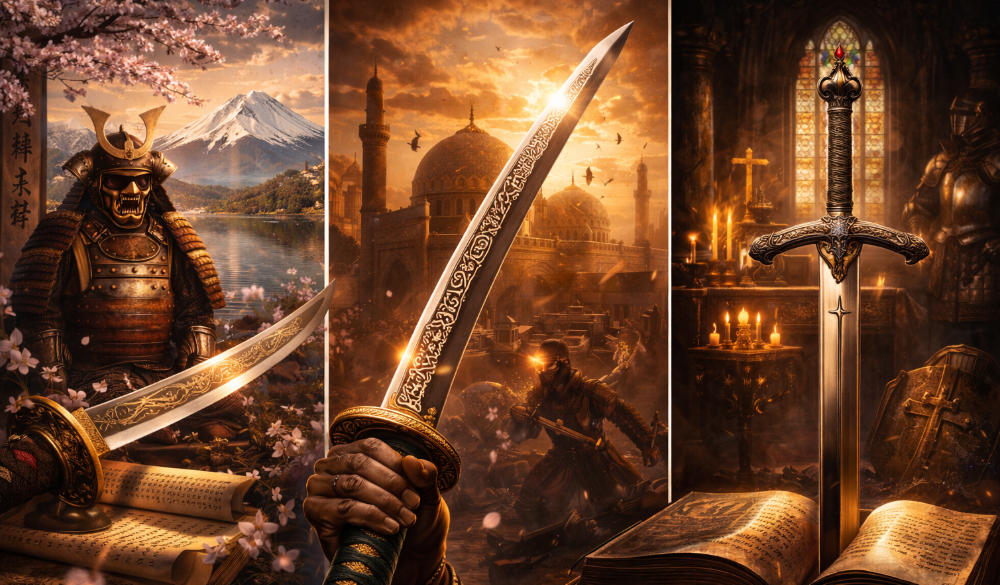
Why Have Swords Always Symbolized Power, Justice, and the Human Soul?
Throughout the long course of human civilization, few objects have transcended their practical function as thoroughly as swords. Far more than mere tools of killing, they evolved into complex symbols carrying ideas of power, justice, faith, and honor. Although cold weapons have long retreated from the front lines of modern warfare, swords as spiritual symbols continue to shine with an undiminished edge in our language, rituals, and popular culture.
Today, we cross the boundaries of Eastern and Western traditions to explore the deeper symbolic meanings of these enigmatic blades beyond the battlefield—and to uncover why swords have so often been regarded as extensions of the human soul.
The Legitimization of Power: Royal Authority and the Sword as a Scepter
Since ancient times, swords have served as tangible representations of supreme power and rulership. In medieval Europe, a monarch’s coronation ceremony was often accompanied by the presentation or wearing of the 'Sword of State,' symbolizing the sovereign’s authority to enforce law and protect the realm.
This symbolism runs just as deep in the East. In Japan, one of the Imperial Regalia—the Kusanagi no Tsurugi—has for centuries represented the divine legitimacy of the emperor’s rule. Even today, ceremonial swords are still bestowed upon high-ranking military officers during promotions, not for combat use but to emphasize the solemnity of command. For rulers, the sword is not merely a threat of force, but a foundation of order and authority.
The Embodiment of Justice: Law, Judgment, and the Meaning of the Double Edge
In Western art and sculpture, Lady Justice (Justitia) is typically depicted holding scales in one hand and a sword in the other. Here, the sword symbolizes the power of judgment—the scales weigh right and wrong, while the blade enforces justice.
Notably, the double-edged design of a sword carries a powerful symbolic duality. It can strike down enemies, yet if misused, it can also harm its wielder. This “double-edged sword” metaphor serves as a warning to those in power: authority must be exercised with responsibility and moral restraint. In medieval chivalric codes, the sword was entrusted with the mission of protecting the weak and upholding truth, allowing it to retain a noble moral aura even amid the brutality of war.

The Meaning of Katana
katana (刀) in Japanese literally means 'knife' or 'single-edged blade.'
-
Etymology:
Originally, katana referred broadly to single-edged blades and did not exclusively mean the samurai sword. In ancient Japan, it was conceptually contrasted with tsurugi (剣), the straight, double-edged sword. -
Modern usage:
Today, katana most commonly refers to the curved, single-edged, two-handed sword used by Japanese samurai—the iconic weapon recognized worldwide. -
Cultural meaning:
Beyond being a weapon, the katana is regarded as 'the soul of the samurai', symbolizing honor, responsibility, and the spirit of Bushidō.
In short, while katana literally means 'blade,' culturally it represents the identity and spirit of the Japanese warrior.
A Vessel of the Soul: Bushidō and Spiritual Discipline
Among all sword cultures, the Japanese reverence for the katana is perhaps the most profound. To a samurai, the sword was not merely a weapon, but an extension of the self.
The forging of a katana is itself a highly ritualized process, blending Shinto concepts of purity with the craftsman’s relentless dedication. Within Bushidō philosophy, the sword embodied the samurai’s dignity and self-discipline. To lose one’s blade was tantamount to losing social status and purpose. This personalization of cold weapons elevated the sword beyond metal, transforming it into a physical vessel of willpower, courage, and moral cultivation.
Religion and Myth: Divine Blades and Supernatural Power
Across world mythologies, swords are often imbued with supernatural power, serving as bridges between mortals and the divine. From Excalibur, the sword of destiny in Arthurian legend, to Gram, bestowed by Odin in Norse mythology, these legendary weapons are said to cut through fate itself or banish darkness.
In religious iconography, swords are also used as instruments of purification and protection. In Buddhism, the bodhisattva Manjushri wields a sword to sever ignorance and delusion. These cultural motifs reveal humanity’s tendency to transform the sword into a spiritual tool—one capable of clearing paths and illuminating truth in the face of fear and uncertainty.
Modern Continuity: From Heraldry to Popular Culture
Even in an age where firearms dominate warfare, the symbolic power of swords remains vibrant. Crossed swords in modern family crests and military insignia continue to signify defense, valor, and readiness.
In contemporary popular culture—such as the lightsabers of Star Wars or legendary weapons in fantasy games—swords remain central symbols of personal growth and awakening. Humanity’s enduring fascination with swords reflects a longing for clear cause and effect, personal courage, and mastery over one’s destiny.
Across Generations: Rites of Passage and Family Honor
In many ancient societies, swords served not only as weapons but as markers of adulthood and tangible links to family lineage and honor. In European knightly culture, the dubbing ceremony was one of the most solemn moments in a man’s life. A lord lightly touched the recipient’s shoulders with a sword, granting not only the right to fight but also the duty to protect the weak and remain loyal to the land. The sword thus became a living contract, marking the transformation from boyhood to knighthood.
Similar traditions existed in samurai families, where a boy would receive his first weapon upon reaching a certain age. This inheritance of the sword was, in essence, the physical transmission of family values and ancestral glory. Even today, many antique swords are carefully preserved as heirlooms—symbols not only of past battlefields but of enduring family resilience. For modern collectors, holding a centuries-old blade conveys not just cold steel, but the warmth of countless lives that once bore it.
Craftsmanship and Aesthetics at Their Peak: Cultural Value as Art Objects
When removed from the smoke of battle, swords reveal their true identity as masterpieces of human craftsmanship. Their symbolism lies not only in lethality, but in every forged grain, engraved guard (such as the Japanese tsuba), and ornate scabbard. This pursuit of beauty reflects humanity’s instinct to seek art even within instruments of violence.
In the modern world of arms collecting, fascination with swords has long surpassed functionality. Whether an antique original or a high-quality reproduction, the craftsman’s spirit—months or years spent refining a flawless edge—commands deep respect. The curves, sheen, and balance of a sword embody a 'static sense of power,' quietly displayed in private collections and museums alike. This transformation from weapon to artwork stands as one of the most captivating chapters in sword symbolism.
Hand Forged European Sword Viking Sword 1095 Folded Steel Iron Fittings

Conclusion: An Edge That Never Dulls
The allure of swords lies in their contradictions. They represent destruction and creation, killing and protection. By exploring the symbolic culture of swords, we uncover not merely the history of weapons, but a civilizational narrative of how humanity forged courage, honor, and moral codes into steel.
No matter how times change, the cold gleam of a blade—and the historical weight and spiritual force it carries—will forever occupy a place in humanity’s collective memory. For collectors and cultural enthusiasts alike, understanding the stories behind these blades transforms the simple act of gripping a hilt into an encounter with a soul forged across millennia.

