


Why Is There a Nine-Ring Sword? History, Meaning & Combat Logic
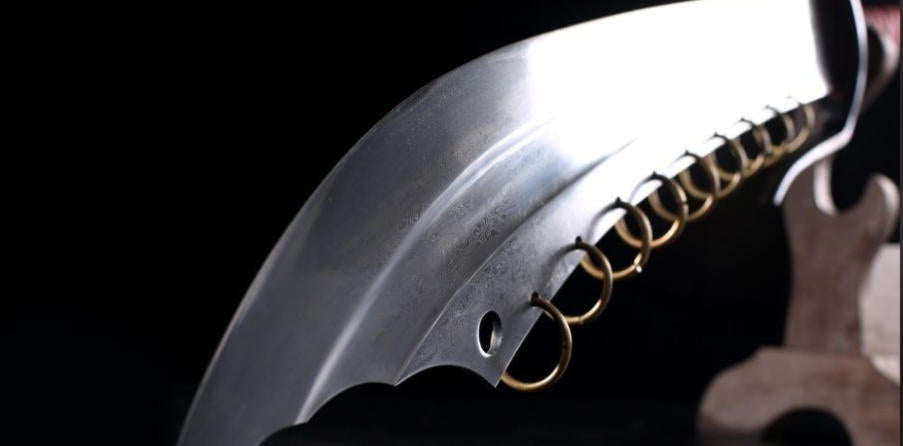
Within the system of ancient Chinese weapons, the Nine-Ring Sword is one of the most recognizable and legendary weapons ever created. Unlike ordinary war blades, its defining feature is not the blade length or cutting geometry, but rather the row of metal rings attached along the spine of the weapon. These rings create a unique visual identity and have made the weapon one of the most recognizable symbols in traditional Chinese martial arts, folk weapon culture, and film history.
Many people searching terms like why is there a nine-ring sword, Chinese ring sword, or nine-ring broadsword history often ask the same question:
Why did ancient people attach nine metal rings to a sword? Were they designed for combat, psychological intimidation, or simply decoration?
With the rise of martial arts movies, fantasy weapon culture, and the growing search interest around s.w.o.r.d. #9 | sword 9, the Nine-Ring Sword has once again become a topic of discussion among historical weapon enthusiasts, researchers, and collectors worldwide.
What makes the subject especially fascinating is that there has never been a universally accepted explanation for the purpose of the Nine-Ring Sword.
1. What Is a Nine-Ring Sword?
The Nine-Ring Sword belongs to a unique category of traditional Chinese long-handled bladed weapons and is often classified under the Chinese Broadsword System.
Its primary structural characteristics include:
- Large broadsword blade structure
- Long-handled weapon design
- Blade spine openings for ring attachment
- Metal ring construction
- Typically configured with nine rings
In modern martial arts circles, it may also be referred to as:
- Nine-Ring Broadsword
- Chinese Ring Sword
- Traditional Chinese War Blade
- Ringed Dao Weapon
Due to its highly distinctive appearance, some modern users also search for s.w.o.r.d. #9 | sword 9, making it an emerging long-tail keyword associated with ring swords and Chinese weapon culture.
Interestingly, not all historical ring swords had exactly nine rings.
Some examples featured:
- Three rings
- Five rings
- Seven rings
- Nine rings
The number nine eventually became the most iconic version because of its deep cultural significance in Chinese civilization.

2. Why Nine Rings? Symbolism Behind Ancient Chinese Numerology
When asking why the weapon contains nine rings, the most common explanation may not be military at all.
Instead, it may be cultural.
In ancient China, the number nine held extraordinary importance.
It often symbolized:
- Imperial authority
- Completion
- Supremacy
- Eternity
- Cosmic order
The number repeatedly appeared throughout traditional Chinese systems:
- Nine Tripod Cauldrons
- Nine Dragons
- Nine Heavenly Levels
- Nine-Rank Bureaucratic System
- Nine-layer Imperial Architecture
Because of this, many historians believe that the rings were not randomly chosen, but represented status, authority, and symbolic power.
Certain martial traditions even suggest:
Nine rings symbolize ultimate unity and return.
Although historical evidence remains limited, this interpretation remains popular among martial artists and collectors.
3. What Were the Metal Rings Actually Used For?
This remains one of the most debated aspects of the Nine-Ring Sword.
Currently, four major theories exist regarding the purpose of the rings.
1. Sound Intimidation and Battlefield Psychology
The most widely accepted theory suggests that the rings primarily produced sound.
When the weapon was swung:
The metal rings repeatedly struck the blade and each other.
This created:
- Metallic collision sounds
- Vibrating tones
- Continuous rattling effects
On ancient battlefields, these sounds may have helped:
- Increase battlefield presence
- Intimidate enemies
- Create psychological pressure
- Boost morale
Sound-based psychological warfare was common in ancient warfare.
Examples include:
- War drums
- Bronze gongs
- Military horns
- Horse bells
The Nine-Ring Sword may have functioned as part of a similar acoustic intimidation system.
Some martial researchers even suggest that the sound could make enemies overestimate weapon size or troop strength during chaotic engagements.
2. Altering Weight Distribution and Swing Dynamics
Another theory comes from weapon mechanics research.
The rings may have affected:
- Balance point location
- Swing inertia
- Downward striking force
- Blade feedback sensation
Theoretically, additional weight could increase momentum during chopping motions.
However, increased mass also creates disadvantages.
Extra weight may reduce:
- Speed
- Flexibility
- Recovery time
Therefore many researchers believe the rings acted as supplementary features rather than primary combat mechanisms.
3. Interfering with Enemy Weapons
A less common theory proposes that the rings may have interacted with opposing weapons.
Potential effects include:
- Catching enemy blades
- Disrupting attack angles
- Increasing collision complexity
Historical support for this theory remains weak.
Most scholars remain skeptical.
4. Martial Arts Training Functions
In modern Chinese martial arts, the practical use of the Nine-Ring Sword is much clearer:
Training.
During forms and routines, the rings continuously provide movement feedback.
This helps practitioners:
- Control swing speed
- Improve power generation
- Increase movement stability
- Develop explosive strength
Within modern Chinese martial arts weapons systems, the Nine-Ring Sword often functions more as a training and performance tool than a battlefield weapon.
4. Was the Nine-Ring Sword Actually Used in War?
This remains one of the largest historical debates surrounding the Nine-Ring Sword.
Films often portray it as a devastating battlefield weapon.
Reality may have been much more complicated.
Common historical Chinese military blades included:
- Tang Dao
- Ring Pommel Sword
- Podao
- Willow Leaf Saber
- Yanling Dao
These weapons emphasized:
- Balanced weight
- Sustained combat use
- Efficient production
- Battlefield practicality
Compared to them, the Nine-Ring Sword was:
- Heavier
- More mechanically complex
- More expensive to manufacture
- Less agile
Because of these factors, many historians believe that while the weapon may have seen occasional use in combat, it likely never became a standard military issue weapon.
Instead, it may have served roles such as:
- Ceremonial weaponry
- Martial school training tools
- Folk demonstrations
- Opera stage props
- Status symbols

5. Why Did the Nine-Ring Sword Become a Martial Arts Icon?
If real battlefield use was limited, why did the Nine-Ring Sword become so famous?
The answer is simple:
Because it looks powerful.
Its design naturally creates strong visual impact:
- Oversized blade shape
- Moving metal rings
- Distinct sound effects
- Dynamic motion aesthetics
This makes it perfect for:
- Martial arts films
- Kung fu cinema
- RPG weapon systems
- Anime weapon designs
- Fantasy Chinese sword settings
Many fictional depictions exaggerate its power and mystique.
Today, users searching s.w.o.r.d. #9 | sword 9 frequently encounter related content, creating a growing SEO association between these terms and the Nine-Ring Sword.
6. Nine-Ring Sword vs Other Ancient Chinese Blades
Nine-Ring Sword vs Tang Dao
Tang Dao:
- Strong military role
- Practical combat design
- Relatively lightweight
Nine-Ring Sword:
- Greater performance value
- Sound and visual emphasis
- Strong symbolic meaning
Nine-Ring Sword vs Guan Dao
Guan Dao:
- Heavy battlefield pole weapon
- Designed for cavalry suppression
- Prioritizes raw destructive force
Nine-Ring Sword:
- More visually distinctive
- Stronger martial arts identity
- Greater theatrical appeal
7. Why Is 's.w.o.r.d. #9 sword 9' Becoming Associated with Ring Swords?
As online culture and collecting trends evolve, unusual search phrases increasingly become connected with historical weapons.
Examples include:
s.w.o.r.d. #9 | sword 9
Users may search these terms looking for:
- Weapon ranking systems
- Legendary blades
- Fantasy equipment lists
- Game weapon concepts
- Nine-Ring Sword collectibles
Although the phrase itself is not a historical term, search behavior is gradually transforming it into a long-tail traffic source.
8. Conclusion: What Is the Real Meaning Behind the Nine-Ring Sword?
Historically, the Nine-Ring Sword was more than simply a weapon.
It represented a combination of:
- Combat design
- Symbolic numerology
- Ritual culture
- Martial traditions
- Visual expression
Therefore, the answer to why is there a nine-ring sword may never be purely about combat.
The Nine-Ring Sword may have existed not only for killing, but for sound, status, visual impact, and cultural symbolism.
This also explains why the Nine-Ring Sword continues to appear in martial arts culture, films, collecting communities, and global weapon discussions today—while gaining new attention through search terms such as s.w.o.r.d. #9 sword 9.

