


William Wallace Sword Explained: History, Truth & Claymore Facts
- Posted by COOLKATANA
Is the William Wallace Sword Real? History, Structure, and True Origin Explained
In European cold weapon systems and medieval warfare history, the William Wallace Sword is a legendary weapon that combines historical controversy with strong cultural symbolism. It became globally famous through the Scottish independence war hero William Wallace and was further popularized by the film Braveheart, making the keyword william wallace sword a consistently high-search-volume topic worldwide.
However, its true origin, structural classification, and historical attribution remain widely debated in academic and weaponology research.
What Is the William Wallace Sword? A Legend of History and Controversy
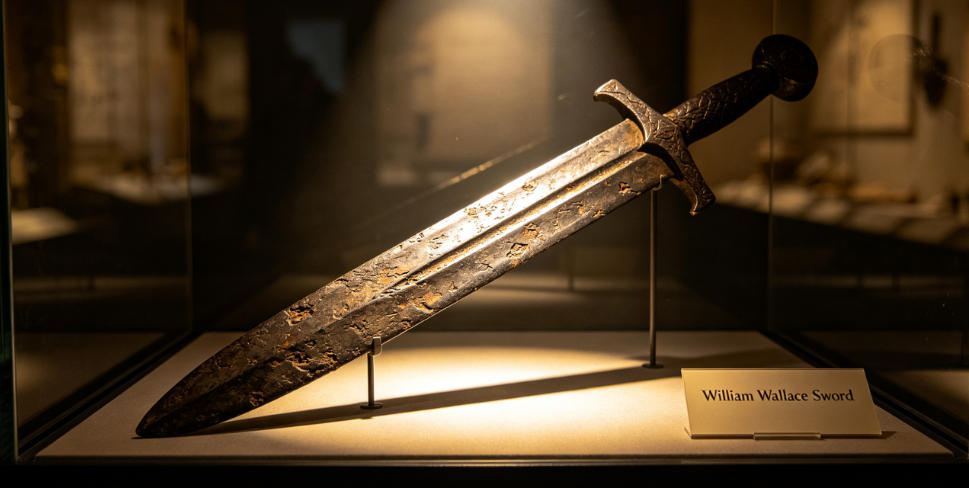
The so-called William Wallace Sword generally refers to a large two-handed greatsword preserved within Scotland’s national memorial system. It is widely associated with William Wallace, the Scottish independence leader, and is displayed in exhibitions linked to the Wallace Monument in Stirling.
Because of this association, it has become a symbolic artifact of the Scottish Wars of Independence.
However, its historical authenticity is controversial. William Wallace lived during the late 13th to early 14th century, while the structural features of the existing sword align more closely with late 15th-century Scottish two-handed greatsword traditions (early claymore evolution).
Key inconsistencies include:
- The sword’s length and balance resemble later “formation-breaking greatswords”
- Metallurgical and forging techniques reflect more advanced craftsmanship
- The guard and grip proportions match later medieval battlefield designs
As a result, many researchers believe it is more likely a later reconstructed or commemorative artifact, rather than Wallace’s original battlefield weapon.
Despite this, the William Wallace Sword remains extremely significant culturally. In medieval history and national narratives, the symbolic meaning of a weapon often exceeds its physical authenticity. It has become a representation of Scottish resistance, freedom, and national identity.

William Wallace and the Scottish Wars of Independence
William Wallace was one of the key military leaders of Scotland’s resistance against English rule in the late 13th century.
Key historical milestones include:
- 1297: Victory at the Battle of Stirling Bridge
- Appointed 'Guardian of Scotland'
- 1305: Captured and executed by England
During this period, Scottish warfare relied heavily on dense infantry formations, making formation-breaking weapons strategically important. This historical context explains the later development of large two-handed swords in Scotland.
Weapon Structure Analysis of the William Wallace Sword (Weaponology Perspective)
From a cold weapon engineering perspective, the William Wallace sword is closer to a late medieval two-handed greatsword / early claymore system. It is not merely symbolic but reflects a battlefield-oriented design optimized for breaking formations and suppressing infantry density.
1. Extended Blade Geometry
- Typical total length: 140–180 cm
- Long blade ratio with forward-biased mass distribution
- Center of gravity positioned approximately 10–20 cm forward
This design prioritizes angular momentum over stabbing efficiency.
In dense infantry formations, the weapon generates wide sweeping strikes that disrupt shield walls and spear lines, creating tactical openings.
2. Two-Handed Grip System
- No shield usage; fully two-handed control
- Grip length: approximately 30–50 cm
- Multiple grip positions (extended strike / close control / blocking)
This configuration requires significant strength and training but provides:
- Larger attack radius
- Greater control precision
- Higher impact stability
Tactically, it functions as a formation-breaking weapon rather than a dueling sword.
3. Blade Cross-Section and Structural Mechanics
Typical characteristics include:
- Diamond or hexagonal cross-section
- Prominent central ridge
- Gradual tapering toward the tip
Engineering advantages:
- Increased resistance to bending during impact
- Concentration of mass for higher inertial force
- Improved instantaneous cutting pressure
Compared to earlier single-handed swords, this weapon behaves more like a kinetic impact weapon, prioritizing force delivery over agility.
4. Crossguard System
- Primary function: prevent enemy blade sliding into the hand
- Structural role: provides leverage for blocking and control
- Tactical value: improves close-combat weapon manipulation
Some Scottish greatswords feature slightly flared guard extensions, enhancing both defensive coverage and battlefield intimidation.
5. Balance System and Combat Logic
The design philosophy is straightforward:
- No emphasis on rapid stabbing techniques
- Focus on decisive opening strikes
- Use heavy blows to break enemy formation stability
Its combat style can be summarized as:
'One effective strike to gain tactical space advantage.'
Therefore, it was typically used in coordination with infantry charges rather than as a standalone weapon.

Relationship Between Claymore and the William Wallace Sword
Within weapon classification systems, the William Wallace sword is often associated with the claymore tradition, but distinctions exist:
- Early claymore (13th–14th century): transitional, variable designs
- Classic claymore (15th–17th century): standardized two-handed form
- William Wallace sword: closer to a transitional proto-type greatsword
It is therefore better understood as a symbolic prototype of Scottish greatsword evolution, rather than a standardized model.
Tactical Purpose: Why Were Such Large Swords Needed?
From a military history perspective, large two-handed swords served clear battlefield functions:
1. Anti-Formation Weapon
- Disrupts spear walls and shield formations
- Creates gaps in dense infantry lines
2. Anti-Armored Combat
- Uses mass-driven impact against armor
- Targets weak structural joints
3. Psychological Impact
- Large weapons create visual intimidation
- Enhances morale advantage in close combat
Why Did Braveheart Have Such a Strong Cultural Impact?
The film Braveheart significantly shaped modern perceptions of the William Wallace sword:
- Reinforced the 'freedom warrior' archetype
- Fixed the oversized greatsword as a cultural symbol
- Increased global interest in medieval weapon collecting
However, the weapon proportions shown in the film are historically exaggerated for dramatic effect.
Keyword Ecosystem and Modern Interest
With the growing popularity of medieval weapon studies and cold weapon collecting, searches related to william wallace sword continue to increase. High-value related keywords include:
- william wallace sword history
- Scottish claymore sword origin
- medieval two handed sword facts
- Braveheart sword real weapon
- Scottish medieval weapons collection
- historical greatsword reproduction
These keywords are widely used in weapon collector websites, historical blogs, film weapon analysis content, and reproduction sword product pages, forming a high-value SEO ecosystem combining academic research and commercial interest.
Conclusion: Why Did This Sword Become a National Symbol?
The importance of the William Wallace Sword does not lie solely in whether it truly belonged to William Wallace, but in what it represents:
- The evolution of medieval greatsword warfare
- The historical memory of Scottish independence
- The cultural reinterpretation through modern media
It has evolved from a possibly disputed artifact into a powerful symbolic object spanning history and culture.
If any medieval European sword can represent 'freedom and resistance,' the William Wallace sword is undoubtedly one of the most iconic.

